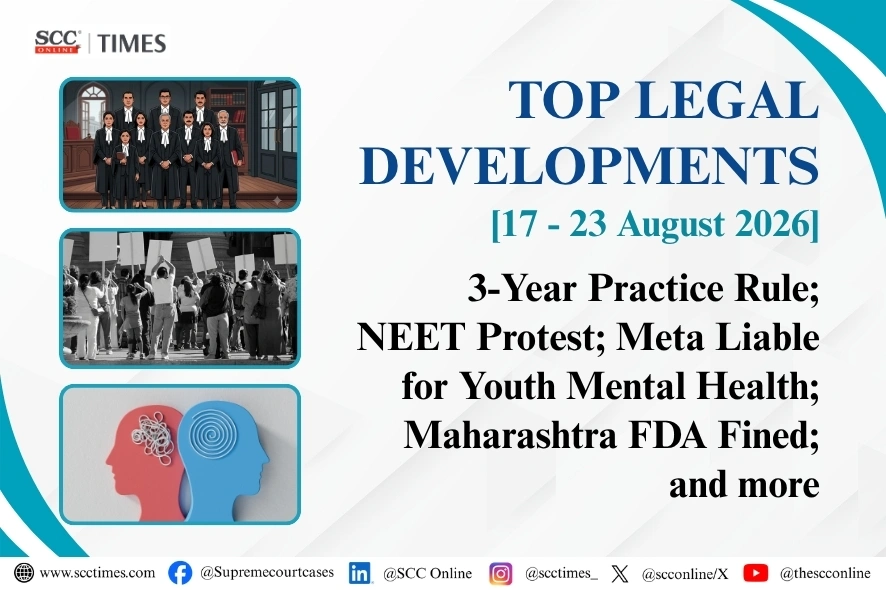
This roundup of weekly legal developments in India covers significant developments including the Saradha Chit Fund Scam, global food labelling standards, the Pioneer newspaper dispute, the Lal Qila Metro blast case, Deena’s ‘Hanging-Method’, guidelines on fair elections, etc.
STORY OF THE WEEK
From 3 years to 1, plus training and law clerkship: Path to becoming a Civil Judge (Junior Division) modified in a 2:1 verdict.
The Supreme Court, in a 2:1 verdict, reconsidered the directions issued in its judgment dated 20 May 2025 restoring the requirement of 3 years’ practice at the Bar. The Court, while upholding the underlying need for prior exposure to the working of courts, held that the requirement had to be implemented in a manner which was fair to fresh and recent law graduates and did not unnecessarily narrow the field of candidates available to the subordinate judiciary.
[Bhumika Trust v. Union of India, 2026 SCC OnLine SC 1687, decided on 21-8-2026]
Read more: HERE
SUPREME COURT HIGHLIGHTS
ARBITRATION | Pre-deposit conditions in Arbitration can’t make right to sue “illusory or nugatory”; Larger Bench to decide on S.K. Jain
The Supreme Court expressed doubts about the continuing authority of S.K. Jain v. State of Haryana, (2009) 4 SCC 357, holding that a pre-deposit condition cannot make the right to sue “illusory or nugatory”.
[Santosh Associate (P) Ltd. v. Haryana State Industrial and Infrastructure Development Corpn. Ltd., 2026 SCC OnLine SC 1584, decided on 17-8-2026]
Read more HERE
BAIL | Saradha Chit Fund Scam: Bail granted to Sudipta Sen after nearly a decade in custody
The Supreme Court in a petition challenging the Gauhati High Court’s order dated 20 January 2025 refusing bail application filed by the appellant, former Chairman and Managing Director of the Saradha Group in connection with multi-crore Saradha chit fund scam.
[Sudipta Sen v. CBI, 2026 SCC OnLine SC 1659, decided on 18-8-2026]
Read more: HERE
CRIMINAL LAW | “Not a single instance of a botched execution in India”: Reference of Deena’s ‘Hanging-Method’ ruling to Larger Bench for reconsideration, declined
The Supreme Court while deliberating over this writ petition challenging the constitutionality of Section 354(5), Criminal Procedure Code, 1973 (CrPC) insofar as it prescribes hanging as the sole method of execution, declined to refer Deena v. Union of India, (1983) 4 SCC 645, decided by three-Judge Bench of the Supreme Court, to a larger Bench for reconsideration of the Constitutional validity of Section 354(5) CrPC [corresponding to Section 393(5), Nagarik Suraksha Sanhita, 2023 (BNSS)].
[Rishi Malhotra v. Union of India, 2026 SCC OnLine SC 1602, decided on 18-8-2026]
Read more: HERE
CUSTODIAL DEATH | ₹1,200 worth of Liquor, a death in custody, a “cover-up story”: CBI Probe and ₹25 Lakhs Interim Compensation ordered for deceased’s family
The Supreme Court directed the CBI to register a regular criminal case and investigate the circumstances leading to his death, while directing the State of Chhattisgarh to pay ₹25 lakhs as interim compensation to his legal heirs.
[Lahra Bai Tamre v. State of Chhattisgarh, 2026 SCC OnLine SC 1550, decided on 12-8-2026]
Read more: HERE
EVIDENCE LAW | “No dearth of financial resources, no obligation to aid the Court”: RIL’s latest attempt to reopen excluded evidence through witness testimony in 2005 Suit failed
The Supreme Court upheld the Bombay High Court’s redaction of portions seeking to introduce through oral evidence the contents of internal documents and communications already held irrelevant and excluded from the record.
[Reliance Industries Ltd. v. NTPC Ltd., 2026 SCC OnLine SC 1579, decided on 14-8-2026]
Read more: HERE
ELECTION LAW | No more withdrawing cases after a change in Government: Guidelines issued to curb black money and electoral inducements
The Supreme Court emphasised the need to safeguard free and fair elections and issued a series of directions aimed at curbing the use of black money and other inducements in elections.
[State of Karnataka v. Prathik Parasrampuria, 2026 SCC OnLine SC 1587, decided 17-8-2026]
Read more: HERE
FOOD SAFETY | 150% Growth in Ultra-Processed Foods: Why the centre is being pushed to match global front-of-package labelling standards
The Supreme Court directed that, “the Union in consultation with the experts may arrive at the decision on visual appearance (coloured indicators, interpretive words, numbers, letters or symbols, numerical information, percentage) of the FOPL.”
[3S and Our Health Society v. Union of India, 2026 SCC OnLine SC 1656, ordered on 13-8-2026]
Read more: HERE
INSOLVENCY AND BANKRUPTCY | Can High Court entertain Writ Petition against NCLT Order when IBC provides Appeal?
The Supreme Court held that where an NCLT order passed under the Insolvency and Bankruptcy Code, 2016 (IBC) is appealable under Section 61, the High Court should ordinarily refrain from entertaining a writ petition challenging that order and direct the aggrieved party to pursue the statutory appellate remedy.
[Davis Koottala Varkey v. Samson T. George, 2026 SCC OnLine SC 1560, decided on 5-8-2026]
Read more: HERE
LABOUR LAW | Suppression of Criminal Antecedents: Termination cannot be automatic where employee proves bona fide lack of knowledge; directs reinstatement with 50 per cent back wages
The Supreme Court set aside the termination of a Technician (Process) employed with Fertilizers and Chemicals Travancore Ltd., holding that non-disclosure of a criminal antecedent cannot, by itself, constitute an automatic ground for termination.
[Shatrughn Yadav v. Fertilizers and Chemicals Travancore Ltd., 2026 SCC OnLine SC 1537, decided on 11-8-2026]
Read more: HERE
MOTOR VEHICLE ACCIDENT | Spousal and Parental Consortium form part of “Just Compensation” in Motor Accident Claims; Compensation enhanced by ₹1.46 Lakh
The Supreme Court reaffirmed that a spouse is entitled to spousal consortium and each eligible child is entitled to parental consortium for the premature loss of a parent, and these amounts form part of “just compensation” in a motor accident claim. Accordingly, the Court enhanced the compensation to ₹12,47,272, with the additional amount carrying interest at 7.5 per cent per annum from the date of filing of the claim petition until realisation.
[Sameem Begum v. K. Venkat Swamy, 2026 SCC OnLine SC 1577, decided on 14-8-2026]
Read more: HERE
MOTOR VEHICLE ACCIDENT | Electrocution claims attract Strict, Not Absolute Liability; Disputed facts bar recourse under Article 226
The Supreme Court held that an electrocution claim against a State electricity authority attracts strict liability, not absolute liability. Further, where material facts are disputed, the appropriate remedy ordinarily lies before the competent adjudicatory forum and not before the High Court under Article 226 of the Constitution. The Court clarified that compensation in electrocution cases must be assessed based on “just and reasonable, fair compensation”, rather than by mechanically applying the multiplier method prescribed under the MV Act.
[Karnataka Power Transmission Corpn. Ltd. v. Rekha, 2026 SCC OnLine SC 1545, decided on 12-8-2026]
Read more: HERE
NEET PROTEST | NEET Paper Leak Protest Violence: 5-Member Enquiry Committee constituted; Probe into harassment of Women Protestors to be prioritised
The Supreme Court while considering this writ petition concerning inter alia the alleged excessive and disproportionate use of force by the police, paramilitary forces, and other security personnel against peaceful protestors assembled at Jantar Mantar, New Delhi, and at various other locations across the country in connection to NEET Examination 2026 protests. The Court constituted a five-Member High Powered Enquiry Committee (HPEC) for an independent and impartial investigation into the incidents of violence.
[Shailendra Mani Tripathi v. Union of India, 2026 SCC OnLine SC 1683, order dated 18-8-2026]
Read more: HERE
HIGH COURT HIGHLIGHTS
ADJOURNMENT | “Appears that, under shock due to loss in Bar Association elections, counsel is not available”: Adjournment granted
The Madhya Pradesh High Court allowed adjournment, remarking that it appeared that the appellant’s counsel was unavailable due to being under shock after losing the High Court Bar Association elections.
[Dashrath Kumar v. Principal Secretary to Governor of Madhya Pradesh, WA No. 961 of 2023, decided on 19-8-2026]
Read more: HERE
ARBITRATION | Justice Sujoy Paul appointed as Sole Arbitrator in Pioneer Newspaper Arbitration dispute
The Madhya Pradesh High Court, upon interpretation of Clause 9 of memorandum of understanding (MoU), held that the application is maintainable as once Clause 9 refers to place of arbitration, it would become the juridical seat in view of Section 20, Arbitration and Conciliation Act, 1996 and Clause 9 indicates that courts at Bhopal or New Delhi will have the jurisdiction and the place shall be Delhi or Bhopal or as decided by the parties and since, parties did not decide differently, the seat of arbitration was Delhi or Bhopal and the High Court exercising jurisdiction over Delhi or over Madhya Pradesh would have the jurisdiction to entertain the application. The Court appointed Justice Sujoy Paul, Former Chief Justice, Calcutta High Court, as the sole arbitrator to adjudicate upon the disputes arising between the parties from the MoU or arbitration agreement in question.
[Idieal Multi Media Network (P) Ltd. v. Cmyk Printech Ltd., 2026 SCC OnLine MP 24365, decided on 5-8-2026]
Read more: HERE
BAIL | Pre-arrest bail denied to media editor accused of making false bribery allegations against minister.
The Orissa High Court held that, considering the materials on record and perusal of the statement of the correspondent working under the petitioner, recorded under Section 183, Nagarik Suraksha Sanhita, 2023 (BNSS) and other statements, the Court was not inclined to entertain the application for the exceptional remedy of pre-arrest bail. The Court accordingly rejected the application, while clarifying that its observations were only for the purpose of considering the bail application and would not be construed as expressing any opinion regarding the complicity of the petitioner.
[Sudhanshu Sekhar Rout v. State of Odisha, ABLAPL No. 8997 of 2026, decided on 6-8-2026]
Read more: HERE
BAIL | “That Ship Has Sailed”: Default Bail denied to Lal Qila Metro Blast accused, Upholds 180-Day UAPA detention under Section 43-D
The Delhi High Court held that, the reference to Section 167, Criminal Procedure Code, 1973 (CrPC) in Section 43-D (2) UAPA is to be construed as a reference to the corresponding provision, Section 187, Nagarik Suraksha Sanhita, 2023 (BNSS), by virtue of Section 8(1), General Clauses Act, 1897. The Court further held that the first proviso to Section 43-D(2) UAPA continues to permit extension of the detention period up to 180 days, and an accused in a UAPA case is not entitled to default bail merely upon expiry of 90 days
[Jasir Bilal Wani v. NIA, CRL.A. 444 of 2026, decided on 18-8-2026]
Read more: HERE
BAIL | Mother’s Settlement cannot override State’s duty to prosecute; Bail denied to Father accused of Sexually Assaulting Minor Daughter
The Kerala High Court held that, a parent or guardian cannot legally compromise or settle proceedings concerning the alleged sexual assault of a minor. The Court further held that such a settlement cannot override the State’s duty to prosecute offences against children.
[Shiju v. State of Kerala, 2026 SCC OnLine Ker 9067, decided on 3-8-2026]
Read more: HERE
CRIMINAL LAW | Mere Covid-19 WhatsApp rumour creating panic does not constitute offence under S. 505(2) IPC
The Jammu & Kashmir and Ladakh High Court considered, whether a Covid-19 WhatsApp rumour creating panic that two positive cases had been detected in a locality could attract criminal liability under Section 505(2), Penal Code, 1860 (IPC). The Court observed that the allegations did not disclose the essential ingredients of the offence, as there was no allegation or material showing any intent or likelihood to create enmity, hatred or ill-will between different groups, and consequently quashed the FIR and all consequential proceedings.
[Sandeep Kumar Bhat v. State (UT of J&K), 2026 SCC OnLine J&K 611, decided on 7-8-2026]
Read more: HERE
Also Read: Delhi HC clarifies an advocate’s GST liability as insolvency professional |SCC Times
FAMILY AND PERSONAL LAWS | Proof of Hindu marriage requires ceremonies; Voter-list entry alone not conclusive
The Patna High Court held that the appellant had failed to prove the factum of her marriage with the respondent in accordance with the Hindu religious rites and rituals. The Court observed that, in the absence of any clinching evidence establishing the existence of a valid matrimonial relationship between the parties, the appellant had not made out a case for interference with the judgment and decree passed by the Family Court.
[X v. Y, 2026 SCC OnLine Pat 8373, decided on 5-8-2026]
Read more: HERE
FOOD SAFETY | Pune sweet shop shut despite 98% Compliance; Maharashtra FDA ordered to pay ₹5 lakhs compensation for loss suffered
The Bombay High Court held that, food licence suspension cannot continue after 98 per cent compliance is achieved. The Court found the explanation that the suspension could not be revoked because an appeal was pending to be wholly unconvincing, observed that all deficiencies had been rectified, and consequently vacated the suspension order, restored the retail food business, and ordered Maharashtra FDA to pay ₹5 lakhs compensation for the loss suffered during the period of closure.
[Gurunanak Dairy & Sweets v. Union of India, 2026 SCC OnLine Bom 9410, decided on 17-8-2026]
Read more: HERE
LAND ACQUISITION | Can trees standing on acquired land attract statutory benefits? Executing court must interpret ambiguous decree to give true effect to it
The Bombay High Court held that, in the event of an ambiguity in the decree, the executing court cannot interpret the decree to grant relief which is not implicit or expressly excluded; however, the claimants sought execution of the decree by considering the settled position of law about the trees being part of land and thus the executing court was entitled to consider the claim of the claimants for grant of statutory benefits against the trees.
[Rukhmabai Keshav Tappe v. State of Maharashtra, 2026 SCC OnLine Bom 9518, decided on 7-5-2026]
Read more: HERE
PROPERTY LAW | Appeal cannot follow once consent is given: Court reiterates bar under S. 96(3) CPC on appealing consent decrees
The Himachal Pradesh High Court held that, where the final decree in partition proceedings is passed on the basis of a compromise duly acknowledged and signed by all parties, an appeal against the consent decree is barred under Section 96(3), Civil Procedure Code, 1908 (CPC). The Court held that the first appellate court had rightly concluded that an appeal against such a consent decree was not maintainable.
[Raj Kumar v. Sneh Lata, 2026 SCC OnLine HP 5166, decided on 11-8-2026]
Read more: HERE
RESERVATION | “Why should women candidates be deprived of higher posts?” Reservation of 30% posts for women in Oudh Bar Association’s Executive Body directed
The Allahabad High Court allowed the petitions, holding that the reservation decided by the Association was not adequate and not in tune with the letter and spirit of the Supreme Court’s directions in Deeksha N Amruthesh v. State of Karnataka, 2026 SCC OnLine SC 666. Accordingly, the Court issued directions reserving 30 per cent seats for women candidates in upcoming and future elections to the Oudh Bar Association.
[Divya Tripathi v. Bar Council of Uttar Pradesh, 2026 SCC OnLine All 25974, decided on 14-8-2026]
Read more: HERE
SPORTS BETTING | “Allegations not inherently absurd or improbable”: Why relief was denied to businessman Satish Sanpal in ₹21.55 Lakh IPL Betting Case
The Madhya Pradesh High Court, denied the application, holding that it could not be stated that the allegations against businessman Satish Sanpal were inherently absurd or improbable, or even if the prosecution material was accepted completely, no offence would be made out. Furthermore, the contentions raised by Satish Sanpal essentially related to appreciation of evidence and the merits of the prosecution case, which could not be adjudicated in the present proceedings.
[Satish Sanpal v. State of M.P., Misc. Criminal Case No. 11693 of 2026, decided on 11-8-2026]
Read more: HERE
SARFAESI ACT | Writ remedy not maintainable where efficacious DRT remedy available against sale of mortgaged property
The Bombay High Court held that, the petitioner had an alternative, efficacious statutory remedy of approaching the Debt Recovery Tribunal (DRT) under the Securitisation and Reconstruction of Financial Assets and Enforcement of Security Interest Act, 2002 (SARFAESI Act). The Court observed that the petitioner had admittedly already taken recourse to the said statutory remedy while challenging the first sale notice and that the proceeding was still pending. The Court accordingly dismissed the writ petition.
[Ravijyot Finance and Leasing (P) Ltd. v. Unity Small Finance Bank Ltd., Writ Petition No. 3842 of 2026, decided on 17-8-2026]
Read more: HERE
SERVICE LAW | After 46 years, promotion denied on Adverse Entries found unfair: Retired Police Officer granted retrospective promotion
The Allahabad High Court held that the restoration applications were maintainable and accordingly allowed the same, restoring the writ petition which had earlier been dismissed for want of prosecution. The Court further held that the State Public Services Tribunal’s judgment dated 30 November 2012 could not be sustained and quashed the same. Consequently, the Court directed the respondents to grant promotion to the petitioner to the post of Inspector of Civil Police with effect from 16 March 1980, along with all consequential promotional pay, service benefits, and corresponding retiral benefits.
[Ram Autar Singh Yadav v. State of U.P., 2026 SCC OnLine All 25919, decided on 4-8-2026]
Read more: HERE
SERVICE LAW | Retired Armed Forces personnel cannot be denied ex-serviceman status when seeking re-employment after completing prescribed service; CAT order upheld
The Delhi High Court held that Armed Forces personnel who had already completed the prescribed period of service could not be denied the status of an ex-serviceman merely because the application for civil employment was made after expiry of that period. Consequently, the respondent was entitled to the age relaxation under Rule 5, Ex-Servicemen (Re-employment in Central Civil Services and Posts) Rules, 1979. The Court further held that an administrative decision must stand or fall on the reasons stated in the original order and cannot subsequently be sustained by introducing additional grounds. Since the cancellation of the respondent’s candidature was based solely on an erroneous denial of ex-serviceman status, it was unsustainable.
[ESI Corpn. v. Jagadish Chandra Sharma, 2026 SCC OnLine Del 5129, decided on 7-7-2026]
Read more: HERE
SERVICE LAW | No negative marking, no prejudice: Grace Marks in Coal India promotion exam upheld
The Calcutta High Court dismissed the challenges raised against the Coal India Limited’s 2021 promotional examination, holding that awarding uniform marks for 19 erroneous questions did not amount to changing the rules of the game. Since there was no negative marking, the Court found no prejudice or discrimination in the selection process. The Court concluded that the petitioners had failed to establish that the selection or promotion process was arbitrary, or illegal and declined to interfere with the expert opinion.
[Ganesh Tiwari v. Coal India Ltd., 2026 SCC OnLine Cal 11868, decided on 10-8-2026]
Read more: HERE
FOREIGN COURT HIGHLIGHTS
PAKISTAN | Qualified on paper, not yet recognised in Law? Role of Professional Registration clarified
The Peshawar High Court, Pakistan, considered whether additional nursing qualifications acquired before the closing date of an advertisement, but registered with the Pakistan Nursing Council (PNC) thereafter, could be counted towards merit. The Court held that, in regulated professions such as nursing, possession of a qualification is not complete merely upon passing an examination or obtaining a diploma. Rather, “possession” is a composite legal status requiring both academic attainment and statutory recognition through registration with the relevant regulatory body. Finding that the respondent’s additional qualifications were registered after the closing date, the Court held that the Khyber Pakhtunkhwa Public Service Commission (KPPSC) had lawfully deducted the marks awarded for those qualifications. Accordingly, the Court set aside the impugned judgment.
[The Khyber Pakhtunkhwa Public Service Commission v. Mst. Bibi Aisha, Civil Revisions No. 1379 of 2025, decided on 20-5-2026]
Read more: HERE
USA | From Engagement to Harm: Meta Ordered to Fund $567 Million Abatement Plan Over Youth Mental Health and Child Safety Risks
The New Mexico Court, USA, considered whether Meta’s operation of Facebook and Instagram contributed to a statewide youth mental health crisis and created a public nuisance under New Mexico law. The Court held that Meta’s platforms were a cause of, and substantially contributed to, a public nuisance in New Mexico by contributing to youth mental health harms and sexual exploitation of children. The Court further held that Meta knowingly implemented engagement-optimising features harmful to adolescents, failed adequately to disclose platform risks, and interfered with public health, safety and welfare. Accordingly, the Court ordered extensive abatement relief, including the creation of a $567 million abatement fund, in addition to a previously awarded $375 million civil penalty under the New Mexico Unfair Practices Act, 1967 (UPA).
[State of New Mexico v. Meta Platforms, Inc., No. D-101-CV-2023-02838, decided on 6-8-2026]
Read more: HERE
OTHER DEVELOPMENTS OF THIS WEEK
LEGISLATION UPDATES
394 Entities, 36 Professionals: CBDT launches Nationwide Verification of Suspicious Foreign Remittances
The Central Board of Direct Taxes (CBDT) announced that the Income Tax Department had undertaken a nationwide verification exercise into suspicious foreign remittances identified through data analytics and ground intelligence.
Read more: HERE
Birth Tourism Under Scrutiny: US Tightens Visa Rules Through Executive Order
The White House announced an executive order aimed at curbing birth tourism and strengthening enforcement of immigration rules governing temporary visa categories.
Read more: HERE
Jammu & Kashmir High Court’s Third Bench to Come Up in Ladakh
The Union Cabinet headed by Prime Minister Narendra Modi approved the sitting of a bench of the High Court of Jammu and Kashmir in Ladakh, a move aimed at improving access to justice for residents of the Union Territory.
Read more: HERE
Mines and Minerals (Development and Regulation) Amendment Act, 2026 restricts State levies on Mineral Rights and Mineral-Bearing Lands.
On 17 August 2026, the President assented to the Mines and Minerals (Development and Regulation) Amendment Act, 2026, introducing significant changes to the regulatory framework governing mineral rights and mineral-bearing lands.
Read more: HERE
Not automatic, not for everyone: BCI’s One-Year Window for AIBE XIX enrolment, Explained
The Bar Council of India (BCI) issued a communication to all State Bar Councils regarding the submission of enrolment certificates by candidates who appeared for and successfully cleared AIBE XIX under the undertaking-based eligibility framework.
Read more: HERE
TReDS Now Mandatory: What the MSMED Amendment Act, 2026 actually changes for MSME Payments
The Micro, Small and Medium Enterprises Development (Amendment) Act, 2026 received Presidential assent, introducing significant changes to the MSME regulatory framework. The amendments provide for mandatory routing of certain MSME receivable settlements through the Trade Receivables Discounting System (TReDS), tighter timelines for dispute resolution, stronger enforcement of awards and revised penalties.
Read more: HERE
UGC clears One-Year PG Programmes in Open and Distance Learning and Online Mode under NEP 2020
The University Grants Commission (UGC) issued a circular clarifying the framework for offering One-Year Postgraduate Programmes through Open and Distance Learning (ODL) and/or Online mode under the National Education Policy (NEP), 2020.
Read more: HERE
UGC-NET Re-Exam for English, Commerce, Sociology on September 9-10: What Went Wrong, and What Happens Next
The National Testing Agency (NTA) announced the re-conduct of the UGC-NET June 2026 examination for English, Commerce and Sociology, following complaints regarding multiple errors in the question papers. A committee constituted by NTA identified several factual, typographical and translation errors, as well as repetition of previously administered questions.
Read more: HERE
EXPERT CORNER
INTERVIEWS
KNOW THY JUDGE
LAW MADE EASY
OP.ED.
-
Protecting Revenue Without Penalising Purchasers: Is Section 16(2)(c) Crossing the Line? by Aanish Aggarwal
-
Denial of Input Tax Credit to Bona Fide Purchasers: Re-examining Section 16(2)(c) in Light of Section 76 by Deepak Poddar and Deepali Poddar
-
Change the Lawyer, Not the Law? Self-Regulation, Independence of the Bar and Legal Education by Talha Abdul Rahman
-
Rectifying the Aims and Objectives of Preliminary Enquiry under Section 173(3) BNSS by Amber Singh
-
Trade Mark Infringement in the Digital Marketplace by Alhan Kayser
OTHER UPDATES
-
Top Legal Developments This Week [10-16 Aug, 2026] | SCC Times
-
President appoints 9 Advocates as Judges of Punjab & Haryana HC | SCC Times
-
SC Collegium Recommends New Judges for 3 High Courts | SCC Times
-
Over 400 Cases settled on Day 1 of SC’s SAMADHAN SAMAROH | SCC Times
-
SCBA Election Results 2026: Pradeep Rai elected President | SCC Times
-
Bar Council of Delhi Election Results 2026 Declared post SC Directions | SCC Times
-
CJI Surya Kant on SAMADHAN SAMAROH and Mediation | SCC Times
-
NTA Major Reforms: 50+ Staff Removed, Security Overhaul | SCC Times
-
VMAC 2026 Panel: Training Lawyers for Mediation Advocacy | SCC Times
-
Russian International Arbitration Congress 2026 to convene in Moscow | SCC Times
WATCH NOW
-
Senior Advocate Menaka Guruswamy on Courtroom Preparation | Sidebar Tales by SCC Times
-
Sidebar Tales Episode 4| Menaka Guruswamy on Constitutional Law & Courtroom Craft
-
Retirees Completing 6 Months’ Service Entitled to Notional Annual Increment: Bombay HC | SCC Times
-
SC flags Evidence Procurement by Private Investigators | SCC Times