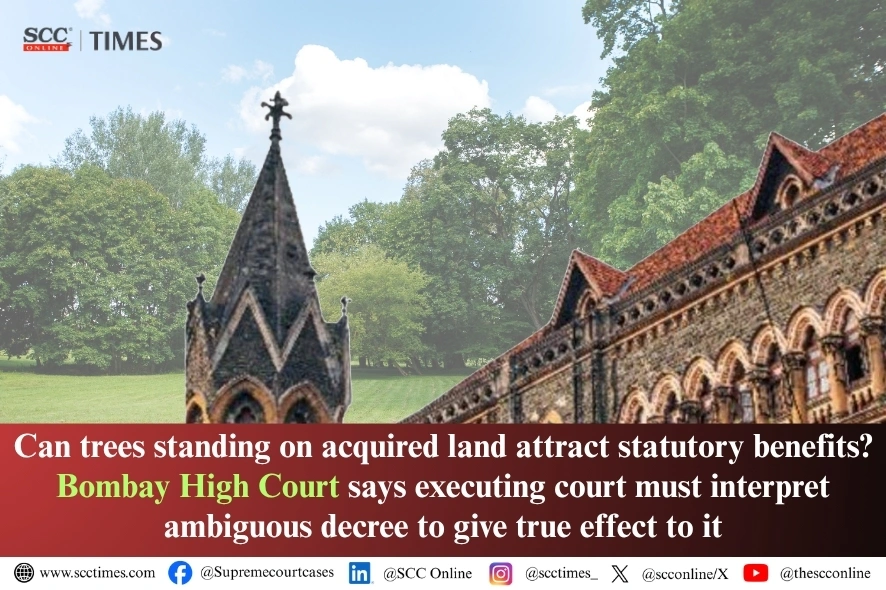
Bombay High Court: In a petition assailing the executing court’s order granted statutory benefits only for the acquired land and not the trees standing on the land, the Single Judge Bench of Prafulla S. Khubalkar, J., held that in the event of an ambiguity in the decree, the executing court cannot interpret the decree to grant relief which is not implicit or expressly excluded; however, the claimants sought execution of the decree by considering the settled position of law about the trees being part of land and thus the executing court was entitled to consider the claim of the claimants for grant of statutory benefits against the trees.
Background
The present petition arose from a land acquisition dispute, wherein the petitioners’ land together with 37 orange trees was acquired, and an award was passed in 1999.
The petitioners sought a reference under Section 18, Land Acquisition Act, 1894. By judgment and decree dated 27 April 2011, the Reference Court enhanced the land compensation by fixing the land value at ₹52,036 per acre and separately valued the 37 orange trees at ₹2,77,500. Statutory benefits under Sections 23(1-A) and 23(2) of the Act were granted only in respect of the land value.
The acquiring body challenged the Reference Court’s judgment in the first appeal, which was dismissed by judgment dated 27 November 2019, thereby confirming the decree.
The petitioners thereafter filed execution proceedings, claiming compensation for the land as well as the trees. By order dated 1 January 2024, the executing court directed grant of statutory benefits in respect of the land but declined to grant such benefits in respect of the trees.
The petitioners subsequently filed a review application and sought statutory benefits for the trees. The review application was rejected by order dated 9 May 2025.
Aggrieved by the orders dated 1 January 2024 and 9 May 2025, the petitioners filed the present petition challenging the refusal to grant statutory benefits on the compensation awarded for the trees.
Issues
Whether the executing court erred in refusing the benefits only on account of the absence of clarity in the judgment and decree, which is under execution.
Analysis and Findings
At the outset, the Court noted that the respondents opposed the petition primarily on the ground that the executing court cannot travel beyond the decree. However, the legal position that trees standing on acquired land constitute a part of the land was not disputed.
The Court stated that, accordingly, there was no dispute regarding the proposition laid down in Chaturbhuj Pande v. State of Bihar and Pramilabai Ade v. State of Maharashtra. Relying on the principle laid down by the Supreme Court in Chaturbhuj Pande, as followed by the Allahabad High Court in Wing Commander P.D. Bali (since deceased) through his legal heir Shardendu Bali v. State of U.P., 2013 SCC OnLine All 12154, and the position laid down in Pramilabai Ade, the Court held that the claimants’ entitlement to statutory benefits in respect of trees was fairly settled.
Executing Court’s Power to Interpret an Ambiguous Decree
The Court considered whether the executing court had erred in refusing statutory benefits merely because of a lack of clarity in the judgment and decree under execution. In this context, the Court considered the legal position laid down in Sanwarlal Agrawal’s case regarding the power of an executing court to construe an ambiguous decree.
The Court held that although an executing court cannot travel beyond the decree, where the decree is ambiguous on material aspects, it is the duty of the executing court to interpret it so as to give true effect to the decree. Such interpretation, however, cannot extend to granting something that is neither implicit in the decree nor capable of being derived from it, and must remain confined to its logical outcome.
Statutory Benefits on Compensation for Trees
Applying this principle, the Court noted that the petitioners were not seeking variation or enlargement of the decree or any enhanced compensation. They were seeking execution of the decree by applying the settled legal position that trees standing on acquired land constitute part of the land.
The Court further noted that the respondents had not disputed the petitioners’ entitlement to statutory benefits in respect of the trees. The Court therefore held that the executing court was entitled to consider the petitioners’ claim for statutory benefits on the compensation awarded for the trees.
Decision
The writ petition was partly allowed. The Court quashed and set aside the order dated 1 January 2024 to the extent that it refused statutory benefits on the compensation for the 37 orange trees.
The Court held that the petitioners were entitled to statutory benefits on the compensation value of the 37 orange trees standing on the acquired land and permitted them to approach the executing court for appropriate directions.
The writ petition was accordingly disposed of, with no order as to costs.
Also Read: SC: Appeal Challenging Statutory Benefits Requires Ad Valorem Court Fee | SCC Times
[Rukhmabai Keshav Tappe v. State of Maharashtra, 2026 SCC OnLine Bom 9518, decided on 7-5-2026]
Advocates who appeared in this case:
For the petitioners: Parth Malviya, Advocate
For the respondents: K.H. Bhondge, AGP for Respondent 1/State
Mangesh Kadu, Advocate for Respondent 2 and 3