Disclaimer: This has been reported after the availability of the order of the Court and not on media reports so as to give an accurate report to our readers.
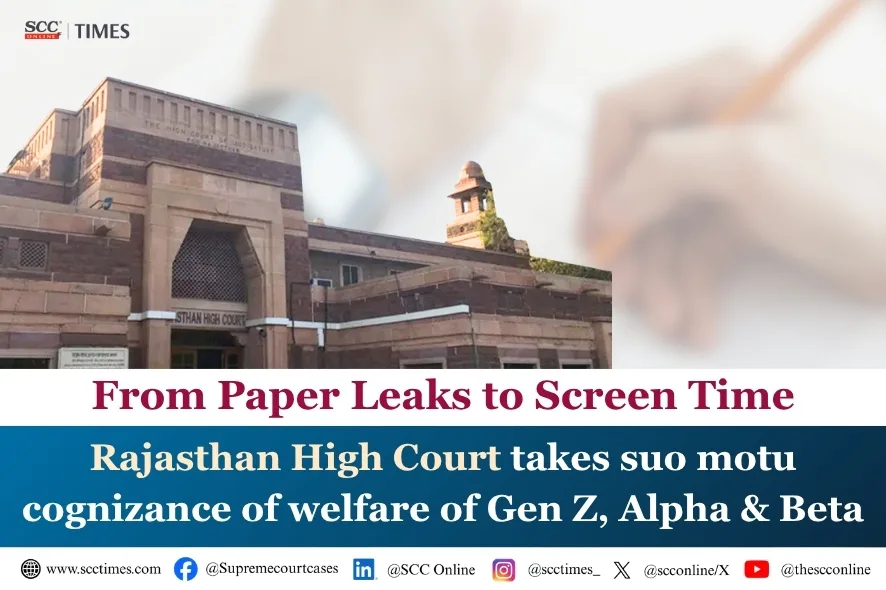
Rajasthan High Court: Taking suo motu cognizance of the issues affecting the welfare and future of “Generation Z”, “Generation Alpha” and “Generation Beta”, a Single Judge Bench of Anoop Kumar Dhand, J., examined several concerns relating to education, technology, paper leaks, screen time, nutrition, health, safety and school infrastructure and emphasised the need to modernise the education system by integrating artificial intelligence (AI), digital learning and other emerging technologies while preserving foundational skills such as reading, writing, independent thinking and reasoning.
The Court also directed the respondents to take comprehensive measures to address the challenges faced by these generations and ensure that educational institutions adequately prepare them for the future.
Also read: Raj HC takes suo motu cognizance of liquor vend timing violations in Jodhpur
Background
“Children are future of a nation because they grow up to become its workforce, leaders and caretakers. How we, as a nation, care, teach and protect them today will decide the strength, safety and success of our country tomorrow. They are flowers of our national garden and it is our prime duty to protect these flowers.”
Stating the aforementioned, the Court took judicial notice of the following categories of students and children:
-
“Gen Z” — The students studying in colleges and universities, belonging to the “Generation Z”, born between 1997 to 2012. The Court stated that the “key trait of this generation is that they are digital natives”.
-
“Gen Alpha” — The students currently studying in schools, colleges and universities across the nation and the State, especially in government schools situated in urban/rural and village areas, where they study in primary, upper-primary and secondary schools. The Court stated that “Gen Alpha” are those born between 2013—2025 and this generation is also known as the “AI Generation”, having grown up with AI technology since their birth.
-
“Gen Beta” — The newly born babies, that is, “Generation Beta”, who are supposed to get admission to nursery and primary schools soon. Their birth years fall between 2025 to 2039, and this generation is also known as the “Automation Generation”, which will grow with AI assistants, robotics, climate change and space exploration as normal day-to-day things.
The Court emphasised that “Day in and day out, the electronic and print media highlights the condition of the Government Schools situated in urban, rural and village areas, which do not provide the basic education, technology and infrastructure for growth of these children.”
Suo Motu cognizance
Thus, taking suo motu cognizance, the Court expressed its deep concern and stated that “where on the one hand, the nation prepares ‘Gen Z’, ‘Gen Alpha’ and ‘Gen Beta’ to lead India in 2047 and beyond, on the other hand, the foundational institutions meant to nurture them, particularly the Government Schools in rural and village areas continue to suffer from systemic deficiencies”. The Court stated that the current state of the rural schools reflects a larger malaise and “when these educational institutions, where the most vulnerable sections of the children belonging to the new generation lack basic infrastructure, training, medical facilities, washrooms, newly emerging technology, etc. is a matter of grave concern”.
The Court stated that in order to compete with international standards and with other developing and developed nations, it is imperative that our nation’s educational institutions, particularly universities, schools and colleges, adopt new techniques including AI, digital learning, and allied technologies considering the entire world’s rapid progress in today’s technological era.
The Court further highlighted that the “right to education is not merely a statutory right, but it flows from Articles 21 and 21A of the Constitution”. The Court emphasised that education is the foundation of a democratic polity and the means through which the fundamental duties under Article 51-A of the Constitution are realised. Further, the Court observed that the State, under Article 45 of the Constitution, which is a Directive Principles of State Policy, is under a constitutional obligation to provide facilities for education to all children and to ensure that such education is holistic, scientific and progressive, while preserving the cultural and intellectual heritage of the nation.
The Court stated that “while technological advancement is the need of hour, an unbridled and exclusive dependence on technology in the field of education may also have irreversible consequences”.
The Court stated that if the present and future generations are trained exclusively based on the latest technology, while foundational skills are disregarded, several consequences may arise:
-
The skills of handwriting and manual writing may eventually become extinct.
-
The practice of reading physical books and developing comprehension through written text may gradually be lost.
-
Students may become completely reliant on speech-to-text technology, AI-generated content and printouts, which may adversely affect independent thought processes, analytical abilities and original writing skills.
-
The cognitive development resulting from reading, writing by hand, and engaging in individual contemplation may be stunted.
The Court, therefore, emphasised that “while we must embrace AI and modern pedagogical tools to remain globally competitive, we cannot do so at the cost of abandoning the basic faculties of reading and writing”.
The Court stated that education must prepare children not merely to operate machines and algorithms, but also to develop the ability to think, write, read, and reason independently. Technology should serve as a tool and an aid in the educational process and must not become a substitute for human intellect. The Court, therefore, emphasised the urgent need to amend and reframe the existing education policy imparted in schools, colleges and universities across the State and the country in a manner that:
-
integrates AI, digital literacy, coding and technology-based learning in order to meet global standards;
-
mandatorily retains and strengthens the practices of handwritten work, reading physical books, note-making and conducting examinations in written format; and
-
ensures that technology is utilised to supplement, rather than supplant, foundational learning.
The Court stressed that “Generation Z” is facing grave difficulties due to repeated paper leaks, and the said “malpractice is adversely affecting both their present academic performance and future prospects”. The Court stated that “paper leaks severely disrupt the academic timelines, mental health and career opportunities of Generation Z, creating widespread mistrust in the public evaluation system”. The Court opined that a foolproof and robust mechanism must be established to address this issue in order to safeguard the interests of the students.
The Court emphasised that “spending more time on screens is correlated with mental and physical harm in the development of children” and stated that the World Health Organisation (WHO) has issued the “Guidelines on physical activity, sedentary behaviour and sleep for children under 5 years of age” where the growing issue of sedentary screen time has been addressed. Further, the Court observed that “to prevent harmful excesses of screen time, some governments have introduced regulations on usage in foreign countries”. WHO’s guidelines, issued on 2 April 2019, recommend zero screen time for infants under one year of age, and less than one hour per day for children aged 1 to 4, while emphasising that quality time spent on interactive, non-screen activities with caregivers, reading, storytelling, singing, is important for a child’s development.
Regarding the State’s duty, under Article 47 of the Constitution, to raise the nutrition levels and standard of living, and to improve public health as among its primary duties, the Court stated that the Food Safety and Standards Authority of India (FSSAI) notified the Food Safety and Standards (Safe Food and Balanced Diets for Children in Schools) Regulations, 2020 (2020 Regulations) to make the said duty effective. The Court highlighted that despite its passing in 2020, no effective steps were taken by the Centre and State Governments for strict implementation till date. The Court emphasised that the recent media reports necessitate monitoring to ensure compliance with the 2020 Regulations and to protect the health of lakhs of children in Rajasthan from obesity and lifestyle diseases.
Show cause notice & directions issued
Thus, the Court issued show-cause notice to the respondents including Department of Education and Human Resources; Ministry of Consumer Affairs, Food and Public Distribution; FSSAI; Rajasthan State Commission for Protection of Child Right and Rajasthan’s Department of Education and directed them to file a status report and action plan on the following points:
-
Steps taken by the Centre as well as by the State Government to frame foolproof and robust mechanism in order prevent paper leakages in the future.
-
Measures to address the major challenges faced by Generation Z, including the education-to-employment gap, mental health and digital burnout, unemployment and insecurity in the gig economy, high cost of living and housing, climate anxiety, lack of political and policy representation, and cyber safety and AI disruption.
-
Steps to ensure quality education and digital readiness, including filling vacant posts of teachers, principals and wardens, conducting special recruitment drives for Physical Training Instructors (PTIs), Computer Teachers and Counsellors, implementing the “Digital Z-Alpha-Beta” plan, and providing smart classrooms, computers, internet connectivity and digital literacy training in village schools.
-
Measures for regular health check-ups, availability of first aid and medical assistance, proper monitoring of mid–day meal quality and nutrition, and installation of CCTV cameras and appointment of female staff for the safety and security of girl students.
-
Provision of basic infrastructure and hygiene facilities in all village government schools, including functional separate toilets for boys and girls, drinking water, electricity with power backup, boundary walls, playgrounds and sports equipment.
-
Formulation of a policy to limit screen time for Generations Z, Alpha and Beta, considering the adverse impact of excessive screen use on sleep, focus, social skills, mental development, reading, learning, writing and communication.
-
Measures for accountability and monitoring, including surprise inspections of government schools in villages by the Rajasthan State Commission for Protection of Child Rights and the District Collectors concerned, with reports to be submitted to the Court within 8 weeks.
-
Constitution of a “Generation Z, Alpha and Beta Monitoring Cell” under the Chief Secretary to review the progress every 3 months and submit quarterly reports to the Court regarding the state of infrastructure in such schools.
Further, the Court issued the following directions to the respondents:
-
Rajasthan and FSSAI shall file a detailed affidavit within 6 weeks setting out the steps taken for implementation of the 2020 Regulations in all Government, government-aided and private schools in Rajasthan.
-
The State shall strictly enforce Regulation 5(1) of the 2020 Regulations and ensure that no high fat, sugar and salt (HFSS) food, as defined therein, is sold in school canteens or within 50 m of school gates. District Magistrates and Block Education Officers shall conduct monthly inspections to ensure compliance.
-
All school canteens shall, within 8 weeks, display menu boards containing the calorie count, ingredients and nutritional information of every food item, with “Traffic Light Labelling” being adopted.
-
Every school shall, within 4 weeks, constitute a “School Food Safety and Nutrition Committee” comprising teachers, parents and student representatives, and the list of such committees shall be uploaded on the Department’s website.
-
The State, in coordination with FSSAI, shall undertake awareness drives for students, parents and vendors regarding balanced diets and the harmful effects of junk food.
-
The State shall ensure that the mid–day meal and other nutrition schemes comply with the balanced diet guidelines issued by FSSAI under the Schedule to the 2020 Regulations.
-
A dedicated portal/helpline shall be created for reporting violations relating to food safety and nutrition in schools.
Further, the Court directed the State to ensure that carbonated drinks, chips, bakery items with trans-fat, or other food items having HFSS are not sold in any school in Rajasthan in contravention of the mandate contained under the 2020 Regulations.
Also read: Gen-Z Lingo Alone Not Voyeurism: Karnataka HC Quashes FIR
[In Re: “In the matter of Welfare and Future of Generation Gen-Z, Gen-Alpha and Gen-Beta”, 2026 SCC OnLine Raj 5156, decided on 24-8-2026]
Advocates who appeared in this case :
For the Petitioner:
For the Respondent: