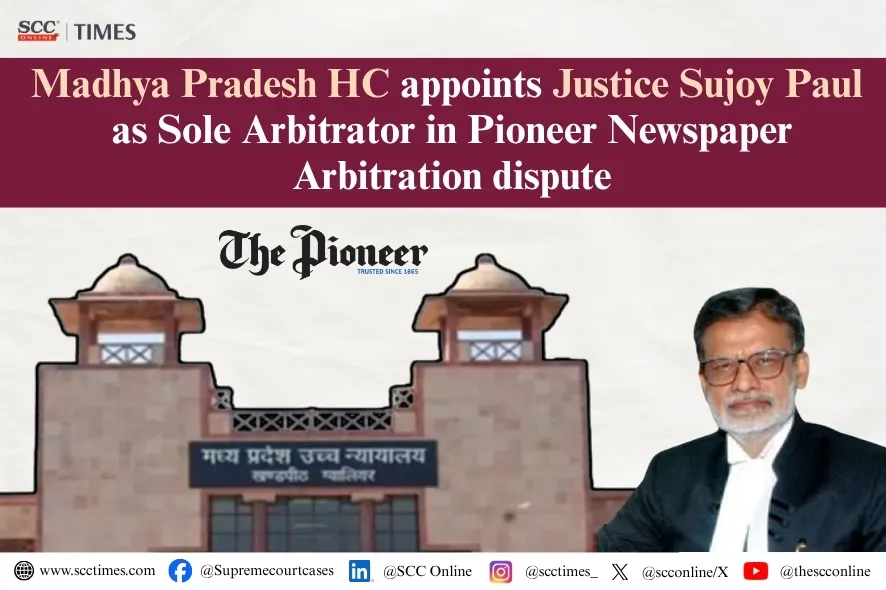
Madhya Pradesh High Court: Where the maintainability of an application filed under Section 11(6), Arbitration and Conciliation Act, 1996, for the appointment of presiding arbitrator, was challenged, a Single Judge Bench of Vivek Jain, J., upon interpretation of Clause 9 of memorandum of understanding (MoU), held that the application is maintainable as once Clause 9 refers to place of arbitration, it would become the juridical seat in view of Section 20, Arbitration and Conciliation Act, 1996 and Clause 9 indicates that courts at Bhopal or New Delhi will have the jurisdiction and the place shall be Delhi or Bhopal or as decided by the parties and since, parties did not decide differently, the seat of arbitration was Delhi or Bhopal and the High Court exercising jurisdiction over Delhi or over Madhya Pradesh would have the jurisdiction to entertain the application. The Court appointed Justice Sujoy Paul, Former Chief Justice, Calcutta High Court, as the sole arbitrator to adjudicate upon the disputes arising between the parties from the MoU or arbitration agreement in question.
Background
This application was filed under Section 11(6), Arbitration and Conciliation Act, 1996, for appointment of presiding arbitrator, as the parties appointed their arbitrators by virtue of Clause 9 arbitration agreement or MoU, who could not arrive at an agreement upon the name of the third and presiding arbitrator.
The parties, being the parent company publishing Pioneer newspaper and its franchisee (applicant), had an agreement for publishing and circulating “Pioneer” newspaper at Bhopal. A dispute arose between the parties, notices were issued, arbitrators appointed but there was a deadlock as to the name of the presiding arbitrator. The MoU between the parties was executed on 10 March 2004. The dispute over appointment of the presiding arbitrator accordingly arose more than 2 decades after the agreement itself, following the 2 party-appointed arbitrators’ inability to agree on a third, presiding arbitrator.
There was no dispute regarding the existence of dispute, arbitrability of dispute and the existence of arbitration agreement. The applicant appointed Bhavana Sadho, retired District Judge, whereas the respondents appointed Justice Ram Gopal Mishra, former Acting Chief Justice of a High Court, as arbitrators.
As per Clauses 8 and 9 MoU, the dispute shall be subject to jurisdiction of the Court at Bhopal or New Delhi. Clause 9 provided that the place of arbitration shall be New Delhi or Bhopal or as decided by the parties.
The Court had to interpret the clauses to find out as to whether Clause 9 amounts to fixation of seat of arbitration in terms of Section 20(1), Arbitration and Conciliation Act, 1996, or if it simply amounts to fixation of venue as per Section 20(3), Arbitration and Conciliation Act, 1996, i.e., New Delhi or Bhopal or as decided by the parties.
The determination of whether Clause 9 fixed the seat of arbitration therefore carried significant consequences: If it did, the application would properly lie before either the Delhi High Court or the Madhya Pradesh High Court; if it did not, jurisdiction would instead have to be assessed under Section 20, Civil Procedure Code, 1908, a test the respondents contended pointed only to Delhi.
Issue
Whether the application was maintainable and whether the Court had the territorial jurisdiction to entertain the application?
Analysis and Decision
The Court noted the applicant’s contentions that this Court had the requisite jurisdiction to entertain this application in view of Clauses 8 and 9 MoU, as Clause 8 mentioned that all disputes under the MoU shall be subject to jurisdiction of Court situated at Bhopal or New Delhi and as per Clause 9, the place of arbitration shall be at Delhi, or Bhopal, or as decided by the parties. Since parties could not arrive upon consensus for any other place, the agreement Clause defining the place of arbitration had to be referred to and in terms of Sections 20(1) and (2), Arbitration and Conciliation Act, the place of arbitration would mean the seat of arbitration and it would be the juridical seat of arbitration. Moreover, the expression “place of arbitration” employed in Clause 9 is not mere venue of arbitration which would be relatable to Section 20(3) of the Arbitration and Conciliation Act.
The Court took note of the submissions of the respondents that Clause 9 did not define the seat of arbitration, and the jurisdiction was to be seen as per Section 20 CPC because the arbitration agreement did not prescribe any seat of arbitration. There was no designation of juridical seat in the terms and conditions of MOU and in the absence of agreement comprising any jurisdiction clause or any seat of arbitration, this Court had no jurisdiction to entertain this application. Applying Section 20 CPC, the matter was cognizable only by the Court having jurisdiction over New Delhi.
The Court referred to Supreme Court judgments, Bharat Aluminium Co. v. Kaiser Aluminium Technical Services Inc., (2012) 9 SCC 552 (BALCO) and BGS SGS SOMA JV v. NHPC, (2020) 4 SCC 234, where the Court had the opportunity to consider the difference between “seat” and “venue” under the Arbitration and Conciliation Act. The Court referred to the ruling of the Supreme Court that the designation of a place of arbitration, even if mentioned as venue of arbitration, renders the said place the juridical seat of arbitration in absence of any significant contrary circumstances or intention of the parties.
The Court observed that in case of Indus Mobile Distribution (P) Ltd. v. Datawind Innovations (P) Ltd., (2017) 7 SCC 678 it was held by Supreme Court that once a seat is designated by the parties, then it becomes like exclusive jurisdiction clause and the court of that seat alone can have a jurisdiction to entertain applications concerning the arbitral proceedings.
Taking note of the rulings of Supreme Court, the Court observed that so far as the dual places of arbitration are concerned, the MoU indicated that Courts at Bhopal or New Delhi will have the jurisdiction and the place shall be Delhi or Bhopal, or as decided by the parties. And since, parties did not decide differently, therefore, the seat of arbitration was Delhi or Bhopal and the High Court exercising jurisdiction over Delhi as well as over Madhya Pradesh would have the jurisdiction to entertain the application under Section 11(6) Arbitration and Conciliation Act.
The Court distinguished the judgment in Ravi Ranjan Developers (P) Ltd. v. Aditya Kumar Chatterjee, 2022 SCC OnLine SC 568 relied upon by the respondents, on facts, stating that the judgment would not apply to the present case as the relevant clause in that case was related to “sitting of the arbitral tribunal”, whereas in the present case Clause 9 of the MoU refers to “place of arbitration”, which is not related to place of meeting of arbitration tribunal or the place of sitting of arbitration tribunal, but refers to the place of arbitration.
The Court opined that once Clause 9 refers to place of arbitration, it would become the juridical seat in view of Section 20 Arbitration and Conciliation Act and hence, in terms of judgment of the Constitution Bench in BALCO case, the proceedings are maintainable before the Madhya Pradesh High Court.
Since no other disputes were raised as to the arbitrability of the dispute and existence of arbitration agreement, the Court appointed Justice Sujoy Paul, Former Chief Justice, Calcutta High Court, as the sole Arbitrator to adjudicate upon the disputes arising between the parties from the MoU in question.
The Court directed the Registrar (Judicial-I) to obtain the necessary consent and disclosure of Justice Sujoy Paul, which if not received within 15 days, then the case to be listed before the Court for “directions” on 31.08.2026 and if received, then the case shall be treated as disposed of. The parties were directed to appear before the arbitrator on 01.9.2026 and such further dates as may be fixed by the arbitrator in that regard.
[Idieal Multi Media Network (P) Ltd. v. Cmyk Printech Ltd., 2026 SCC OnLine MP 24365, decided on 5-8-2026]
Judgment Authored By: Justice Vivek Jain
Advocates who appeared in this case:
Applicant: Arjun Bajpai
Respondent: Omar Ahmad, Harsh Khbar