Disclaimer: This has been reported after the availability of the order of the Court and not on media reports so as to give an accurate report to our readers.
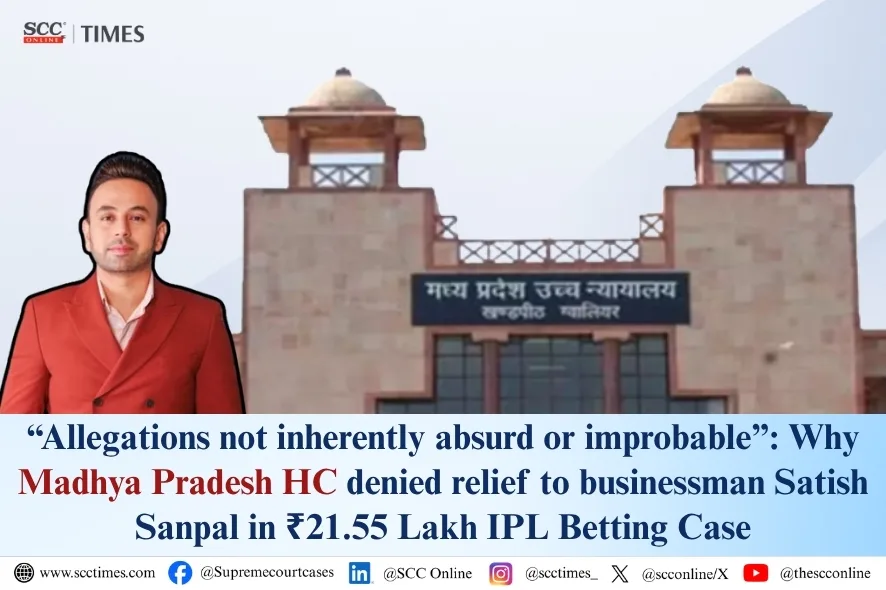
Madhya Pradesh High Court: In a quashing application filed by businessman Satish Sanpal in a ₹21.55 lakhs IPL betting case, the Single Judge Bench of Himanshu Joshi, J., denied the application, holding that it could not be stated that the allegations against businessman Satish Sanpal were inherently absurd or improbable, or even if the prosecution material was accepted completely, no offence would be made out. Furthermore, the contentions raised by Satish Sanpal essentially related to appreciation of evidence and the merits of the prosecution case, which could not be adjudicated in the present proceedings.
Background
As per the prosecution case, in 2022, the police received information about illegal IPL betting activities. Upon conducting a raid, they found 2 accused persons involved in betting activities. Consequently, the impugned FIR was registered. Under Section 4-A, Public Gambling Act, 1867, and Sections 109, 112, 114, 120-B, and 420, Penal Code, 1960 (IPC), as well as the consequential proceedings.
During investigation, it was discovered that businessman Satish Sanpal was involved in the crime as the mastermind of the alleged betting racket. He had allegedly opened fake shell companies and conducted huge transactions, thereby defrauding the government. After completing the investigation, police filed the charge-sheet before the court concerned, and Satish Sanpal was implicated in the case.
Analysis
At the outset, the Court reiterated that while exercising inherent jurisdiction under Section 528, Nagarik Suraksha Sanhita, 2023 (BNSS), it was not required to meticulously appreciate or scrutinise the evidence collected by the investigating agency as that would be done by the trial court. The inherent jurisdiction is to be exercised sparingly and with circumspection. At the stage of consideration of a prayer for quashing, the Court is not expected to conduct a mini-trial or determine the ultimate truthfulness of the allegations. If the material collected during investigation, taken at its face value, discloses the ingredients of the alleged offences and raises a prima facie case requiring adjudication, the proceedings ordinarily ought not to be interdicted.
Noting this, the Court stated that merely because Satish Sanpal disputed the said material or offered an explanation in respect thereof could not be a ground for quashing the criminal proceedings at this stage.
Regarding the contention that he was residing in Dubai since 2020 and had not visited India after March 2020 also could not, by itself, furnish a ground for quashing the proceedings. The Court added that if the prosecution alleged his involvement in the betting racket through other persons, companies, financial transactions, communications or other means, the question whether such material was sufficient to establish his participation, notwithstanding his alleged residence abroad, was a matter which has to be tested on the basis of evidence during trial. The passport documents relied upon by him might constitute a defence or circumstances in his favour, but their effect could not be conclusively determined in the present proceedings.
“The alleged offences are not such that the physical presence of the petitioner at the place of the raid is, by itself, a sine qua non for his liability.”
Regarding the contention that he was not named in the FIR or the initial documents, the Court stated that this did not, by itself, render the prosecution case liable to be quashed. An FIR is not expected to contain the entire prosecution case or the names of every person who may ultimately be found involved in the commission of the offence. The investigating agency is entitled to investigate the source of the offence and the role of other persons who subsequently come to light during investigation. Thus, the Court held that the mere subsequent implication of Satish Sanpal could not be treated as a ground for exercising the inherent jurisdiction of this Court.
Furthermore, the Court held that the argument that the prosecution had relied upon statements recorded under Section 161 CrPC did not warrant interference at this stage as they are matters of evidence and are to be considered by the trial court.
So far as the contention regarding the alleged companies and Satish Sanpal’s status as a director was concerned, the Court noted that he relied upon the Ministry of Corporate Affairs’ (MCA) records to contend that he had ceased to be a director in one of the companies and was never a director in some of the other companies. However, the prosecution case could not be examined in isolation merely based on the designation reflected in the MCA records.
The Court held that the role allegedly attributed to him, the relationship between the persons involved, the way the alleged betting activities were conducted, and the other circumstances collected during investigation were matters which required appreciation of evidence. The fact that the companies were filing statutory returns or that they were registered entities also did not, by itself, conclusively rule out their alleged use in the commission of the offences in question.
Regarding the contention that the alleged amount of ₹21.55 lakhs was not recovered from him or at his instance, the Court stated that recovery of money from an accused is not an indispensable requirement in every case of conspiracy or participation in an organised illegal activity. Accordingly, the Court held that whether the petitioner had any connection with the bank account concerned, whether any financial trail connects him with the alleged transactions, and whether the other circumstances relied upon by the prosecution establish his participation were questions which could properly be determined only after appreciation of evidence during trial.
On the interpretation of Section 4-A, Public Gambling Act, the Court reiterated that it was not required to finally determine whether each ingredient of the offence had been established beyond reasonable doubt at the stage of quashing. If the material collected during investigation prima facie warranted examination of Satish Sanpal’s alleged role in the betting operation, the same cannot be foreclosed at the threshold.
As far as the plea of parity was concerned, the Court stated that the principle of parity is not an absolute rule that every accused named in the same FIR must necessarily receive identical treatment irrespective of the material collected against each accused. The Court has to examine the specific role attributed to the accused and the material available against him. The fact that proceedings against one co-accused have been quashed based on the material and circumstances prevailing in his case cannot, by itself, be treated as determinative of the case of the petitioner. Unless the factual and evidentiary foundation of both cases is demonstrably identical, an order passed in favour of one accused cannot mechanically be extended to another accused.
In the present matter, the Court held that it could not be stated that the allegations against Satish Sanpal were inherently absurd or improbable, or even if the prosecution material was accepted completely, no offence would be made out. On the contrary, the charge-sheet, which was filed, contained material which required examination by the trial court.
Thus, the Court held that the present case did not fall within any of the categories which warrant exercise of inherent jurisdiction for quashing of the FIR or the consequential criminal proceedings. The contentions raised by Satish Sanpal essentially relate to appreciation of evidence and the merits of the prosecution case, which could not be adjudicated in the present proceedings.
Accordingly, the Court declined the application.
[Satish Sanpal v. State of M.P., 2026 SCC OnLine MP 26645, decided on 11-8-2026]
Advocates who appeared in this case:
For the applicant: Senior Advocate Naman Nagrath and Advocate Anushasit Arya
For the respondent: Addl. Advocate General B.D. Singh and Government Advocate Priyanka Mishra