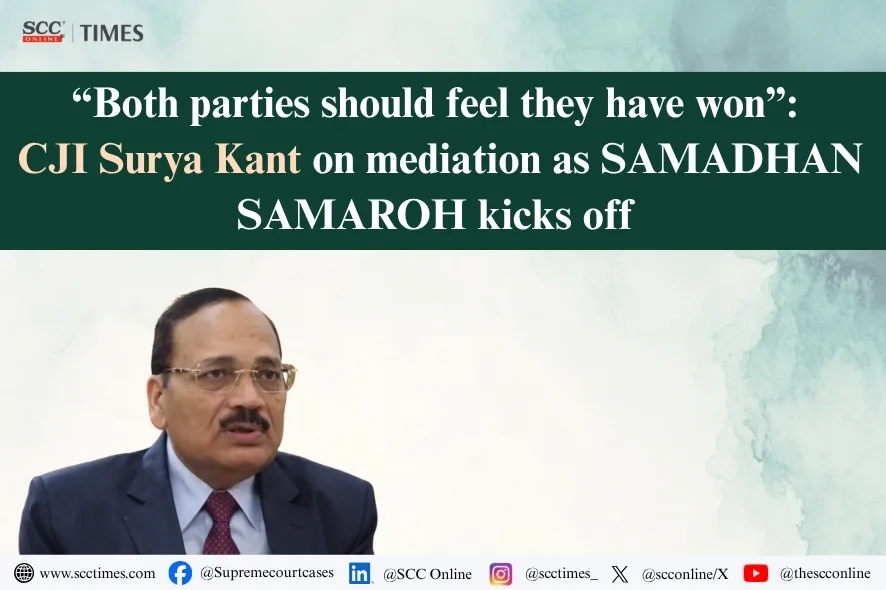
Recently, the Supreme Court of India announced ‘Supreme Court Action for Mediated Adjudication and Disputes Harmonization Across Nation’ – SAMADHAN SAMAROH, an initiative aimed at advancing the vision of participative justice and doorstep delivery of justice. Commencing on 21 April 2026, the initiative seeks to facilitate amicable resolution of pending matters before the Supreme Court through consent-based resolution mechanisms and will culminate in a Special Lok Adalat from 21 to 23 August 2026.
CJI Surya Kant on SAMADHAN SAMAROH
Speaking about the initiative in a recent interaction, Chief Justice of India, Justice Surya Kant, explained that SAMADHAN SAMAROH seeks to identify matters pending before the Supreme Court where the parties may be able to settle through mutual agreement and mediation. He informed that the initiative brings together the efforts of the Supreme Court and the legal services authorities to identify such matters, covering disputes including family matters, motor accident claims, commercial litigation, company matters, land acquisition and compensation disputes, as well as tax-related cases.
Chief Justice Surya Kant also spoke about the impact of prolonged litigation on litigants, particularly the financial cost, effect on quality of life and stress experienced by families. He said the objective was to enable parties, wherever possible, to conclude their disputes without either side feeling that it had simply lost. In his words, the aim is that “both the parties should go with smiling faces and both should feel that we have won”, while preserving family, social and business relationships.
Also Read: CJI on Mediation: “We Called It Panchayat” | ADR & Rule of Law
Justice P.S. Narasimha on SAMADHAN SAMAROH
Speaking separately on the same subject, Justice P.S. Narasimha, Judge, Supreme Court of India, explained the concept and practical implementation of SAMADHAN SAMAROH. He described it as a new name for what is popularly known as mediation. He identified two concerns that the initiative seeks to address: the large pendency of cases and the need for disputes to be resolved more easily and comfortably, without excessive technical procedure. He identified informality as the essence of the process.
Justice Narasimha distinguished mediation from ordinary adjudication by emphasising that the parties themselves retain the power to decide the dispute. Rather than an independent adjudicating authority determining the outcome, mediation provides the parties with the space and process to arrive at a resolution through their own decision-making. He described this voluntary character as the principal advantage of mediation, observing that a resolution reached through the parties’ own deliberate decision-making can be “far more enduring” and “far more satisfying” than a decision imposed through adjudication.
On implementation, Justice Narasimha explained that the Supreme Court had previously used the legal services mechanism to reach litigants at the grassroots level, including through the National Legal Services Authority (NALSA), where mediators facilitated discussions between parties and the resulting resolution was transmitted to the Supreme Court. The present approach, he said, has expanded upon that model by involving the advocates representing the parties and, where institutional litigants are involved, the lawyers and officers representing those institutions. The objective is to bring these different stakeholders into the process so that a settlement can ultimately be placed before the Court for appropriate orders.
Justice Narasimha also pointed to the legal enforceability of mediated settlements. He explained that agreements reached through mediation and Lok Adalats have the character of enforceable documents and can be executed in the same manner as a court judgment. He said this provides parties with the assurance that a settlement reached through the process will be binding and capable of enforcement.
Justice Narasimha further noted that the process does not depend upon a rigid referral procedure. Matters may be referred by an Advocate-on-Record or by the Court itself when it considers that a dispute may be amenable to resolution. He reiterated that “the essence of this resolution is informality”, distinguishing the process from the formal structure of ordinary court proceedings.
On the lessons from earlier Special Lok Adalats, Justice Narasimha identified institutionalisation as a central requirement. He said that mediation and Lok Adalat exercises should not be conducted intermittently with a new team assembled for each exercise and the experience subsequently lost. Instead, he said, the process needs a permanent structure that can build upon “institutional memory and institutional expertise” and continue improving with each exercise.
He identified several challenges in developing such a system, including persuasion, building trust, mediator training and domain expertise. According to Justice Narasimha, many mediators presently come from the legal profession and therefore need to develop skills distinct from those used in adversarial advocacy. He also emphasised the need for a permanent institutional mechanism and mediators with expertise in the subject matter of the disputes. In this regard, he observed that even technically complex disputes involving insolvency, acquisition, corporate matters and trademarks could be effectively mediated, depending on the expertise of the mediator.
The matters being considered span several areas, including land acquisition, matrimonial and property disputes, injunction matters, commercial disputes, motor accident claims and cheque-bouncing cases. Justice Narasimha also noted that tax-related resolutions had emerged in significant numbers during the present exercise, which he attributed in part to positive engagement from the Finance Ministry.
For Justice Narasimha, however, the success of SAMADHAN SAMAROH cannot be assessed merely by counting the number of settlements. He said he would assess it by “how well we have formulated our institutional mechanism for mediation in times to come”, describing the present exercise as “a stepping stone” in a continuing process.
He returned to this point towards the close of the conversation, stressing that the experience must be converted into institutional memory. Recording the difficulties encountered and the steps taken during each exercise, he said, would enable future Lok Adalats to build progressively on what has already been learnt. He concluded by observing,
“Step by step we will improve, that is how institutions are always built,”
Also Read: CJI Surya Kant redefines mediation at the Commonwealth Peace Mediation Conference 2026 | SCC Times