Disclaimer: This has been reported after the availability of the order of the Court and not on media reports so as to give an accurate report to our readers.
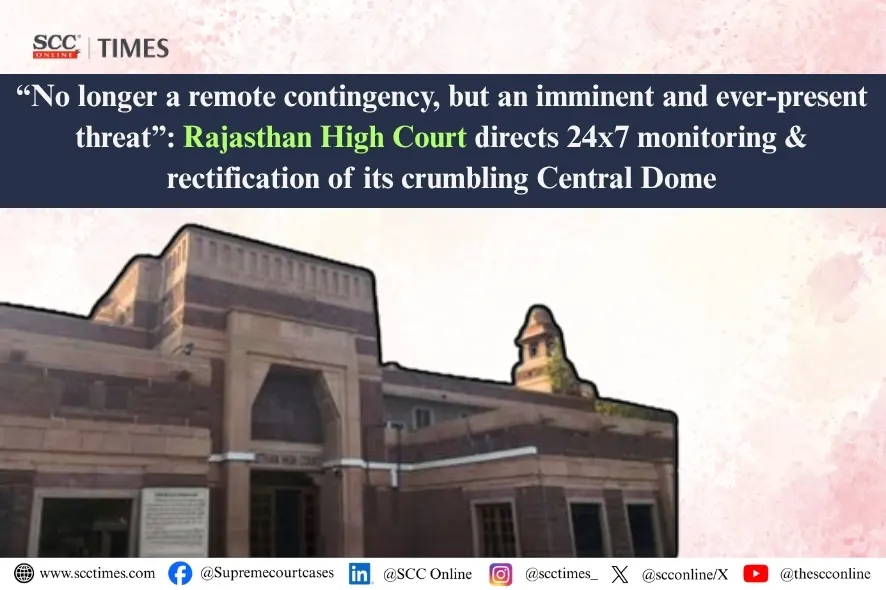
Rajasthan High Court: Taking suo motu cognizance of the deteriorating structural condition of its Principal Seat building at Jodhpur and the imminent threat posed by the Central Dome, the Division Bench of Pushpendra Singh Bhati and Praveer Bhatnagar, JJ., expressed grave concern over the safety of persons within the premises.
The Court noted that, according to the expert opinion of IIT Bombay, the Central Dome was structurally compromised to such an extent that its failure was no longer a remote contingency but an “imminent and ever-present threat”. Taking note of the repeated structural, sanitary, drainage and fire-safety defects reported in the building within a few years of its occupation, the Court directed immediate protective measures, continuous structural health monitoring and comprehensive affidavits from the authorities concerned, while requiring senior State and RSRDC officials and experts to remain personally present on the next date of hearing.
Background
The foundation of the New (Existing) Building of the Rajasthan High Court, Principal Seat, Jodhpur, was laid on 20 April 2007 and thereafter, boundary wall of 3 sides of the premises was constructed by the Public Works Department (PWD).
On 23 December 2010, memorandum of understanding (MoU) was executed with the Rajasthan State Road Development & Construction Corporation Ltd. (RSRDC Ltd.) and construction of the main building commenced on 20 April 2011.
The structural work of the building was completed by the end of 2013, and it was handed over on 6 December 2019, followed by its inauguration by the President of India, Law Minister of India, Chief Justice of India, Chief Minister, Supreme Court Judges and other dignitaries.
Within a span of a few years only, the said building was found to be in extremely deteriorating condition, including its Central Dome. The Central Dome, standing at an approximate height of 21 metres and occupying a central and prominent position within the building, was found by IIT Bombay’s expert opinion to be structurally compromised to such an extent that its failure was no longer a remote contingency but an “imminent and ever-present threat.”
Analysis
The Court took suo motu cognizance of said condition and noted that the dome occupied a central and prominent position in the building which as per IIT Bombay experts’ opinion was “structurally compromised to such an extent that its failure is no longer a remote contingency but an imminent and ever-present threat”. The Court opined that the consequences of such a catastrophe would be catastrophic, involving potential loss of precious human lives and irreparable damage to the dignity and functioning of this Constitutional Court.
Stating that the matter did not stand in isolation, the Court took judicial note of the fact that before completion of 5 years from the date of taking over possession of the building, many structural defects occurred, which were nothing but a series of prior and continuing structural and maintenance failures within the same building. These included:
-
repeated incidents of roof/false-ceiling collapse in Courts, Judges’ Chambers, judicial sections and the dome;
-
falling plaster;
-
pervasive seepage, water ingress and leakage;
-
defective sanitary and drainage systems;
-
inadequate fire-management and fire-safety arrangements;
-
visible cracks in load-bearing and non-load-bearing elements, etc.
The Court took note of a specific chronology of failures recorded across the building since its occupation: before 20 February 2023, false ceilings collapsed in some Courts and a chamber; on 20 February 2023, the false ceiling in another Court was damaged; on 29 April 2023, a part of the roof fell in the Dome itself; on 23 and 28 June 2023, false ceilings fell in the Civil Misc. Appeal Section and the Bill Section respectively, due to plaster flaking; on 12 September 2024, the false ceiling in yet another Court collapsed following water accumulation; on 24 September 2024, the roof fell near the ground-floor lift; on 13 April 2025, plaster fell in the Dome area; on 1 October 2025, plaster fell in the Statistics Section; and on 29 November 2025, the false ceiling of the corridor leading to the Registrar General’s office collapsed, with the corridor toward the Chief Justice’s chambers also found to be in a dilapidated condition upon inspection.
The Court stated that “the cumulative effect of the deficiencies demonstrated a systemic failure in the upkeep, monitoring and timely rectification of a building that houses the highest Constitutional Court of the State”. The Court emphasised that such neglect is “wholly unacceptable and cannot be countenanced”.
The Expert Committee of IIT Jodhpur, after inspecting the site, submitted its Preliminary Report dated 20 March 2023 and Final Report dated 19 April 2023, noting ceiling collapse due to severe corrosion of reinforcement, improper waterproofing, cracking, plastering defects, tile de-lamination and other signs of structural deterioration. It recommended a comprehensive structural audit, NDT, and corrosion-related testing, and temporary repairs with appropriate corrosion protection.
Thereafter, P.T. Mase & Associates submitted its Structural Audit Report dated 9 May 2024, recommending repairs of the damaged areas. The tests indicated doubtful concrete quality at certain locations, reduced pH/carbonation, active corrosion risk, and excessive chloride content in borewell water, rendering the water unsuitable for construction without purification.
Various other structural defects, including spalled plaster, exposed/corroded reinforcement, damaged columns, and improperly fixed tiles, were also reported. RSRDC Ltd. thereafter estimated structural repair and retrofitting works at approximately ₹57.65 crore, categorising the defects into high, medium and low criticality, and repair works were taken up in phases.
A fire incident also occurred in Court Room 2 on 18 September 2024, during which the installed fire-safety system was found non-functional. An FIR dated 12 November 2024 was thereafter registered.
Pursuant to the directions issued, IIT Bombay is undertaking a Structural Audit & Capacity Assessment of the remaining untreated areas of the building. As per its interim findings, the building is undergoing progressive deterioration, primarily due to reinforcement corrosion, carbonation and localised chloride contamination, with approximately 40 per cent of the inspected areas being vulnerable to concrete spalling. IIT Bombay accordingly recommended immediate precautionary measures, including cordoning off the Dome area, permitting only dry mopping throughout the building, and promptly addressing all seepage and plumbing-related leakages.
Pursuant thereto, the Dome area was cordoned off, and RSRDC was directed to submit a retrofitting plan and immediately attend to the seepage and plumbing-related leakages.
Decision
The Court issued notices to the respondents including Rajasthan’s Public Works Department, Department of Finance, and Law & Legal Affairs Department and further to Department of Justice, Ministry of Law & Justice.
The Court directed the respondents to file comprehensive affidavits on or before 24 August 2026 disclosing:
-
Present status of all safety audits, structural health monitoring systems, load-bearing capacity assessments, residual life evaluations, and the degree of urgency of intervention as assessed by competent structural experts.
-
Precise administrative, technical and contractual reasons for the continued existence of pervasive seepage, defective sanitary installations, inadequate fire-safety arrangements, drainage failures, progressive structural cracks and repeated roof collapses despite earlier incidents and prior knowledge.
-
Exact role, contractual obligations, supervisory responsibility, financial accountability, quality control and performance of RSRDC and every other agency, contractor or consultant involved in the original construction, subsequent alterations, maintenance and any ongoing works relating to the building and the dome.
-
Immediate interim measures already taken or proposed to be taken to safeguard human life and property pending permanent structural remediation, including the nature of engineering interventions, their scientific basis, the names of the experts recommending them, and the exact timeline of implementation.
-
Fully costed, time-bound, stage-wise and enforceable action plan for the permanent strengthening, reconstruction or complete replacement of the Central Dome and the comprehensive rectification of every identified structural, sanitary, drainage, fire-safety and other defect, identifying the executing agency, budgetary allocation, source of funds and officers responsible for execution, supervision and monitoring.
-
Names, designations, contact details and present postings of every officer of RSRDC who has been or is currently responsible for the structural safety, maintenance, fire safety and overall upkeep of the building since its construction/occupation, so that personal accountability may be fixed, if required.
Further, the Court directed the respondents to ensure the following:
-
Immediate, effective and scientifically sound temporary protective measures, including restricted/prohibited access, propping, shoring, steel scaffolding, protective netting or any other engineering intervention recommended by competent structural experts of national repute, to avert any sudden collapse.
-
Continuous, round-the-clock structural health monitoring of the Central Dome and all critical structural elements by qualified structural engineers of proven expertise, with daily written reports, including photographic/video documentation, submitted to the Registrar General and placed before the Court.
-
No person gets exposed to unnecessary or avoidable risk in the affected zones, with clear bilingual, Hindi and English, signage, physical barriers, access-control protocols and security deployment strictly enforced.
-
A detailed, written and comprehensive safety and evacuation protocol is prepared in consultation with structural engineers and fire-safety experts of national standing, circulated to all stakeholders, and mock drills conducted.
-
All temporary or permanent works are executed only under the direct supervision of competent structural engineers of proven expertise from institutions of national repute and not left to routine departmental processes or contractors of ordinary competence.
-
A dedicated Control Room to be established within the High Court premises under the direct supervision of the Registrar General, manned 24×7 by technical and administrative personnel, for continuous monitoring and immediate response.
-
Immediate photographic and video documentation of the present condition of the Central Dome and all critical areas to be undertaken by a competent agency and preserved for the record of the Court.
The Court stated that any affidavit found to be incomplete, evasive, vague, delayed or designed to downplay the gravity of the situation would be viewed with utmost seriousness and might invite adverse orders, including personal appearance, personal accountability and appropriate proceedings.
Further, the Court expressed its extreme seriousness and sternest possible disapproval of any further delay, bureaucratic inertia, inter-departmental shifting of responsibility or any attempt to minimise, downplay or obscure the gravity of the structural threat. It stated that any failure to respond with the required urgency, transparency, completeness and personal accountability would invite appropriate and stringent orders, including personal appearance, fixation of individual responsibility and other coercive or corrective measures.
The Court constituted a team of lawyers to assist it as Amicus Curiae whose names would be suggested by the Presidents of the Rajasthan High Court Lawyers’ Association, Jodhpur and Rajasthan High Court Advocates’ Association, Jodhpur. The Presidents and General Secretaries of both Associations shall be ex officio members of the said team. The Court also requested Ravi Bhansali, Senior Advocate, G.R. Punia, Senior Advocate, Dhirendra Singh, Senior Advocate, Jagmal Singh Choudhary, Senior Advocate, Manish Shishodia, Senior Advocate, Vikas Balia, Senior Advocate and Rajesh Joshi, Senior Advocate to assist in the matter at hand.
Further, the Court directed for the listing of the matter on 24 August 2026 with the following directed to remain personally present:
-
Chief Secretary, Government of Rajasthan, Jaipur;
-
Principal Secretary, Department of Finance, Government of Rajasthan, Jaipur;
-
Principal Secretary, Public Works Department, Government of Rajasthan, Jaipur;
-
Managing Director, RSRDC, Jaipur;
-
Director General of Police, Rajasthan, Jaipur;
-
One nominee each of IIT Jodhpur and IIT Bombay; and
-
One nominee of P.T. Mase & Associates, Nagpur.
[Structural integrity, safety and imminent peril to human lives arising from the Central Dome and allied defects in the Building of the Rajasthan High Court, Principal Seat, Jodhpur, In Re, 2026 SCC OnLine Raj 5058, decided on 10-8-2026]