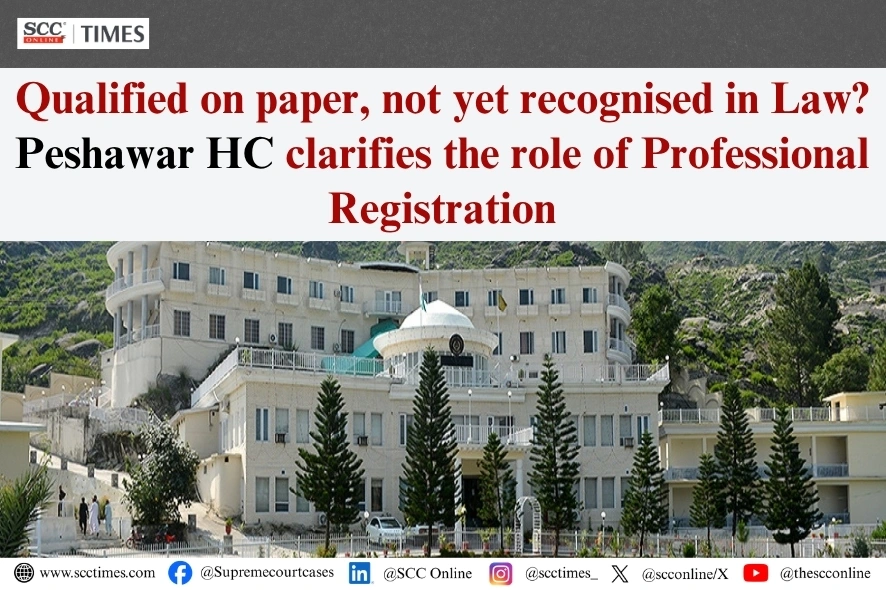
Peshawar High Court: In connected revision petitions arising out of recruitment for the post of Sister Tutor (BPS-17), Muhammad Faheem Wali, J., considered whether additional nursing qualifications acquired before the closing date of an advertisement, but registered with the Pakistan Nursing Council (PNC) thereafter, could be counted towards merit. The Court held that, in regulated professions such as nursing, possession of a qualification is not complete merely upon passing an examination or obtaining a diploma. Rather, “possession” is a composite legal status requiring both academic attainment and statutory recognition through registration with the relevant regulatory body. Finding that the respondent’s additional qualifications were registered after the closing date, the Court held that the Khyber Pakhtunkhwa Public Service Commission (KPPSC) had lawfully deducted the marks awarded for those qualifications. Accordingly, the Court set aside the impugned judgment.
Background
The litigation arose from an advertisement issued by the KPPSC inviting applications for five posts of Sister Tutor (BPS-17) in the Health Department. The respondent applied for the post and was initially placed at the top of the merit list for Zone-III. However, KPPSC deducted marks awarded for her additional qualifications, because those qualifications were registered with the Pakistan Nursing Council on 10 February 2014, after the advertisement’s closing date of 30 August 2013. As a result, she fell below the merit threshold, and the respondent was recommended and appointed.
Aggrieved, the respondent initially approached the High Court through a writ petition. The Court declined to exercise constitutional jurisdiction due to disputed questions of fact but allowed her to seek an alternate remedy. She subsequently instituted a civil suit, which was decreed in her favour and further upheld by the appellate court. KPPSC and the appointed candidate thereafter challenged the concurrent findings before the High Court through the present revision petitions.
Analysis, Law, and Decision
1. What constitutes “possession” of a professional qualification?
The Court observed that the principal controversy did not concern whether the respondent had academically completed her qualifications before the closing date. Rather, the dispute centred on the legal meaning of the word “possession” appearing in Regulation 19(a) of the KPPSC Regulations, 2003, (KPPSC Regulations) which provides that only qualifications possessed on the closing date are to be taken into consideration.
The Court held that, in highly regulated professions such as nursing, medicine, and law, possession of a qualification cannot be reduced to the mere fact of passing an examination or obtaining a diploma. Professional registration is not a procedural formality; rather, it is a constituent element of the qualification itself. Until registration occurs, the qualification remains incomplete for legal and professional purposes. According to the Court, a diploma may physically exist, but without registration it remains legally dormant and incapable of authorising professional practice. Consequently, possession of a professional qualification constitutes a composite legal status.
2. Possession means legal eligibility, not mere academic attainment
The Court relied on Rule 10(3) of the Khyber Pakhtunkhwa Civil Servants (Appointment, Promotion and Transfer) Rules, 1989 (APT Rules), which requires a candidate for initial appointment to possess the prescribed educational and technical qualifications. Reading the APT Rules together with the KPPSC Regulations, the Court held that “possession” in the context of professional recruitment refers to legal eligibility and not merely the completion of an academic course.
According to the Court, professional qualifications operate within a regulatory framework. Therefore, possession of such a qualification necessarily encompasses both the acquisition of the academic credential and the recognition of that credential by the relevant statutory regulator.
3. Registration is the legal mechanism that gives life to a professional qualification
The Court attached considerable significance to Section 23 of the Pakistan Nursing Council Act, 1973 (PNC Act), which prohibits government hospitals from employing unregistered nurses except in narrowly defined trainee circumstances. According to the Court, this statutory prohibition demonstrates that registration is not a post-recruitment formality but a legal prerequisite for recognition and employment within the profession. In the present case, the respondent was unable to establish that she fell within the statutory trainee exception contemplated by Section 23 PNC Act. Consequently, her additional qualifications lacked legal efficacy on the closing date of the advertisement.
The Court further noted that the PNC Act consistently treats registration as the event that transforms an academic qualification into a recognised professional qualification. Accordingly, an unregistered qualification cannot be regarded as legally possessed for merit purposes.
4. Statutory provisions must be interpreted purposively
The Court relied on established principles of statutory interpretation and observed that words appearing within a regulatory framework must be construed in a manner that advances the object of the law and avoids rendering statutory provisions redundant. In this regard, the Court held that interpreting “possession” to include unregistered professional qualifications would defeat the purpose of the PNC Act and undermine the Council’s statutory role in maintaining professional standards. Such an interpretation would permit reliance on qualifications that had not yet received legal recognition from the body entrusted with regulating the profession.
5. Professional qualification is not complete until registration occurs
Referring to the scheme and preamble of the PNC Act, the Court observed that the legislation treats training and registration as interconnected components of professional recognition. The legislature did not intend academic certificates alone to suffice for the attainment of professional status.
The Court referred to Dr. Mumtaz Ahmed v. Federation of Pakistan, 2015 CLC 577, wherein it was observed that the relationship between a healthcare professional and the public is inherently fiduciary in nature. The judgment further recognised that the protection of vulnerable members of the public and the preservation of human life are paramount considerations that outweigh any individual hardship claimed by a candidate.
Aligning these findings with the present case, the Court held that formal registration is the only legally recognised mechanism for verifying that a professional possesses the “sufficient knowledge and skill” required to deal with matters affecting public health and safety. The Court stated that any interpretation treating registration as a remediable technicality would compromise public safety and undermine the trust reposed by the public in healthcare professionals.
The Court further noted that obtaining a recognised qualification merely entitles an individual to seek registration; professional status vests only after the qualification is entered into the register maintained by the Council. Accordingly, it held that possession of a professional qualification is a unified legal status comprising both academic attainment and statutory registration. Until both elements are present, the qualification remains legally incomplete.
6. Registration cannot be treated as a curable technicality
The Court rejected the reasoning adopted by the courts below that late registration constituted a remediable irregularity. It held that eligibility is determined with reference to a fixed cut-off date and constitutes a “static snapshot” as of that date. Qualifications that are not legally vested and recognised on the closing date cannot subsequently be relied upon for merit purposes.
Since the respondent’s additional qualifications were registered only on 10 February 2014, whereas the closing date of the advertisement was 30 August 2013, the Court held that those qualifications could not be considered in the calculation of merit. The KPPSC therefore acted lawfully in deducting the marks awarded for those qualifications.
7. Was registration required even though the advertisement did not mention it?
The respondent argued that the advertisement did not expressly require registration by the closing date. Rejecting this contention, the Court held that eligibility is not determined solely by the wording of an advertisement. Recruitment advertisements operate within an existing statutory framework comprising service rules, regulatory statutes, and governing regulations.
The Court observed that statutory requirements do not lose their force merely because they are not reproduced in a newspaper advertisement. Rather, they are inherent in the legal framework governing the profession. Since the PNC Act and the applicable service rules formed part of that framework, compliance with those provisions remained mandatory regardless of whether they were expressly mentioned in the advertisement.
8. Whether the courts below had correctly appreciated the law?
The Court concluded that the courts below had materially misread the governing legal framework. By treating registration as a remediable technicality, they failed to appreciate its mandatory nature within the professional regulatory regime.
The Court further held that the lower courts erred in treating late registration as a curable defect, overlooking the principle that eligibility is determined through a “static snapshot” taken on the closing date. Any credential that is not legally vested, duly registered, or otherwise fully recognised by that date cannot be factored into the calculation of merit.
Accordingly, the Court held that KPPSC’s decision constituted a corrective measure aimed at ensuring that merit was determined in accordance with the KPPSC Regulations, the APT Rules, and the PNC Act. Since the respondent’s additional qualifications had not acquired legal recognition by the closing date, those qualifications could not lawfully contribute to her merit score.
[The Khyber Pakhtunkhwa Public Service Commission v. Mst. Bibi Aisha, Civil Revisions No. 1379 of 2025, decided on 20-5-2026]
Advocates who appeared in this case:
For the Petitioner: Bilal Khan AAG; Ali Gohar Durrani, Advocate & Zarak Arif Shah, Advocates; Mehtab Gul, Law Officer, KPPSC.
For the Respondents: Zahid Ullah Zahid, Advocate.