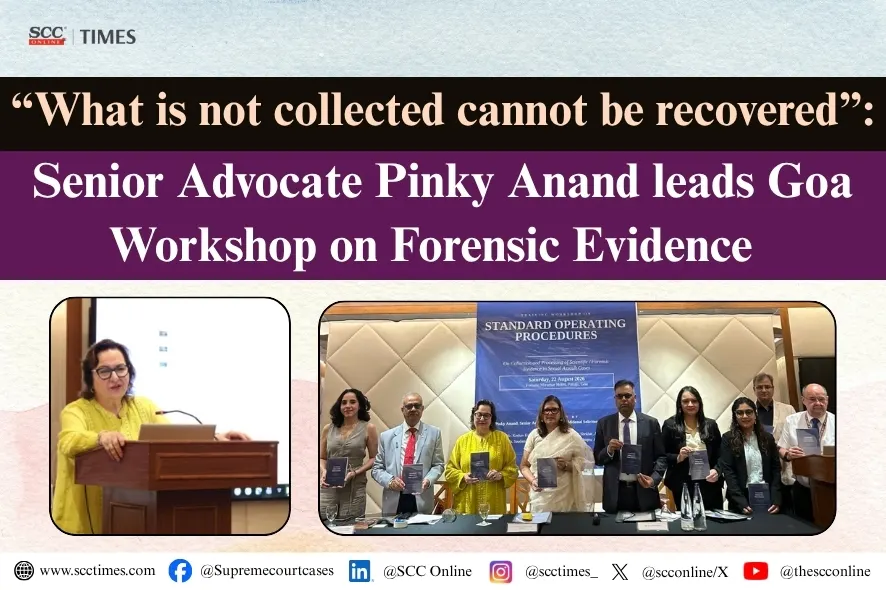
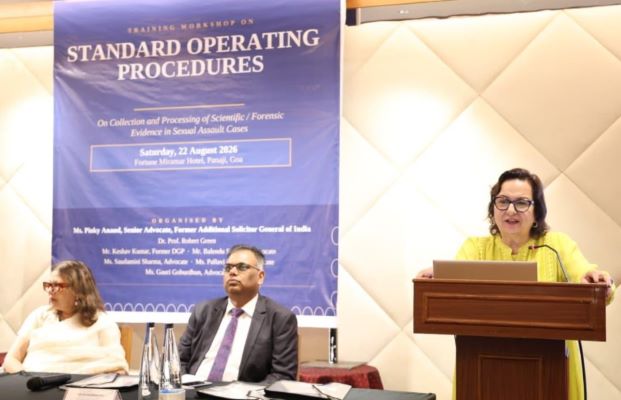
Senior Advocate and former Additional Solicitor General of India, Dr Pinky Anand conducted a training workshop in Goa on 22 August 2026, to strengthen the implementation of Standard Operating Procedures (SOPs), for the collection and presentation of forensic evidence in cases of rape, sexual assault, gender-based violence and child abuse. The workshop brought together frontline police officers, prosecutors, judicial officers, medical practitioners and other professionals, and followed the launch of the SOPs by Dr Anand at the Police Headquarters in Panjim, Goa, on 26 April to mark World DNA Day last year. The SOPs aim to strengthen the collection, handling and presentation of forensic evidence and have been expanded to cover child abuse victims.
The workshop was chaired by Dr Pinky Anand and facilitated by Dr Keshav Kumar IPS (Retd), former DGP Gujarat, and Dr Robert Green OBE, Professor of Forensic Sciences, Justice Dr Neela Gokhale, Judge of the High Court of Bombay, and Mr K.R. Chaurasia, Inspector General of Police, Goa, were also present.
A key focus throughout the workshop was the adoption of a victim-centred approach in cases of sexual assault and gender-based violence. The participants discussed the need for coordination across the criminal justice system to ensure that survivors are treated with dignity and sensitivity, while forensic evidence is collected and presented in a manner that supports due process and access to justice. The training provided participants with a practical, step-by-step understanding of best practices in the collection, preservation, chain of custody and presentation of forensic evidence before courts. Through case studies and practical discussions, participants also examined how effective handling and presentation of forensic evidence can contribute to fair trials and strengthen criminal justice outcomes for victims of sexual violence.
The workshop further highlighted the role of legal practitioners in effectively presenting forensic evidence in court. Medical experts shared insights into the collection and processing of forensic evidence, including practical and technical considerations affecting its reliability and evidentiary value.
Justice Dr Neela Gokhale emphasised the importance of forensic evidence, citing examples from her career and stressing the importance of standardising the procedures.
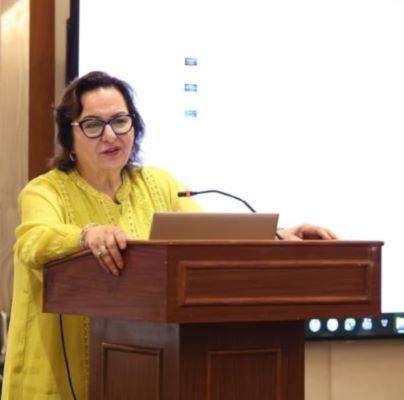
Dr Pinky Anand said,
“In cases of sexual and gender-based violence, the evidence that decides the case is often gone within hours, a survivor bathes, clothes are washed, a room is cleaned and what is not collected in that first window cannot be recovered later.”
Referring to Santosh Kumar Singh v. State through CBI, (2010) 9 SCC 747, the Priyadarshini Mattoo case, Dr Anand highlighted the consequences of mishandling forensic evidence. She stated that although DNA analysis established the link to the accused, the trial court acquitted him largely because of the manner in which the evidence had been handled and proved, with the High Court and Supreme Court subsequently restoring the conviction fourteen years after the offence.She stated that the SOPs are crucial to ensuring proper handling of forensic evidence from the first responder through an unbroken chain of custody that can withstand cross-examination.
Reference to BNSS provisions on forensic evidence
Dr Anand further referred to the Nagarik Suraksha Sanhita (BNSS), 2023, for timely medical examination of a woman, forwarding of reports within seven days and forensic experts attending the scene with videography of collection in offences punishable with seven years or more. She emphasised that better forensic practices must strengthen the case before the court and must not become a fresh threshold of belief for survivors to clear.
Goa DGP Alok Singh on coordinated approach to forensic evidence
Director General of Police, Goa, Mr Alok Singh stated that Goa, as a global tourist destination, attracts millions of people every year and that its law enforcement cadres are committed to seeing justice served for victims, their families and wider public safety. He stated that Goa was well placed to bring together police, doctors, civil society, prosecution and judiciary towards the common goal of ensuring best practices in forensic evidence collection. He further stated that the collective endeavour would always be to provide the best possible service to victims and keep citizens and international tourists safe in Goa.
IGP K.R. Chaurasia highlights Rule of Law and fairness in investigation
Mr K.R. Chaurasia, Inspector General of Police, Goa, highlighted the philosophy underlying the SOPs and stated that the Rule of Law demands equality before law as well as fairness in procedure. He added that the SOPs are needed to ensure fair and effective investigations for survivors.
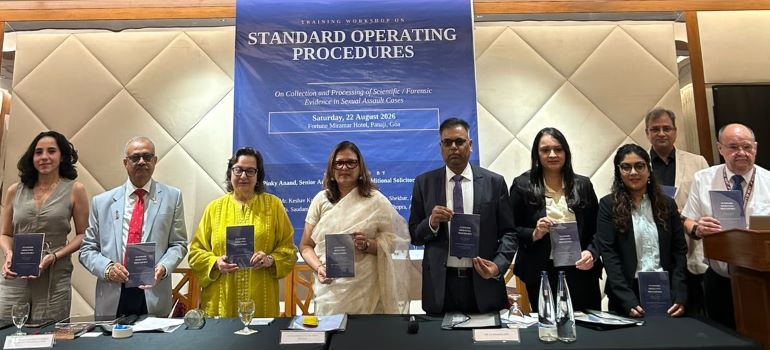
The workshop marked an important step towards translating the SOPs from policy into practice and strengthening coordination between the police, medical professionals, prosecutors and the judiciary in responding to sexual assault and gender-based violence.