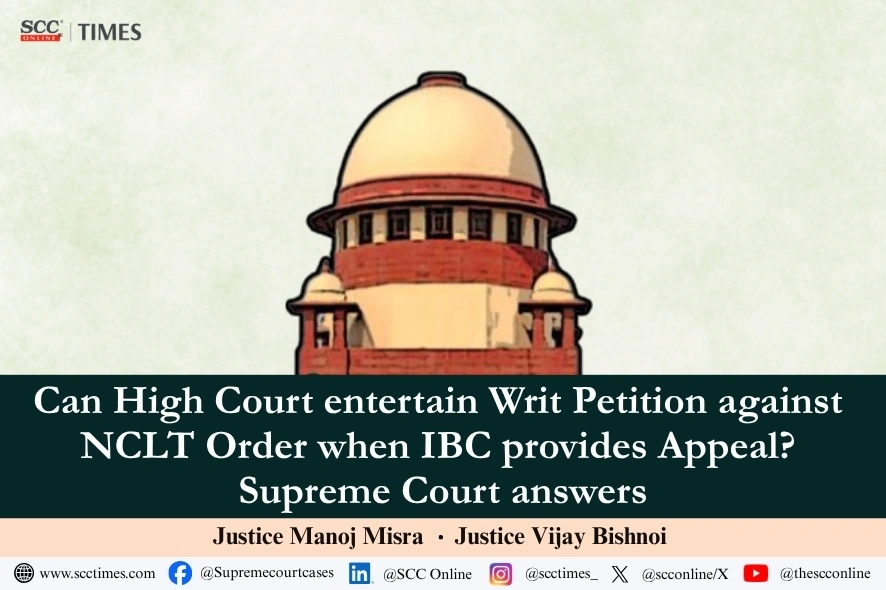
Supreme Court: In an appeal challenging the Kerala High Court’s order entertaining a writ petition against an National Company Law Tribunal (NCLT) order passed during liquidation proceedings, the Division Bench of Manoj Misra and Vijay Bishnoi, JJ., held that where an NCLT order passed under the Insolvency and Bankruptcy Code, 2016 (IBC) is appealable under Section 61, the High Court should ordinarily refrain from entertaining a writ petition challenging that order and direct the aggrieved party to pursue the statutory appellate remedy.
The appeal arose from an order dated 21 April 2026 by which the Kerala High Court entertained a writ petition challenging an order passed by the NCLT during liquidation proceedings and issued notice and an interim order.
While entertaining the appeal against the High Court’s order, the Court had stayed the impugned order and further proceedings before the High Court.
The appellant contended that the High Court’s powers under Articles 226 and 227 of the Constitution could not be curtailed by statute. However, judicial discipline requires an order passed under the IBC to be challenged within the statutory framework provided by the Code.
The appellant relied on KSK Mahanadi Power Co. Ltd. (CoC) v. U.P. Power Corpn. Ltd., 2024 SCC OnLine SC 4013 and Mohd. Enterprises (Tanzania) Ltd. v. Farooq Ali Khan, 2025 SCC OnLine SC 23.
Finding
The Court found substance in the appellant’s submission. The Court noted that Section 61 IBC provides a right of appeal to any “person aggrieved” by an order of the adjudicating authority under Part II of the Code. The provision uses the expression “order” without restricting the nature of the order against which an appeal may be filed.
Also Read: NCLAT rejects condonation of 1-day delay beyond statutory period under Section 61(2) IBC | SCC Times
In these circumstances, the Court held that judicial discipline requires the High Court to refrain from entertaining a challenge to an order passed by the adjudicating authority/NCLT under the Code, particularly when the aggrieved person can raise the grievance in an appeal under the Code.
Accordingly, the Court set aside the High Court’s order and dismissed the writ petition on the ground of alternative remedy, while granting liberty to the writ petitioners to pursue the appropriate remedy under the IBC.
The respondents pointed out that the statutory appeal under the IBC had to be filed within the prescribed period, which could not be extended beyond 45 days, and that the period had already expired. The Court therefore permitted them to approach the National Company Law Appellate Tribunal (NCLAT) within 15 days, along with an application under Section 14, Limitation Act, 1963 seeking exclusion of the period during which the proceedings remained pending before the High Court and the Supreme Court. The Court directed that such an application be considered in accordance with law. The appeal was allowed.
Also Read: Key Amendment Bills Introduced in Rajya Sabha | SCC Times
[Davis Koottala Varkey v. Samson T. George, 2026 SCC OnLine SC 1560, decided on 5-8-2026]
Advocates who appeared in this case:
For the appellants: Senior Advocate Navin Pahwa, AOR Pankhuri Bhardwaj, Amit Pai, Honey Satpal, Nipun Singhvi, Vedant Dave, Mayur Jugtawat, Arjun Sagar, Advocates
For the respondents: Senior Advocate P.B. Suresh Kumar, Senior Advocate Arvind Varma, AOR Pranav Krishna, Akhil Suresh, Asher Revi Job, Pattathil Pranav Menon, Naduvilaparambil Sebastian, Mahima Chauhan, Raghavi Shukla Advocates