1. Please introduce yourself to our readers.
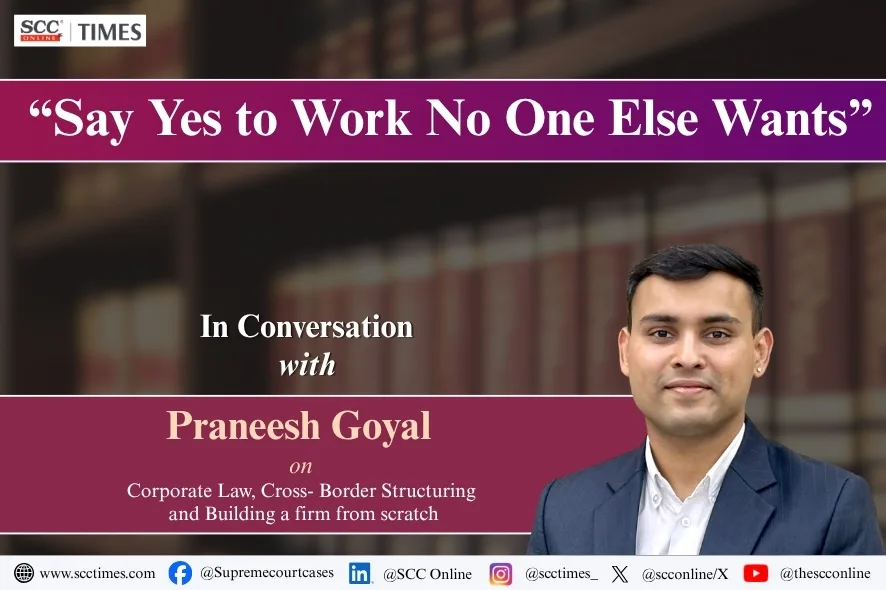
Hi! I am Praneesh Goyal, a corporate lawyer and co-founding partner at MGCo. Legal in India and EQUBE Legal in UAE. We started both in 2023. My work focuses on corporate law, M&A, and cross-border structuring, mostly for hospitality, fintech, and private equity (PE)-backed clients operating between India and the UAE. I also serve as the Chief Representative for India Discovery Fund in the Middle East. We built the firm to solve a specific problem mainly founders working across both markets kept getting stuck between advisors who did not talk to each other. So, we made sure it is the same team and the same context, on both sides. Three years in, we have been recognised on the Forbes India Legal Powerlist and have won a few industry awards, but what matters more to me is that clients still deal with me directly, not a junior associate.
2. You chose to specialise in areas like healthcare, fintech, private equity, etc. immediately after your undergraduate education from NLU Jodhpur. What inspired you to pursue these particular practice areas?
Honestly, a lot of it started before I even finished law school. My father runs Manish Goyal & Co., a financial advisory firm with over 30 years in the business, so I grew up around conversations about tax structuring, compliance, and client problems. It was dinner table talk long before it was my job. When I joined as a Legal Associate right after NLU Jodhpur, I was not choosing practice areas from a textbook list. I was picking up whatever walked through the door, and what walked through the door was hospitality clients, fintech founders, and PE-backed businesses trying to figure out cross-border structuring.
What kept me in those spaces specifically was that they are all sectors where the legal work actually matters to the business, not just paperwork sitting in a drawer. A hospitality group signing a hotel management agreement, a fintech company navigating regulatory approval, or a PE fund structuring an investment. Get any of that wrong, and it is not a technicality; it is a real problem for real people. I found I liked being close to that kind of work, where you are not just reacting to a dispute after the fact, but are actually part of how the deal gets built.
The other piece is timing. I started right as more Indian businesses were expanding into the UAE and more UAE capital was looking at India. Healthcare, fintech, hospitality, and PE were exactly the sectors moving fastest across that corridor. So, it was not so much a deliberate five-year plan as it was recognising where the real, complicated, cross border problems were showing up, and deciding that was where I wanted to build expertise.
3. Kindly walk us through your career path from law school to becoming Founding Partner at MGCo. Legal? What were the key inflection points along the way?
I started as a Legal Associate at Manish Goyal & Co. (MGCO) right after NLU Jodhpur in 2020, working on tax and corporate advisory. That is where I learned the business side of law. The real inflection point was 2023. I moved to Dubai to help set up MGCO UAE, and around the same time, co-founded MGCo Legal in India with Rohit Sharma. We were just two people with no brand and no referral network, so we took on the work bigger firms did not want.
Around then the venture with India Discovery Fund was also established, which pushed me deeper into cross-border investment work, not just legal advisory. Three years in, that combination, founder led, cross-border, multidisciplinary, is what’s led to recognition like the Forbes India Legal Powerlist and the Asian Legal Business (ALB) India Law Awards. But the biggest inflection point was deciding early on to build one firm across two countries instead of growing one office bigger.
4. What does the “Strategic Business and Investment Practice” at MGCo. Legal actually encompass? Kindly share a deal or matter that you worked on which taught you the most.
The strategic business and investment practice covers company transactions for financial and strategic investors, both friendly and hostile acquisitions, along with investment structuring, insolvency and bankruptcy, and IP and brand protection. It is really the practice group that sits closest to how capital actually moves, not just contracts on paper.
The matter that taught me the most was a cross-border joint venture (JV) between an Indian and a UAE party. A founder called me the night before he was flying out to sign, saying everything was already agreed. By morning I had found that the structure created a permanent establishment in India for the UAE partner, which meant a potential 35 per cent tax exposure plus surcharge and cess, something neither legal team had caught.
That deal taught me that in cross-border work, the biggest risks rarely show up in the clauses people expect to worry about. They hide in the intersection between two legal systems, where each side assumes the other has checked something they have not. It is the reason we built the firm the way we did, one team looking at both sides, instead of two separate advisors hoping nothing falls through the gap.
5. Having established your own law firm, what do you consider the crucial steps or checklist one must keep in mind when planning to set up their law firm from scratch?
A few things stand out from actually going through it.
First, be honest about what problem you are solving, not just that you want to start a firm. For us it was the three-invoice problem, founders working across India and the UAE getting stuck between advisors who did not talk to each other. That clarity shaped every decision after.
Second, take the work no one else wants in the beginning. We cold-emailed companies and got told they would rather go with someone experienced. So, we took on messy shareholder disputes, small contract reviews, and the founder calling at 11 p.m. on a Saturday. That phase is uncomfortable, but it builds judgment and reputation you cannot buy later.
Third, decide early what you will not outsource. We made a call that clients would always get founding partner attention, rather than a junior associate routing messages. That is harder to scale, but it is also what actually kept clients coming back.
Fourth, if you are building across jurisdictions, do not treat it as two separate offices. Same team, same context, and the same approach on the both sides. The moment you split that, you are back to the exact coordination problem clients are trying to escape.
And finally, expect it to take longer than you think before anyone takes you seriously. It took us about three years before recognition like the Forbes Legal Powerlist or at the ALB Awards started coming in. None of that came from a plan; it came from consistently doing the unglamorous work well.
6. Your expertise as Corporate counsel extends to the UAE. How did you expand your practice to handle cross-border transactions involving UAE-based clients?
It started with my father’s firm, Manish Goyal & Co., which had already been serving clients for over 30 years and had natural connections to the Gulf through Indian businesses expanding there. In 2023, I moved to Dubai to set up MGCO UAE, which later became EQUBE Legal, and that was when the cross-border work stopped being occasional and became the core of what we do.
The real shift was realising that UAE clients did not just need UAE advice, they needed someone who understood how a structure would play out on the Indian side too, and vice versa. So instead of building a UAE practice and an India practice separately, we kept the same founding partners and team culture across both. That meant learning both regulatory environments properly, corporate tax, free zone qualification rules, Foreign Exchange Management Act (FEMA), transfer pricing, not just enough to get by, but enough to catch the problems that only show up when you are looking at both systems at once.
Cases like the JV I mentioned earlier, where a UAE structure quietly created a permanent establishment issue in India, are what really forced that expertise to deepen. You do not learn to spot those gaps from a textbook; you learn it from almost missing one.
7. You are based in Dubai. How has the region’s legal and investment landscape evolved since you began practising there, and what makes it distinct from working out of India?
Since I moved to Dubai in 2023, the biggest shift has been on the tax and regulatory side. The UAE corporate tax came into effect, free zones went from a straightforward licensing structure to something that actually requires real substance, qualifying activity checks, and transfer pricing compliance to get the 0 per cent rate. That alone changed a lot of client conversations from “help me set up” to “help me make sure I actually qualify for what I set up”.
There has also been a steady rise in cross-border deal flow, more UAE capital looking at India, more Indian businesses expanding into the Gulf, more Dubai International Financial Centre (DIFC)-linked structures and family offices getting active. So the work has moved from simple entity formation to genuinely complex structuring.
What makes Dubai distinct from India is not really the law itself, it is the pace and the mindset. Deals here move faster, and there is an expectation that you close cleanly the first time, there is less tolerance for the back and forth that is more common in India. At the same time, the market is still young enough that a lot of structures have not been tested yet, so you are often the first person raising a question no one has asked before.
Practising in both places at once is what makes the difference visible. A structure that looks perfectly clean under UAE regulations can quietly create a tax or compliance problem the moment it touches India, and you only catch that if you are actually looking at both sides, not just trusting that the other advisor has it covered.
8. What advice would you offer to young lawyers and law students who wish to build a career like yours, working internationally in a specialised practice?
Do not wait for a five-year plan to feel complete before you start. I did not choose hospitality, fintech, and PE from a textbook, I picked up whatever walked through the door in my first job and got good at it. Say yes to the work no one else wants early on, the messy disputes, the small contract reviews, the late-night calls. That is where real judgment gets built, not in a classroom.
If you want to work internationally, actually learn both systems, do not just learn one and assume the other will sort itself out. The gaps between jurisdictions are where the real risk hides, and you only catch that by understanding both sides properly, not by outsourcing half the picture to someone else.
Be patient with recognition. It took us three years of nobody returning our calls before anyone took us seriously. That phase is uncomfortable, but is also what forces you to actually get good, instead of coasting on a brand name you have not earned yet.
And find a problem you actually care about solving, not just a practice area that sounds impressive. For me it was watching clients get stuck between advisors who did not talk to each other. That clarity is what kept me going through the slow years, and it is still what shapes every decision at the firm today.
1. BA LLB (Hons.) (Business Law) NLU Jodhpur, 2023, Co-Founding Partner, MGCo. Legal and specialises in Corporate Counsel for hospitality, healthcare, fintech, and private equity clients across India and the UAE, recognition in Top 100 Individual Lawyers in India, Forbes India Legal Powerlist 2023.
2. EBC- SCC Online Student Ambassador, Faculty of Law, BHU.