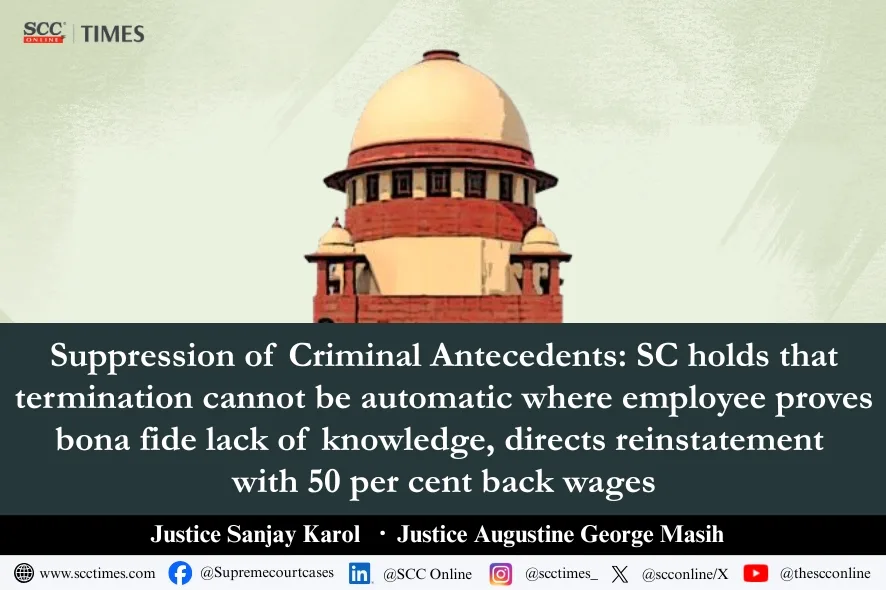
Supreme Court: In a case concerning termination of employment on the ground of alleged suppression of criminal antecedents, a Division Bench of Sanjay Karol and Augustine George Masih*, JJ., set aside the termination of a Technician (Process) employed with Fertilizers and Chemicals Travancore Ltd., holding that non-disclosure of a criminal antecedent cannot, by itself, constitute an automatic ground for termination.
Reiterating the principles laid down in Avtar Singh v. Union of India, (2016) 8 SCC 471, the Court held that the employer must undertake a two-pronged enquiry; first, whether there was, in fact, any suppression or furnishing of false information having regard to the candidate’s knowledge at the relevant time; and second, whether the nature of the antecedent and other relevant circumstances warranted termination. Finding that the appellant had substantiated his bona fide lack of knowledge of the NCR and that the authorities had failed to apply their mind to the nature of the offence, the post held and the subsequent deletion of his name from the array of accused, the Court held the termination to be illegal and directed his reinstatement with consequential benefits, while restricting back wages to 50 per cent.
Background
The appellant was appointed as Technician (Process) with Fertilizers and Chemicals Travancore Ltd. on 5 May 2021 on consolidated pay for an initial period of 2 years. At the time of joining, he furnished an attestation form declaring that no criminal case was pending against him. Subsequently, during verification of his antecedents, it came to light that an NCR dated 3 April 2019 had been registered against him under Sections 323 and 504, Penal Code, 1860. On this basis, a show-cause notice was issued alleging suppression of material information.
The appellant, in his reply, contended that he had bona fide declared the information available to him and was unaware of the NCR, as he had neither been arrested nor served with any summons in relation to the same. He also relied upon a certificate dated 9 July 2020 issued by the Superintendent of Police stating that no adverse entry was found against him. Subsequently, he produced the police final report showing that no evidence had been found against him and that his name had been deleted from the array of accused. Notwithstanding his explanation, his appointment was terminated on 5 August 2023.
Aggrieved, the appellant approached the Kerala High Court. The Single Judge declined to interfere with the termination, holding that the appellant’s plea of lack of knowledge of the NCR involved disputed questions of fact. The Division Bench, by the impugned judgment dated 4 July 2025, affirmed the said view and dismissed the appeal. The appellant has consequently approached the Supreme Court.
Analysis and Decision
The Court rejected the respondents’ objection regarding maintainability of the writ petition on the ground of availability of an alternative remedy under the Industrial Disputes Act, 1947. It held that the existence of an alternative remedy does not operate as an absolute bar to the exercise of writ jurisdiction, particularly where the challenge is to the legality of the order of termination itself.
On the merits, the Court reiterated the settled legal position in Avtar Singh v. Union of India, (2016) 8 SCC 471, that termination on account of suppression of criminal antecedents is not an automatic consequence of non-disclosure. The employer must consider the relevant facts and circumstances, including the nature of suppression, the outcome of the criminal case, the nature of employment and the offence, and any special circumstances.
The enquiry is essentially two-pronged:
-
first, whether there was, in truth, any suppression or furnishing of false information, having regard to the candidate’s knowledge at the relevant time; and
-
second, whether, upon considering the nature and gravity of the offence, the post held, the duties attached thereto and the eventual outcome of the criminal proceedings, termination was warranted.
Applying the first prong, the Court found that the appellant’s consistent stand that he had no knowledge of the NCR stood substantiated by documentary evidence. The certificate dated 9 July 2020 showed that there were no adverse entries against him, while the subsequent police certificate confirmed that his name had been removed from the NCR after investigation, no evidence having been found against him, and that he had neither been called to the police station nor arrested.
The respondents contended that it was unlikely the appellant had no knowledge of the NCR, since his parents were also named as co-accused in the same report. The Court found this submission unpersuasive, observing that no material had been placed on record to show that the appellant’s parents had in fact informed him of the NCR’s registration or that he had otherwise been put on notice of it. In the absence of such evidence, the Court held that the respondents’ submission remained a matter of surmise, incapable of displacing the documentary material, including the 2020 police certificate and the subsequent confirmation of deletion from the array of accused, relied upon by the appellant.
The Court held that knowledge of a fact is a necessary prerequisite for its non-disclosure and that one cannot be said to have suppressed something of which one had no knowledge. At the same time, the Court clarified that such lack of awareness must be established by the candidate and a bare plea of ignorance would not suffice.
As regards the second prong, the Court found that the authorities had failed to undertake the requisite enquiry and had proceeded on the presumption that the existence of the criminal antecedent would automatically render the appellant ineligible. There were no specific findings regarding the nature of the offence, its impact on the nature of the post, or the effect of the subsequent deletion of the appellant’s name from the array of accused. The termination order was, therefore, found to be without application of mind.
Decision
Accordingly, the Court held that the termination of the appellant was not permissible in law, as it failed on both prongs of the enquiry. The termination order was set aside and the appellant was directed to be reinstated forthwith with all consequential benefits. However, back wages were restricted to 50 per cent, payable within 8 weeks, failing which interest at 6 per cent per annum would be payable from the date the amount became due till disbursal. The appeal was accordingly allowed.
Also Read: SC on weighing Entire Record v. Recent Performance in Retirement | SCC Times
[Shatrughn Yadav v. Fertilizers and Chemicals Travancore Ltd., 2026 SCC OnLine SC 1537, decided on 11-8-2026]
*Judgement authored by: Justice Augustine George Masih