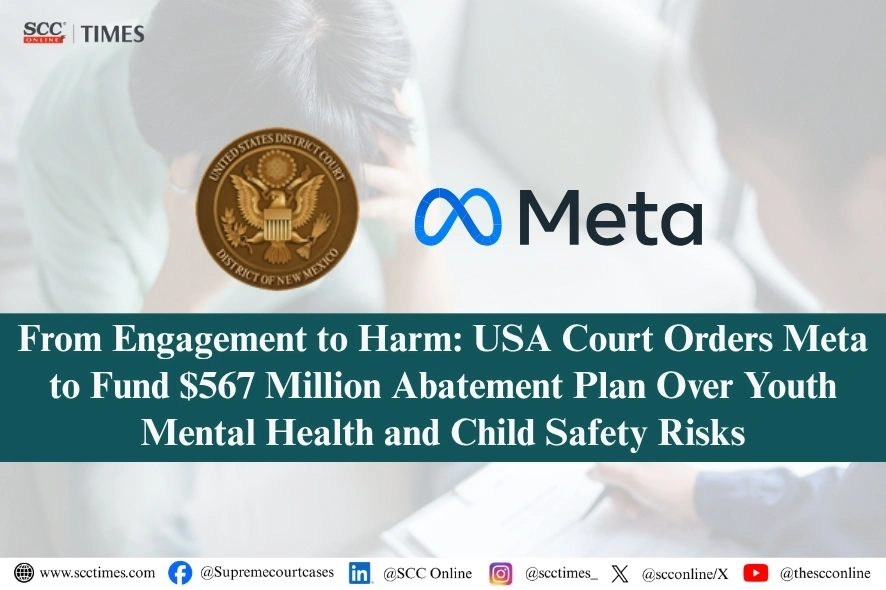
New Mexico Court, USA: In a two-phase proceeding involving consumer protection and public nuisance claims against Meta Platforms, Inc., Bryan Biedscheid, Chief District Judge, considered whether Meta’s operation of Facebook and Instagram contributed to a state-wide youth mental health crisis and created a public nuisance under New Mexico law. The Court held that Meta’s platforms were a cause of, and substantially contributed to, a public nuisance in New Mexico by contributing to youth mental health harms and sexual exploitation of children. The Court further held that Meta knowingly implemented engagement-optimising features harmful to adolescents, failed adequately to disclose platform risks, and interfered with public health, safety and welfare. Accordingly, the Court ordered extensive abatement relief, including the creation of a $567 million abatement fund, in addition to a previously awarded $375 million civil penalty under the New Mexico Unfair Practices Act, 1967 (UPA).
Background
Meta, a multinational technology company incorporated in Delaware, designs, markets, and operates social media services, including Facebook, Instagram, Messenger, and WhatsApp. Meta operates Facebook, Instagram, and WhatsApp in New Mexico, and New Mexico residents, as well as citizens of other states traveling through or visiting New Mexico, use these services. Meta also operates a data centre in Los Lunas, New Mexico, which houses its computing equipment and hardware.
The State of New Mexico commenced proceedings against Meta Platforms, Inc., alleging that Meta’s operation of Facebook, Instagram, Messenger, and WhatsApp violated the UPA and created a public nuisance. The proceedings were divided into two phases. Phase 1 concerned the UPA claims and the assessment of civil penalties, while Phase 2 addressed the State’s request for abatement based on public nuisance.
In Phase 1, the jury found that Meta committed 75,000 violations of the UPA and imposed the maximum civil penalty of $5,000 for each violation, resulting in a total award of $375 million. Phase 2 focused on whether Meta’s conduct created a public nuisance and, if so, the relief required to abate it.
Analysis, Law, and Decision
A. Youth Mental Health Crisis and Social Media
The Court found that the youth mental health crisis in New Mexico has worsened in recent years, adversely affecting adolescents, their families, communities, while placing significant strain on public and community resources throughout the State. New Mexico youth are particularly vulnerable to adverse mental health outcomes due to a range of factors, including adverse childhood experiences such as abuse, neglect, exposure to community violence, and residence in under-resourced or racially segregated neighbourhoods. New Mexico Health Department has determined that these factors increase the risk of mental health conditions both during childhood and later in life. The Court also noted that schools can play either a positive or negative role in youth mental health, but that most school districts in New Mexico lack the funding and resources necessary to provide mental health support to all students who need it.
Against this backdrop, the Court noted that suicide has been either the leading or the second leading cause of death among adolescents in New Mexico in recent years. It further found that indicators of disordered eating among New Mexico youth have increased significantly. According to the Court, these escalating harms have overwhelmed the systems responsible for addressing them. In particular, the Court relied on Dr. Cain’s testimony regarding the burden placed on New Mexico’s healthcare system, noting his evidence that healthcare providers are “drowning” and that “there is a substantial shortage of resources in New Mexico to provide mental health screening, assessment, intervention, and treatment for children and adolescents.
The Court relied on the U.S. Surgeon General’s advisories, expert testimony, academic literature, and New Mexico-specific data. The evidence showed that social media platforms frequently employ engagement-maximising features, including push notifications, autoplay, infinite scroll, popularity metrics, likes, and recommendation algorithms designed to increase user engagement.
The Court accepted evidence that excessive and problematic social media use is associated with adverse mental health outcomes, including depression, anxiety, sleep deprivation, suicide risk factors, and disordered eating. It further found that a substantial proportion of New Mexico youth experiencing these conditions would not have suffered them but for their exposure to social media. On that basis, the Court concluded that social media was a substantial contributing factor to the youth mental health crisis in New Mexico.
B. Meta’s Platform Design and Associated Harms
The Court found that Meta intentionally implemented design features aimed at maximising user engagement and the time users spent on its platforms. Further, expert testimonies highlighted that autoplay, infinite scroll, notifications, algorithmic recommendations, and similar features functioned as engagement-maximising mechanisms. The Court stated that Meta had information that teens’ developing brains diminish their capacity for sound judgment and emotional regulation, making them especially vulnerable to addictive use of Meta’s platforms and the addictive effects of the platforms’ engagement-maximizing features.
The Court further found that Meta’s engagement-optimised platform features recommend the accounts of vulnerable children to adult sexual predators, and vice versa, where its recommendation algorithms predict that such recommendations are likely to generate engagement. When users engage with accounts belonging to children under the age of 18, Meta’s algorithms recommend additional accounts held by children under the age of 18, together with similar content. The Court also found that this harmful engagement extends to users interacting with Meta’s chatbots in a sexualised manner.
The Court observed that significant numbers of people in New Mexico experience harm from Meta’s products because of risks of sexual exploitation, interference with education, and adverse mental health outcomes. One form of child sexual exploitation that has become increasingly common in New Mexico is sextortion, whereby an online predator threatens or coerces a child for financial gain, typically through threats to expose nude or exploitative images of that child.
The Court further stated that the widespread use of social media by children in New Mexico, including Meta’s platforms, interferes with school operations and disrupts student learning environments. Thus, New Mexico is during a teen mental health crisis affecting public health and public safety throughout the State, and Meta’s platforms are a significant contributing cause of that crisis.
C. Public Nuisance and Meta’s Conduct
The Court regarded Meta’s platforms as the factory, the content and engagement mechanisms as the production process, and the resulting youth mental health harms and child sexual exploitation as the harmful emissions requiring abatement. The Court found that the youth mental health crisis in New Mexico has adverse effects on individuals and public resources throughout the State. These effects include feature-connected mental health conditions affecting tens of thousands of children and teenagers, the impact of those conditions on their families and communities, and the disruption caused to schools, law enforcement, and healthcare systems responsible for their wellbeing. The Court concluded that these widespread impacts on individuals and their access to public resources constitute a public nuisance under New Mexico law.
The Court further held that Meta’s platforms create a public nuisance because their purpose and effect is to optimise engagement, including in ways detrimental to teenagers’ health and safety and in ways that affect public resources. It rejected the argument that the existence of other engagement-optimised platforms relieved Meta of liability, finding that Meta’s platforms remained a cause of and substantial factor in creating the public nuisance. The Court also stated that the greater mental health and safety challenges faced by New Mexico teenagers did not absolve the creator of a public nuisance from responsibility for abating the harm it causes.
The Court found that Meta was aware of the risks associated with addiction-like use, problematic engagement, and platform design features. Internal documents showed that features such as autoplay, infinite scroll, recommendation algorithms, and notifications encouraged excessive use and could contribute to harm. The Court further held that Meta’s disclosures concerning platform risks were inadequate. Although Meta published Community Standards Enforcement Reports, it found that those reports were neither sufficiently accessible nor sufficiently informative to communicate the true risks facing adolescents.
Accordingly, the Court concluded that Meta knowingly engaged in conduct contributing to the public nuisance and that its conduct was unreasonable.
D. Whether Section 230 of the Communications Decency Act, 1996 Barred the Claim?
Meta argued that the State’s public nuisance claim was barred by Section 230 of the Communications Decency Act, which immunizes website operators from liability for content posted by third parties on those websites. The Court held that the State’s claims were directed at Meta’s own platform designs, algorithms, engagement features and safety architecture rather than liability arising from third-party content. As the claim focused on Meta’s conduct and design choices, rather than treating Meta as the publisher or speaker of third-party content, Section 230 did not provide immunity.
E. Abatement Relief
The Court held that Meta was required to abate the public nuisance to the extent of its contribution. It emphasised that the objective was not to shut down Meta’s platforms, prohibit content, or interfere unduly with business operations, but rather to address existing harms and reduce future risks to children.
Thus, in addition to a previously awarded $375 million civil penalty, the Court ordered Meta to establish a $567 million abatement fund over a five-year abatement period. The fund was allocated as follows:
-
Awareness and Prevention: $33 million
-
Screening and Assessment: $90 million
-
Referral, Linkage and Coordination: $15 million
-
Treatment: $420 million
-
Implementation, Continuous Quality Improvement and Evaluation: $9 million
The Court reduced the State’s proposed fifteen-year abatement period to five years and reduced certain proposed expenditures after considering the role of other social media companies and the limits of equitable relief.
F. Abatement Measures
1. Age Assurance
The Court ordered Meta to continue improving age-assurance systems, enhance age-prediction tools, proactively review suspected underage accounts, facilitate underage-user reporting, delete confirmed under-13 accounts, and maintain appeal procedures relating to age determinations.
2. Child Sexual Exploitation
The Court ordered Meta to maintain Teen Account protections, keep under-18 accounts private by default, restrict adult-minor communications, strengthen sextortion safeguards, improve reporting mechanisms and apply a one-strike policy for adults engaging in child sexual exploitation. Notably, the Court declined to extend most abatement measures to WhatsApp, finding that the platform, unlike Facebook and Instagram, does not recommend content or connections to users and therefore is not a contributing cause of the public nuisance. The Court also declined to prohibit end-to-end encryption on Facebook, reasoning that the platform has relatively few adolescent users in New Mexico and that the privacy benefits of encryption for the broader user base outweighed the limited risk to minors on that platform. The Court noted that Instagram had already discontinued end-to-end encryption, and ordered that this cessation remain in place through the Abatement Period.
3. Chatbot Safety
The Court directed Meta to prohibit romantic or sexualised interactions between artificial intelligence chatbots and users under 18, and to prohibit adults from using chatbots to simulate or discuss sexualised interactions involving minors.
4. Problematic Use and Addiction
The Court ordered Meta to eliminate most push notifications for users under 18 during school hours and overnight periods, hide like counts by default for minors, and impose a usage limit of 90 hours per month across Facebook and Instagram for users under 18. However, the Court declined to impose abatement measures relating directly to algorithm design, auto-play and infinite scroll, citing concerns involving competition, practicality, Section 230 and the First Amendment.
5. Education and Disclosure
The Court ordered Meta to provide recurring safety and risk disclosures, educational campaigns, parental guidance materials, transparency tools and adolescent-focused information screens concerning platform risks and safety measures.
6. Law Enforcement Coordination
The Court ordered Meta to improve coordination with NCMEC and law enforcement, appoint dedicated law-enforcement contacts, conduct training programmes, improve CyberTip reporting procedures and increase detection rates relating to child sexual abuse material.
[State of New Mexico v. Meta Platforms, Inc., No. D-101-CV-2023-02838, decided on 6-8-2026]
Advocates who appeared in this case:
For the State: New Mexico Department of Justice and Motley Rice, LLC.
For Meta: Holland & Hart LLP; Rodey, Dickason, Sloan, Akin & Robb, P.A.; Kellogg, Hansen, Todd, Figel & Frederick, P.L.L.C.; and Covington & Burling LLP.