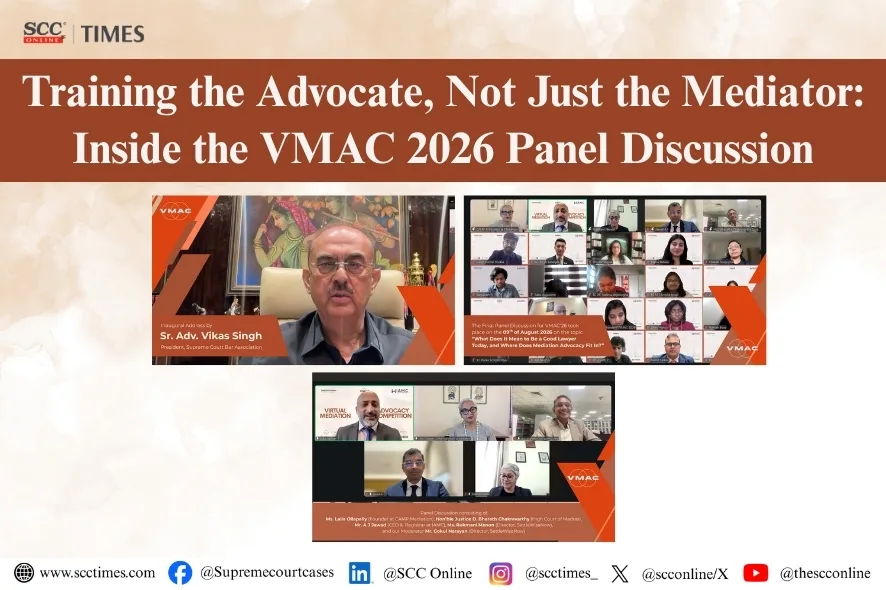
When VMAC 2026 drew to a close on August 9, 2026, it did so not with a simple prize ceremony but with a conversation that went to the heart of why the competition was built in the first place. Moderated by Mr. Gokul Narayan, Founder and Director of SettleWiseNow, the panel brought together Ms. Laila Ollapally, Founder of CAMP Arbitration and Mediation Practice; the Honourable Mr. Justice D. Bharath Chakravarthy of the Madras High Court; Mr. AJ Jawad, CEO and Registrar of IAMC Hyderabad; and Ms. Rukmani Menon, Director of SettleWiseNow. Four voices on the panel, with Mr. Gokul Narayan guiding the conversation as moderator, and a single shared concern between them: mediation advocacy is a distinct skill, and the profession has never really been taught it.
The proceedings had opened with an inaugural address by Mr. Vikas Singh, Senior Advocate and President of the Supreme Court Bar Association, who spoke of advocacy as an art that begins with understanding a client’s problem as one’s own, and of the honesty and credibility that endure across a lawyer’s career. It was a theme the panel would return to again and again.
A question nobody was asking
Conceptualised and organised by SettleWiseNow and co-hosted by IAMC Hyderabad, the competition had, from its very first training session, been built around a single conviction, which the panel served to give voice to.
Mr. Gokul Narayan opened the discussion by identifying the gap that gave VMAC its raison d’être. Every mediation course he had ever encountered, was built around one question: How do you become a better mediator? Almost no one was asking the accompanying complementary companion question, how do you become a better mediation advocate inside a mediation. The legal profession, he argued, had quietly decided the two were unrelated.
“How do you become a better mediation advocate inside a mediation? Somewhere along the way, the profession decided that those two questions were entirely different. I believe they are not.”
Lawyers, he noted, are trained on a single model: conflict is meant to be resolved by another, through argument, through positioning, through winning. That model has produced extraordinary litigators, but it has also produced practitioners who walk into a room built for collaboration and bring a litigation instinct that there is no outlet for. Good mediation advocates who do exist, he said, rarely credit their training for it.
“We currently produce good mediation advocates by chance, by accident, relying on natural talent to do work that was deliberately meant to be done by training.”
That single sentence is, in many ways, the hypothesis of VMAC itself. The competition was designed to turn that accident into a discipline.
Laila Ollapally: the six qualities of a mediation advocate
Ms. Laila Ollapally, who helped build sow the seeds of modern mediation in India when few believed there was a field to build, offered the panel its most concrete framework: six qualities that mark out a strong mediation advocate. She began with the mental posture the role demands, the ability to hold two opposing scripts in mind at once and switch between them on purpose, without ever losing one’s fidelity and commitment to the client. She named this first quality cognitive flexibility, mental agility, and intellectual humility.
Her remaining points built on that foundation. She noted that a good advocate comes into mediation with a spirit of education, ready to bring the mediator up to speed on the facts, the law, and the emotions, and to prepare the parties for a process that is unfamiliar to them. Third, they communicate differently from how they would ordinarily in court.
“They do not poison the well that both parties are supposed to drink from. They are polite. Respectful. Persuasive. But not aggressive.”
Fourth, they handle the law differently, explaining precisely how it favours their client without putting the other side down, treating law as a reference point rather than a weapon, negotiating, as she put it, under the shadow of the law. Fifth, that they are genuine negotiators who know how to create value and claim value and arrive at creative solutions. And sixth, that they know how to borrow the mediator’s powers and control of the process when they need to, to steady an emotional client or have a candid conversation. Taken together, these six qualities still describe a lawyer who continues to be a fearless advocate, but now also a negotiation coach, a risk manager, and a dealmaker.
Justice Bharath Chakravarthy: from warrior to guide
The Honourable Mr. Justice D. Bharath Chakravarthy, an accredited mediator and trainer long before his elevation to the bench, framed the change as one of role and attitude. In traditional litigation, he observed, the lawyer leads from the front as a warrior with a sword, sometimes so far ahead that the client is left behind entirely. Mediation asks for the opposite.
“In a mediation, you are supposed to step back, handhold the client through the process, sometimes going back also without pushing him, but gently nudging him forward when it is necessary.”
What was once regarded as a lawyer’s moral high ground, advising a client in their genuine best interest, has, he said, now become a professional necessity, one that can only be met through deliberate cultural change and continued education of exactly the kind he believes VMAC has set out to provide.
Later, when asked whether the Mediation Act 2023 would force a genuine paradigm shift, Justice Chakravarthy was disarmingly candid: he had opposed the legislation during its consultation stage, likening the attempt to legislate mediation to putting a genie inside a bottle, and that he continues to hold the same view to this day. The Act usefully gives pre-litigation mediation a visible structure, he acknowledged, but he doubted a statute alone could change how lawyers practise. Recalling the long line of provisions before it, from Sections 89 of the Civil Procedure Code to mandatory pre-litigation mediation under the Commercial Courts Act, each reduced to a mere procedural hurdle, far too often, he located the real work elsewhere.
“We have to create a mediating culture in the legal profession, and we should see the Mediation Act only reflecting that culture.”
That culture, he suggested, can begin with something as simple as a notice offering to negotiate before litigation, sent without dressing up the allegations. Returning to the theme in a later question on hybrid processes such as Med-Arb, he distilled the advocate’s task in the mediation phase with characteristic economy.
“I do not prepare him to convince the mediator, I prepare him to get the best out of the opponent.”
AJ Jawad: from problem-inflamers to problem-solvers
Mr. AJ Jawad turned the lens on the profession’s own habits. Legal education, he argued, taught his generation the law but not lawyering itself, and left them to absorb advocacy from whichever senior they happened to join. The instinct that resulted was to take a client’s situation and stretch it to fit the requirements of a courtroom claim, hardening every dispute in the process. He captured the effect with a memorable image: a client walks in thinking the other side is a rascal and walks out convinced he is a bloody rascal, and that hardening, he said, is manufactured first in the lawyer’s office.
Underlying this, he suggested, is a victim-oppressor binary that lawyers reinforce rather than dissolve, with each side cast as wholly wronged and the other wholly to blame. The result is a system that inflames conflict instead of resolving it. His prescription was blunt.
“It is time that we shift the paradigm from being problem-inflamers to becoming problem-solvers for our clients.”
The alternative, he argued, is to think less like a litigator and more like a good physician. A surgeon who loves to operate will reach for the scalpel at every turn; the better instinct is to heal the dispute without putting the parties through the surgery at all. That, he said, is precisely the focus mediation advocacy gives the lawyers of tomorrow.
Rukmani Menon: unlearning the habit of winning
Ms. Rukmani Menon spoke as a litigator who came to mediation later, introduced to the field by Ms. Ollapally in 2012, and who had to unlearn a great deal to do it. In court, she admitted, the foremost thought is always to win, at the cost of putting the other side down, and over a lengthy career that instinct curdles into ego, a tally of victories recited more for the lawyer’s benefit than the client’s. It was only once she began to mediate, she said, that she realised just how completely she needed to approach things differently.
That shift changed how she advised her clients. Rather than reaching automatically for litigation, she began walking them through their options, whether to go to court, to arbitrate, or to settle early on their own terms, and letting them take an informed decision. Mediation, she was clear, cannot be forced on anyone; some clients need to experience the courts before they are ready to consider anything else, and part of a good lawyer’s skill is knowing when, and for what kind of matter, to steer a client towards it. Left unaddressed, she noted, the courts will stay clogged with disputes that need never have been there, crowding out the constitutional and interpretive legal questions that genuinely require a judge.
She also made a point that is often easily overlooked: skilled mediation advocates are not just good for their clients, they are a genuine help to the mediator as well. She recalled once almost returning a labour dispute that lay outside her subject expertise, until the senior counsel on one side explained the matter, along with the assistance of the opposing counsel, explained the basics with such clarity, allowing her to grasp the key principles, allowing the mediation to progress and eventually succeed. Good advocates, she said, keep a mediation from being derailed and, in specialised matters, supply the knowledge a mediator may not have. Her final point looked outward: most disputants know only court-annexed mediation, so it falls to lawyers to make their clients aware about private mediation and where they can choose their institution and their mediator. Far from being adversaries of the process, well-trained advocates are what allow it to work.
The gap VMAC set out to close
Asked what the biggest gap is between what law schools produce and what the profession now needs, Ms. Ollapally answered with a story. After she had helped resolve an intellectual property dispute that had left four young scientists harassed and one driven from the country, the senior side’s own lawyer sat looking downcast. His clients were relieved and grateful; he was not. What, he asked about the same, he spoke about his five years of legal training, his visibility in court, his revenue stream, and where, most importantly for him – in a settlement, was the justice he had been trained to pursue? For Ms. Ollapally, his reaction was an identity crisis that revealed the mismatch precisely: an entire training system builds a lawyer’s identity around winning and visibility, while the profession increasingly needs something else.
Pressed on what a law school should actually produce at the end of five years, Ms. Ollapally called for the comprehensive conflict professional, a lawyer able to move seamlessly between litigation, arbitration, and mediation, and to shift the underlying question from how do I win the case to what best serves my client’s interests. Mediation advocacy, she argued, is not a niche elective but the connective tissue of that training.
“Mediation Advocacy is the bridge, and it should be taught in every subject, a thread that goes right through the five years.”
The panel was unsparing about how far legal education still is from that vision. Mr. Gokul Narayan pointed to the arithmetic: of roughly 3,600 hours of classroom session a typical law student sits through over five years, barely ten are given to the whole of the mediation system, a stepchildly treatment he called abysmal. Yet Mr. AJ Jawad found reason for optimism in the students themselves. He stressed that the quality he sees when he coaches participants in mediation and negotiation competitions, he said, often puts his own generation to shame, and he sees real hope in younger litigants and lawyers who have little patience for manufactured complexity and simply want their problems solved. His frustration was reserved for a system that trains such talent and then tells it to wait a decade before it is allowed to mediate.
This is the gap VMAC was built to close, and the panel’s four perspectives mapped almost exactly onto the competition the students had just completed. Over three preliminary rounds and three knockout rounds, VMAC 2026 asked its participants to attempt to successfully do everything the panel described: to hold two perspectives at once, to educate rather than argue, to treat the law as a reference point, to negotiate value, and to guide a client through a process rather than march ahead of them. The 42 teams did not learn these instincts by accident. They were trained in them, across four dedicated training sessions and six rounds designed to simulate the real work of a mediation advocate.
That is what makes the panel discussion more than a fitting close to the competition. It was a statement of purpose. Mediation advocacy, as Justice Hrishikesh Roy would go on to note in his valedictory address, is a very specialised skill set that the profession has too often overlooked. VMAC 2026 was an argument that it need not stay that way, and that the next generation of lawyers can be taught, deliberately and from the start, to be problem-solvers rather than problem-inflamers.
It is, as the organisers have put it, the beginning of a movement, and one they intend to make much larger.