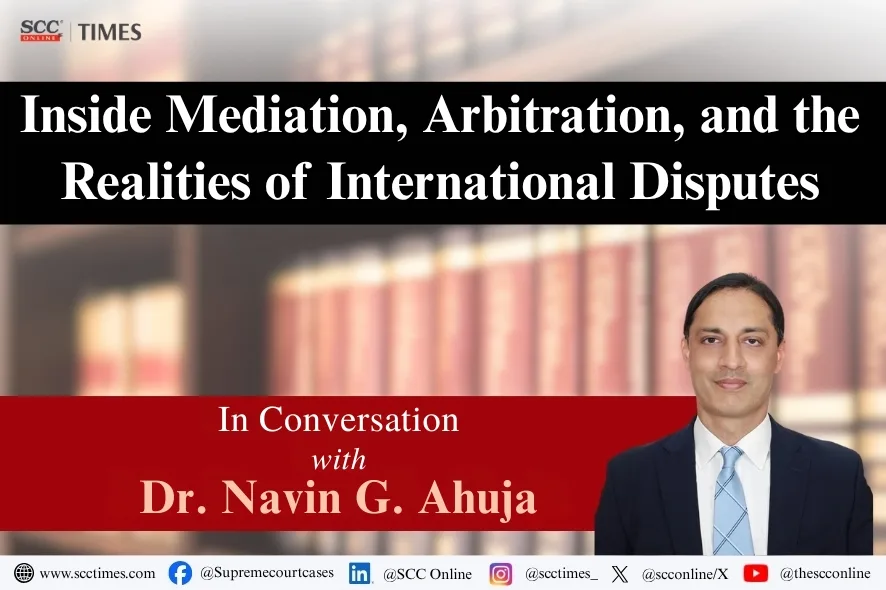
1. Kindly introduce yourself to our readers.
I’m a mediator, arbitrator, and ADR trainer, with nearly two decades of expertise in international sale of goods before transitioning into law. That background gave me a specialist understanding of business dynamics, which I now passionately channel into dispute resolution. I hold a law degree, a Master’s in Alternative Dispute resolution (ADR), and a Doctorate focused on guerrilla tactics in international commercial arbitration.
Currently, I serve as a Visiting Professor of Law at Guangxi University. Additionally, I represent the Asian Institute of Alternative Dispute Resolution (AIADR) as their special representative to Singapore and am also the Director of Mooting and ADR competitions at Damodaram Sanjivayya National Law University (DSNLU) in Visakhapatnam. Also, as Co-President of the Moot Alumni Association (MAA), I help promote the Vis Moot and Vis East to educate others on international arbitration and trade law as well as to strengthen connections among participants and create a global network. I love what I do, and while I have a busy schedule, I’m always open to exciting new opportunities!
2. You have spent nearly two decades in the international sale of goods and manufacturing sector. What made you move from being embedded in disputes to resolving them?
It was definitely an unconventional path. While some lawyers switch to artistic ventures, like opening a bakery or photography, my journey took a different turn. In my first career, I travelled extensively, meeting watchmakers and designing products. We manufactured watchstraps, primarily importing leather from Italy and stainless steel from Japan, with most of the production taking place in China and some in India and Europe.
That experience gave me deep insights from both the seller’s and buyer’s perspectives, and I discovered I had a knack for understanding how people interpret situations differently. I was able to appreciate all viewpoints, which naturally led me to want to help resolve disputes. After achieving and even surpassing my goals in that industry, I felt ready for a new challenge. Law offered me the opportunity to use those skills in dispute resolution while pursuing my passion for helping people.
3. You operate as both a mediator and an arbitrator. When you step into a room, how does your mindset navigate between the two roles?
In mediation, I focus on facilitative techniques; asking key questions that encourage parties to communicate, listen, and understand each other. The aim is to help them reach an agreement that truly works for both sides, rather than just splitting the difference and calling it a day.
I often use the classic “orange” example, which is well-known in negotiation skills literature: Getting to Yes. One child needs the peel for an art project, the other wants the juice. By exploring their needs, they find a solution beyond a simple 50-50 split.
As an arbitrator, my role shifts entirely. Instead of guiding dialogue, I listen to submissions, legal arguments, and authorities, then make a decisive ruling. The two are distinct. Mediation is all about collaboration; arbitration is about judgment.
4. In your book Taming the Guerrilla in International Commercial Arbitration: Levelling the Playing Field, you deal with disruptive tactics. Do you think these tactics are becoming more sophisticated today or simply more normalised?
Yes, absolutely, they are. My book analyses guerrilla tactics — disruptive, dilatory, and “dirty tricks” — and specifically explores why parties resort to them. The final chapter, written during the COVID-19 Pandemic, addresses online guerrilla tactics that emerged with virtual hearings. As virtual hearings became the norm, we faced new challenges, and yes, these tactics have indeed become more sophisticated. While one might argue that employing an experienced arbitrator is a straightforward solution, it raises further questions: How much can an experienced arbitrator handle? And how do we ensure diversity and inclusion in this context?
Practitioners’ reactions to my manuscript were telling: Some felt the tactics were too dangerous to publicise, while others admitted they use them daily. This range of perspectives shows how normalised such behaviour has become, even as it grows more sophisticated.
5. In commercial mediation, especially in international disputes, how do you deal with unequal bargaining power between parties? Can mediation truly remain neutral in such situations?
Unequal bargaining power is a reality, especially in international disputes. Mediators have tools to level the playing field, such as reality testing and exploring alternatives to a negotiated agreement. Training in the psychological aspects of mediation is invaluable here.
After becoming an accredited mediator, I furthered my training with an advanced mediation masterclass that focused on the deeper psychological elements at play in these scenarios. One vital aspect is reminding the parties why they chose mediation over litigation or arbitration, and what could happen if they do not reach an agreement.
Neutrality is non-negotiable in mediation. When a party feels overwhelmed during the process, they can absolutely consult or bring in a lawyer to help them navigate the situation. In any event, mediators facilitate the process through techniques like reality testing, encouraging parties to assess whether their positions or agreements are feasible. This approach ensures that both sides remain actively engaged while the mediator maintains independence and impartiality. It truly is a “Win-Win”.
6. You have trained aspiring mediators from different professional backgrounds. What separates someone who is technically trained from someone who is actually effective in a mediation room?
Technical training provides structure, but effectiveness requires empathy, communication, and judgment. A mediator with instincts but no training risks missteps that could derail the process or damage relationships. Conversely, training without empathy can feel mechanical.
The best mediators combine natural skills with rigorous training, enabling them to navigate complex emotions and power imbalances. Importantly, mediation is not only about reaching settlement. Sometimes, the best outcome is for them not to settle, as long as they follow the process. Interestingly, while approximately 80 per cent of mediations do result in a settlement, many times the most valuable outcome is that parties feel heard and respected, even if they do not reach an agreement.
7. You work across areas such as data privacy, intellectual property, and licensing. Would you say that these newer disputes are more difficult to mediate? If so, is it because of technical complexity or because parties are less willing to compromise?
At first glance, they can appear more complex, but in reality, the mediation process itself remains the same. Transparency about your background is crucial, and mediators must be comfortable with industry jargon to avoid delays or frustration. Disclosing your specialisation is essential, even though your role is not to provide advice or solutions.
Often, the real challenge is not technical complexity but parties’ reluctance to compromise. Negotiations rarely start with a spirit of give-and-take; instead, it often feels like a battle of wills, which makes the mediator’s skill in fostering dialogue and bridging gaps even more critical.
8. You describe yourself as a facilitative mediator. Have there been situations where you felt a more evaluative or interventionist approach was necessary?
Yes, there are times when parties resist listening or remain entrenched on their position. What is fascinating is that sometimes, as a mediator, you can see the solution clearly, but it is essential to hold back. This is not just about your first impression; it is about allowing the parties to discover what they truly want. It is tempting to step in with solutions, but my role is to guide them through, among other things, questions that help uncover deeper interests.
Often, parties discover that their initial positions shift once they articulate their true needs. That is why I prioritise questioning — it empowers them to reach clarity on their own terms.
9. As an empanelled arbitrator and tribunal secretary, what is one structural issue in arbitration today that practitioners openly acknowledge but rarely address?
Guerrilla tactics. There are concerns that certain behaviours may undermine the integrity of arbitration, yet the profession understandably tends to approach these issues with caution, as it is a delicate and complex area. My doctoral work and book were driven by this gap.
Hearing Gary Born’s remark at a Young Singapore International Arbitration Centre (YSIAC) seminar that “we still lack a concrete solution” crystallised my focus. Guerrilla tactics can undermine the integrity of arbitration, and while they’re widely recognised, the conversation around them often stops short of finding real solutions. By shining a light on this topic and tactics, I hope to encourage more open dialogue and practical solutions within the arbitration landscape.
10. What is one word of advice you would give law students and young lawyers interested in the field?
Prioritise people skills. Passion and education matter, but excellent communication and relationships are key to opportunity. Early in my career, I assumed credentials alone would attract opportunities. They did not.
Success requires initiative — networking, reaching out, and showing genuine enthusiasm. You need to actively communicate who you are and why you are passionate about your work. In this field, it is not just about what you know; it is about how you connect.
1. FCIArb, FAIADR.
2. EBC-SCC Online Student Ambassador, Damodaram Sanjivayya National Law University.