


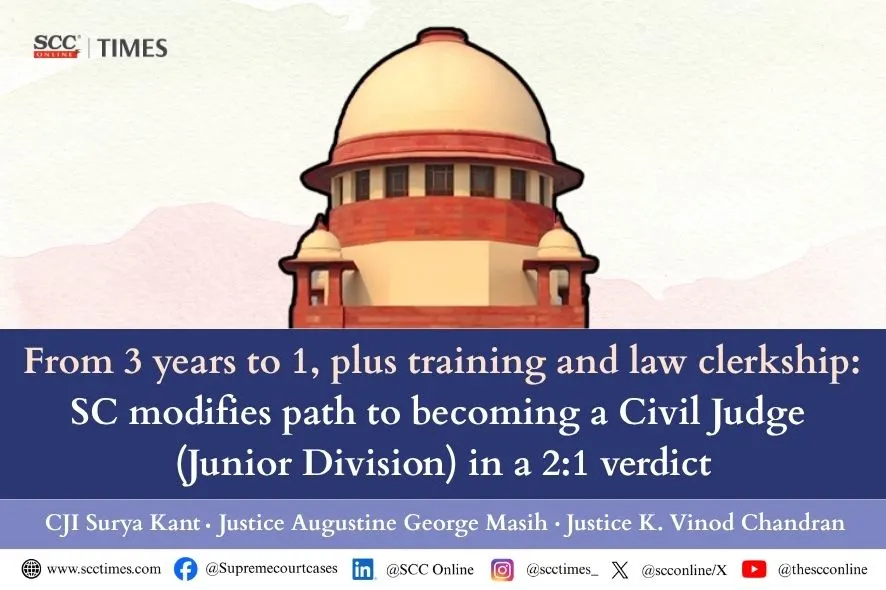
Supreme Court: In a batch of matters concerning the eligibility requirement of prior practice at the Bar for appointment to the post of Civil Judge (Junior Division), a three-Judge Bench of Surya Kant CJ, Augustine George Masih and K. Vinod Chandran, JJ., in a 2:1 verdict reconsidered the directions issued in its judgment dated 20 May 2025 restoring the requirement of 3 years’ practice at the Bar. The Court, while upholding the underlying need for prior exposure to the working of courts, held that the requirement had to be implemented in a manner which was fair to fresh and recent law graduates and did not unnecessarily narrow the field of candidates available to the subordinate judiciary.
Holding that 3 years’ conventional practice at the Bar was not the sole means of securing meaningful courtroom experience, the Court modified the judgment under review and devised a transitional regime permitting all law graduates to apply until 31 March 2027, followed by 1 year of intensive training at the State Judicial Academy and 1 year of structured Law Clerkship. For recruitments from 1 April 2027, the Court prescribed 1 year of actual practice before appearing for the examination, while retaining the requirement of 1 year of institutional training and 1 year of Law Clerkship after selection. The Court also directed that the scheme would remain in force for 5 years and thereafter be placed before the Court for review on the basis of empirical material concerning its efficacy.
Background
The present batch of matters arises from the judgment dated 20 May 2025 passed by the Supreme Court in IA Nos. 93974 of 2019; 72900, 73015 and 40695 of 2021; and 50269 and 201893 of 2022 in WP (C) No. 1022 of 1989, whereby this Court directed that a minimum of 3 years’ practice at the Bar be prescribed as an eligibility criterion for appointment to the post of Civil Judge (Junior Division).
In addition, IA Nos. 336090 and 336091 of 2025 in WP (C) No. 1022 of 1989 seek a direction that the period spent in pursuing higher education in law be counted towards the 3-year practice requirement.
The Second AIJA Case (1993): Introduction of the 3-Year Practice Requirement
In the Second AIJA Case, this Court considered whether a minimum period of practice at the Bar ought to be prescribed as an eligibility requirement for appointment to the post of Civil Judge (Junior Division). Noticing that the qualifications and recruitment procedures for judicial officers at the lowest rung were not uniform across States, and that while most States prescribed 3 years’ practice as a lawyer, some permitted fresh law graduates to enter the judicial service, the Court examined the matter in the light of the constitutional scheme. It noted that 7 years’ practice was prescribed for appointment as a District Judge under Article 233(2), while Articles 217(2)(b) and 124(3)(b) contemplated 10 years’ practice as an advocate for appointment as a Judge of the High Court and this Court respectively. The Court observed that if experience at the Bar was indispensable at these levels, it could not be dispensed with at the level where adjudication first begins. Accordingly, it directed all States to prescribe 3 years’ practice as a lawyer as an essential qualification for recruitment at the lowest rung of the judicial service, with the object of securing competent, independent and honest judicial officers and strengthening the administration of justice and public confidence therein.
The Shetty Commission and the Third AIJA Case (2002): The Requirement Of 3-Year Practice Is Undone
The Shetty Commission, constituted in 1996, examined, inter alia, the qualifications for entry into the judicial service and, in its report dated 11 November 1999, recommended that the requirement of 3 years’ practice at the Bar be done away with. The Commission noted the significant evolution in legal education since the Law Commission’s Fourteenth Report of 1958, particularly the introduction of the 3-year LLB course and integrated 5-year courses incorporating practical legal training. It further observed that insisting upon 3 years’ practice as a precondition for judicial service was defeating the very purpose of enriching the Bar, and that intensive induction training could obviate the necessity of prior practice. The Law Commission, in its 117th Report, had similarly recommended that fresh law graduates be permitted to enter the judicial service, subject to intensive training.
These recommendations were considered by this Court in the Third AIJA Case, decided on 21 March 2002. While noting that the 3-year standing at the Bar had been prescribed pursuant to the Second AIJA Case, this Court accepted the recommendation of the Shetty Commission and held that the mandatory 3 year requirement was not attracting the most qualified candidates to the judicial service. Consequently, the requirement was reversed. The High Courts and State Governments thereafter amended their respective rules, permitting fresh law graduates to enter the judicial service without prior Bar experience. At the same time, this Court emphasised the importance of adequate training, recommending a training period of not less than 1 year and, preferably, 2 years, to equip such recruits for the discharge of their judicial responsibilities.
The Judgment Under Review (2025): The Requirement Is Restored
In 2023, the Court once again examined the eligibility requirements for entry into the judicial service and, after calling for responses from all High Courts and State Governments, reconsidered whether the requirement prescribed in the Second AIJA Case ought to be restored. The Court noted that, following the Third AIJA Case, fresh law graduates, “who may not even have a single day’s experience in practice as a lawyer”, had become eligible to enter the judicial service. A broad consensus emerged amongst most High Courts that a minimum of 3 years’ experience at the Bar needed to be restored, as candidates appointed directly from college were found to lack familiarity with Court procedure, Court decorum and the atmosphere of Court proceedings, and took time to acquaint themselves with the functioning of courts.
The Court found that, during the 20 years in which fresh law graduates had been permitted to enter the judicial service, “the said endeavour has not been a successful experience”. It observed that academic brilliance, by itself, was no answer to the difficulties faced by judicial officers without exposure to the Court environment, and that such candidates were not steeped into the “culture, etiquette, temper and conduct of the court proceedings”. The Court further held that exposure to courts, litigants and briefs would acquaint a candidate with the onerous duties and responsibilities of stakeholders in the judicial system, foster sensitivity to human problems, bring greater clarity to the decision-making process and educate the candidate as to the role of the Bar in the dispensation of justice.
Reiterating the rationale underlying the Second AIJA Case, the Court observed that Judges, from the very day they assumed office, had to deal with questions of life, liberty, property and reputation of litigants. Neither knowledge derived from books nor pre-service training, in the Court’s view, could be an adequate substitute for the first-hand experience of the working of the court system, which could be acquired by assisting seniors and observing how lawyers and Judges functioned. Accordingly, concurring with the views expressed by most High Courts, the Court held that reintroduction of a certain number of years of practice was necessary and, by judgment dated 20 May 2025, issued 10 directions, including the direction relevant to the present controversy prescribing the requisite period of practice at the Bar for entry into the judicial service.
The Court further clarified that all recruitment processes kept in abeyance on account of the pendency of the proceedings would proceed in accordance with the rules applicable on the date of the advertisement or notification.
Also Read: Supreme Court Restores 3-Year Legal Practice Requirement for Civil Judge Eligibility | SCC Times
Present Proceedings
The present petitions arose principally against Directions (vii) and (viii) of the judgment dated 20 May 2025, which restored 3 years’ practice at the Bar as an eligibility requirement for appointment as Civil Judge (Junior Division). The proceedings originated in WP (C) No. 1110 of 2025 filed by Bhumika Trust, representing several 100 persons with disabilities, seeking dispensation of the requirement for the candidates represented by it. On 15 January 2026, the Court prima facie observed that the eligibility condition ought to be uniform across candidates and, before taking a holistic view, sought the views of all High Courts, Law Universities and National Law Schools. In the meantime, review petitions were filed against the judgment under review and, by order dated 10 February 2026, were tagged with the writ petition. Considering the pending challenge to the 3-year practice requirement, the Court extended the application deadlines for existing recruitments up to 30 April 2026 and directed that fresh advertisements carry a cut-off date after 30 April 2026, by order dated 22 May 2026, the interim arrangement was continued until further orders.
Majority reasoning: Why 3 years became 1
The majority, having given its anxious consideration to the submissions advanced before it, the material placed on record by the High Courts, Law Universities/National Law Universities and the learned Amicus Curiae, was not persuaded to reconsider the fundamental question whether some prior exposure to the working of courts was desirable for a person seeking entry into the judicial service. It held that the reasons which had weighed with the Court in restoring the requirement retained considerable force. A Civil Judge was required, from the very first day of service, to deal with questions affecting the life, liberty, property and personal rights of litigants. Exposure to the atmosphere of the Court, including by assisting seniors and observing the manner in which lawyers and Judges functioned, was therefore of considerable value. Such exposure could contribute to the development of judicial temperament, patience, empathy, courtroom discipline and an appreciation of the respective roles of the Bench and the Bar.
The majority, however, found that the more precise question was whether such exposure necessarily required 3 years of conventional practice at the Bar and whether the same ought to be made a condition precedent even to appearing for the examination. It held that the requirement of experience must bear a reasonable relationship with the object which it sought to achieve. The passage of time at the Bar, though a meaningful component, might not be the sole factor behind meaningful courtroom experience. The quality of practice could depend upon the nature of the chamber, the Court in which the advocate practised, opportunities for appearance, availability of a mentor and, in many cases, the financial circumstances of the candidate.
“…there is considerable merit in the proposition that a person who is to assume judicial office ought not to be wholly unfamiliar with the functioning of courts and the practical consequences of judicial orders. Such exposure may contribute to the development of judicial temperament, patience, empathy, courtroom discipline and an appreciation of the respective roles of the Bench and the Bar. We see no reason, in this review jurisdiction, to displace that finding.”
The majority also took note of the immediate and significant effect of the restoration of the requirement upon a generation of law graduates who had pursued their education and prepared themselves for judicial service when fresh graduates were eligible to compete. For more than 2 decades, following the Third AIJA Case, fresh law graduates had been permitted to enter the judicial service without any prescribed period of prior practice. The judgment under review had altered that position by restoring 3 years of practice as a condition even for appearing in the examination. The Court was particularly mindful of candidates who had already completed, or were in the process of completing, their legal education when the change was brought about, observing that their future had been severely affected by the change in status quo.
The majority further observed that the burden of transition was not distributed evenly. Young advocates without established professional networks or financial support could find it difficult to sustain themselves during the initial years of practice. Women candidates could face additional social and familial constraints, while persons with disabilities could face difficulties in obtaining meaningful opportunities for practice at the Bar. However, the Court did not consider it necessary to create separate eligibility regimes for different categories, and noted the need to avoid fragmented standards for entry into judicial service.
Importantly, the majority held that 3 years of practice at the Bar alone did not ensure the familiarity with the working of courts which the requirement sought to secure. Practical experience and judicial competence continued to develop even after a person joined the judicial service. The Court therefore took note of the substantial evolution of the institutional framework for judicial training, with Judicial Academies now providing an opportunity to impart, in a structured and supervised manner, the very skills which a young advocate might otherwise acquire unevenly at the Bar. The suggestions received from the High Courts also pointed towards the importance of combining practical exposure with robust institutional training.
The majority found this approach consistent with the Third AIJA Case, wherein, while dispensing with the 3-year requirement, it had recommended that fresh law graduates undergo training for not less than 1 year and, preferably, 2 years. The majority also attached significance to the judgment under review itself having recognised that experience gained as a Law Clerk with any Judge or judicial officer could be counted towards the prescribed period. Such experience, could provide an understanding of crucial court processes and the functioning of the Court directly relevant to future judicial office.
The majority accordingly clarified that the present exercise was not to be understood as questioning the wisdom of prescribing 3 years of practice, nor as holding that the requirement was inherently unreasonable. The intervention was narrower and was directed to its enforcement and implementation. The majority held that the rule ought to be implemented in a manner which was fair to those affected by its sudden restoration, gave sufficient time for the legal and professional ecosystem to adjust to the new requirement, and did not unnecessarily narrow the field from which the subordinate judiciary could draw its future members. The object of an eligibility rule was to secure suitable candidates for judicial office and not, by the manner of its implementation, to exclude candidates whom the judicial system would otherwise benefit from attracting.
In these circumstances, the majority held that a limited intervention was warranted. The immediate object was threefold:
-
to minimise the hardship caused to fresh and recent law graduates;
-
to provide a structured and workable mechanism for implementation of the requirement without uncertainty or artificial exclusion, and
-
to ensure that the judicial service continued to attract meritorious young persons who might otherwise be lost to other branches of the legal profession or public service.
The majority therefore considered a transitional arrangement necessary. It observed that more than a year had elapsed since the judgment under review, during which candidates had remained uncertain about their eligibility and recruitment processes had been affected by the pendency of the proceedings. As a one-time measure, the majority held that experience gained during the preceding year through practice at the Bar, service as Law Clerks to Judges, or experience in law firms could reasonably be treated at par with 1 year of practice at the Bar.
The majority further held that experience and training were not mutually exclusive and could be complementary. Candidates permitted to enter the selection process during the transitional period would therefore not be placed in the field immediately upon selection. They would initially be appointed as trainee judicial officers and would be required to undergo structured institutional and practical training before being entrusted with independent judicial functions.
A period of 1 year of structured training at the State Judicial Academy was considered sufficient for this purpose. The majority held that such training would provide a common foundation to candidates irrespective of their experience at the Bar and enable the State Judicial Academies to assess them not merely on legal knowledge but also on the practical skills required of a Judge. This period was to be treated as equivalent to 1 year of practice at the Bar for purposes of satisfying the 3-year requirement.
The institutional training was to be followed by a further 1 year of structured Law Clerkship, first under the supervision of a Principal District/District and Sessions Judge or a Member of the Higher Judicial Services and thereafter under a sitting Judge of the High Court concerned. This period was also to be treated as equivalent to 1 year of practice at the Bar. The majority noted that such supervised Law Clerkship would expose the trainee to court proceedings, courtroom decorum, preparation and analysis of cases, evaluation of submissions, application of procedural law and the discipline involved in preparing judicial orders.
Finally, the majority emphasised that the conclusion of the training and Law Clerkship had to be followed by an objective and reasoned evaluation of the candidate’s conduct, diligence, analytical ability, understanding of procedure, capacity to deal with cases, quality of legal reasoning and suitability for judicial office. Such evaluation, however, was not to become an additional or undefined barrier to appointment. Subject to satisfactory evaluation, the trainee was thereafter to enter regular judicial service with the status and remuneration attached to the post.
As regards IA Nos. 336090 and 336091 of 2025, seeking inclusion of the period spent pursuing higher legal education towards the minimum practice requirement, the majority held that the applications warranted rejection, since higher legal education did not, in its view, answer the object of fostering familiarity with and a comprehensive understanding of the functioning of judicial systems.
Justice Chandran’s Dissent
Justice K. Vinod Chandran dissented, holding that no ground existed for review. He reasoned that the three-year requirement had been restored by a three-Judge Bench pursuant to a continuing mandamus first issued in the earlier All India Judges’ Association cases, and that a coordinate Bench could not now dilute that requirement through a structured training regime. He was unpersuaded that a two-year post-selection training programme, under which recruits would receive only half pay and no service credit, offered a workable substitute for practical experience at the Bar, noting that it would leave courts unmanned during the training period and create two classes of recruits from the same selection process depending on their prior practice. He observed that “the forensic and analytical skills of an adjudicator are better learnt in the profession by observing what happens in the Courts,” and that a lawyer’s mistake can be corrected by a senior or an experienced judge, whereas “a Presiding Officer’s mistake puts to peril a litigant.” Accordingly, he would have dismissed the review petitions in their entirety.
Decision
Allowing the review petitions in part, the majority modified the judgment under review and put in place a transitional as well as a post-transitional framework for recruitment to the post of Civil Judge (Junior Division):
-
Transitional period (advertisements issued after the Judgment under Review and up to 31 March 2027):
-
All law graduates were held eligible to apply notwithstanding the 3-year practice requirement. For the purposes of their applications, they were deemed to have completed 1 year of active practice and were not required to furnish a separate Certificate of Practice for such deemed period.
-
Selected candidates were to be designated as “Trainee Judicial Officers” and undergo 1 year of intensive training at the State Judicial Academy concerned. This period was to be treated as equivalent to 1 year of practice at the Bar.
-
During such training, trainees were to receive one-half of the remuneration payable to a Judicial Magistrate First Class, along with the facilities and other benefits ordinarily available to trainees at the State Judicial Academy concerned.
-
The training was to be followed by 1 year of structured Law Clerkship — 6 months under the Principal District/District and Sessions Judge or a Member of the Higher Judicial Services and 6 months under a sitting Judge of the High Court concerned. This period was also to be treated as equivalent to 1 year of practice at the Bar.
-
Upon completion of the Law Clerkship, the supervising High Court Judge was to furnish a reasoned evaluation report regarding the trainee’s performance and suitability. Subject to satisfactory evaluation, the trainee was to be appointed to the regular post and become entitled to the regular pay scale and other service benefits.
-
-
Post-transitional period (advertisements issued on or after 1 April 2027):
-
A candidate seeking to appear for the Civil Judge (Junior Division) examination was required to possess at least 1 year of actual practice.
-
Such practice was to be verified through a Certificate of Practice, issued in accordance with a mechanism to be prescribed by the High Courts, recording the candidate’s presence and participation in effective judicial proceedings.
-
Applications were to be entertained only upon submission of the requisite certificate evidencing 1 year of actual practice in the District Courts.
-
Candidates selected pursuant thereto were nevertheless required to undergo 1 year of intensive training at the State Judicial Academy, followed by 6 months’ Law Clerkship under the District Judiciary and 6 months under a sitting Judge of the High Court concerned.
-
-
The Court directed that all recruitment notifications/advertisements, whether already issued after the judgment under review or issued thereafter, would be governed by the aforesaid directions. The State Governments, in consultation with the respective High Courts, were directed to amend and notify the applicable rules within 3 months.
-
The Court further observed that the scheme was not immutable and that its efficacy could be assessed only after it had operated for a reasonable period. Accordingly, the scheme was directed to remain in force for 5 years, after which material concerning the quality of recruitment, efficacy of training and clerkship, performance of officers and other relevant empirical indicators was to be placed before the Court for reconsideration, if necessary.
-
The Court observed that the scheme would adequately address the grievances raised in WP (C) No. 1110 of 2025, including the requirement of appropriate accommodation for persons with disabilities.
-
IA Nos. 336090 and 336091 of 2025 were dismissed. The judgment under review stood modified to the aforesaid extent, and WP (C) No. 1110 of 2025 as well as the review petitions were disposed of in the above terms. Pending interlocutory applications, if any, stood closed and the interim orders stood vacated.
[Bhumika Trust v. Union of India, 2026 SCC OnLine SC 1687, decided on 21-8-2026]
Judgement authored by:
Majority opinion: Chief Justice Surya Kant
Dissent: Justice K. Vinod Chandran
Really insightful and informative. A clear and well explained take on an important legal development.