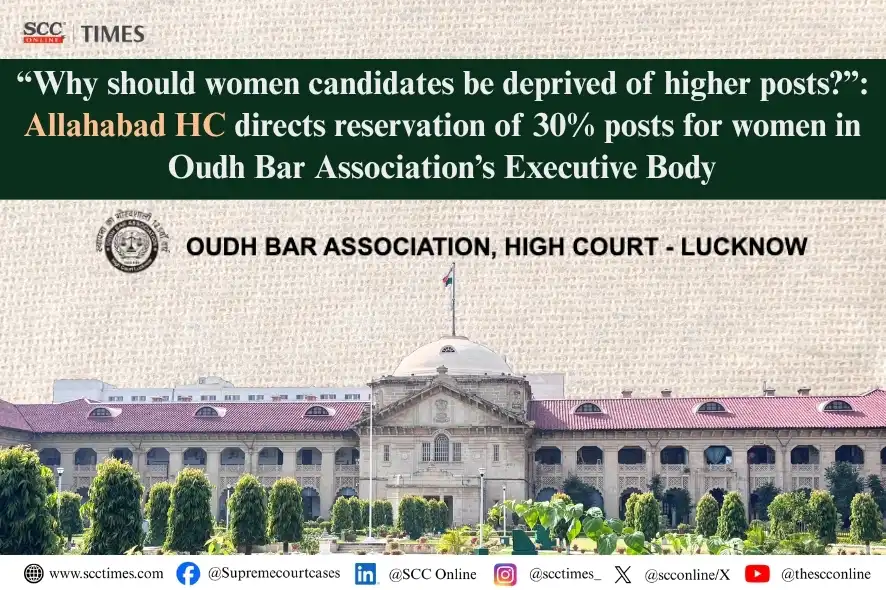
Allahabad High Court: In a set of public interest litigations (PILs) filed seeking 30 per cent reservation for women in the Oudh Bar Association, High Court, Lucknow, the Division Bench of Rajan Roy and Manjive Shukla, JJ., allowed the petitions, holding that the reservation decided by the Association was not adequate and not in tune with the letter and spirit of the Supreme Court’s directions in Deeksha N Amruthesh v. State of Karnataka, 2026 SCC OnLine SC 666. Accordingly, the Court issued directions reserving 30 per cent seats for women candidates in upcoming and future elections to the Oudh Bar Association.
The Court also noted that the General Secretary and President expressed their reservation regarding reservation of posts for women higher than Treasurer, but they could not put forth any such reasoning for such an assertion. Noting this, the Court remarked, “Why should the women candidates be deprived of higher posts? No reason could be put forth in support of this assertion.”
Background
The petitioners filed the present set of PILs seeking direction to the Oudh Bar Association to comply with the Supreme Court’s directions in Deeksha N Amrutesh case for the 30 per cent representation of women advocates in its Executive Committee and Member Governing Council. The petitioner in the first PIL also asked for the Oudh Bar Association to start the representation of 30 per cent seats in its annual general election, particularly the single posts of Secretary, Treasurer, and President be earmarked for women advocate candidates in 2026. Petitioner in the second PIL sought that the post of Treasurer be reserved exclusively for women advocates, and that the top 3 posts be filled by women advocates on a turn-and-rotation basis.
On 26 May 2026, the President and Secretary of the Oudh Bar Association informed the Court that the Oudh Bar Association was bound by the orders of the Supreme Court of 30 per cent reservation to women advocates, but the decision as to which posts should be reserved would be considered by the annual general meeting (AGM) which was scheduled for July 2026. Thereafter, the term of the existing Executive Council of the Oudh Bar Association was extended by a month by the Elders Committee, i.e., till 30 August 2026.
The General Secretary of the Oudh Bar Association informed that in the AGM, a resolution had been passed that 1 post of Treasurer, 3 out of 6 posts of Junior Executive, and 3 out of 6 posts of Senior Executive Body would be reserved for women candidates.
Analysis
Noting the reservation granted by the Oudh Bar Association, the Court held that the same did not ensure adequate representation of women nor was it in tune with the letter and spirit of the orders passed by the Supreme Court in Deeksha N Amrutesh case.
The Court reiterated that in the said case, the Supreme Court issued directions under Article 142 of the Constitution whereby 30 per cent of posts in Executive Body/Governing Council of the Bar Associations had to be reserved for women. These directions are binding on all Bar Associations who were obliged to provide the aforesaid reservation, subject, of course, to any further orders being passed in this regard by the Supreme Court in the aforesaid proceedings pending before it.
The Court also perused orders passed by the Supreme Court in various Interlocutory Applications (IAs) filed in Supreme Court Bar Assn. v. B.D. Kaushik1 regarding reservation of posts in the Governing Body/Council of Supreme Court Bar Association, especially the order dated 8 May 2026.
The Court noted that all Bar Associations are bound by the orders/directions issued by the Supreme Court to provide 30 per cent reservation for women. Additionally, Article 144 enjoins all authorities, civil and judicial, in the territory of India to act in aid of the Supreme Court.
The Court further noted that the outgoing members of the Oudh Bar Association, i.e., the General Secretary and President, whose term had been extended for 1 month, expressed their reservation regarding reservation of posts for women higher than Treasurer, but they could not put forth any such reasoning for such an assertion. Noting this, the Court remarked, “Why should the women candidates be deprived of higher posts? No reason could be put forth in support of this assertion.”
In fact, the Court noted that several senior members of the Bar urged the Bench that adequate representation could be provided to women on various posts in the Executive Council; however, they submitted that the post of President and General Secretary should not be reserved for election this year, i.e., 2026; instead, they can be considered for reservation for the next year and onwards. They also contended that out of 4 posts of Vice President, some could be reserved for women candidates.
Upon perusal of the byelaws of the Oudh Bar Association, the Court took note of the composition of the Executive Council, which is as follows:
-
a President;
-
a Senior Vice President having at least 20 years of regular and active practice;
-
2 Vice Presidents having 10 years of regular and active practice;
-
a Vice President having less than 10 years regular and active practice;
-
a General Secretary;
-
a Treasurer;
-
3 Joint Secretaries;
-
6 Ordinary Members of the Governing Council with more than 15 years of regular and active practice; and
-
6 Ordinary Members with less than 15 years of regular and active practice.
Thus, there were a total of 22 office-bearers of the Executive Council of the Oudh Bar Association, out of which 7 should be reserved for women to abide by the Supreme Court directions. Posts which are less than 3 in number would have to be reserved by applying rotation, to secure adequate representation.
Accordingly, to give effect to the orders passed by the Supreme Court in letter and spirit and to provide reservation of 30 per cent of the posts of Executive Council for women, the Court directed that:
-
2 out of 6 posts of Junior Executive shall be reserved for women in the ensuing elections for 2026, and this reservation shall continue accordingly in the succeeding years.
-
2 out of 6 posts of Senior Executive shall be reserved for women in the ensuing elections for 2026, and this reservation shall continue accordingly in the succeeding years.
-
1 out of 3 posts of Joint Secretary shall be reserved for women in the 2026 elections, and this reservation shall continue accordingly in the succeeding years.
-
The post of Treasurer shall be reserved for women in the ensuing elections of 2026 as already reserved by the Annual General Body, and this post shall again be reserved for women in 2029, then 2032, so on and so forth, by rotation.
-
The post of General Secretary shall be reserved for a woman candidate in the 2027 elections, thereafter, it shall again be reserved for women in 2030, 2033, and so on and so forth, by rotation.
-
The post of Vice President having below 10 years of regular and active practice shall be reserved for a woman candidate in the elections to be held in 2028, and thereafter, it shall again be reserved for women in 2031, 2034, and so on and so forth, by rotation.
-
Out of 2 posts of Vice President having 10 years of regular and active practice, 1 shall be reserved for women in the 2027 elections, which shall again be reserved for a woman candidate in 2030, 2033, and so on and so forth, by rotation.
-
The post of Senior Vice President, having 20 years of regular and active practice, shall be reserved for a woman candidate in the 2026 elections to be held this year, i.e., 2026, and thereafter it shall be reserved for women in 2029, 2032, and continue to be reserved accordingly, by rotation.
-
The post of President shall be reserved for women in the 2028 elections, and thereafter, it shall again be reserved for women in 2031, 2034, and shall continue to be reserved, by rotation.
The Court clarified that it had applied the rotation system on some posts which are less than 3 in number to ensure adequate representation of women candidates.
The Court further directed that if any of the posts reserved for women candidates cannot be filled up due to non-availability of a woman candidate, then such post shall have to be filled by nomination of a woman candidate by the Senior Judge of Allahabad High Court, as per the Supreme Court’s directions.
Furthermore, the Court stated that the aforementioned directions were passed to facilitate the reservation for women advocates as ordered by the Supreme Court under Article 142 of the Constitution. Therefore, they shall be read into the Oudh Bar Association’s existing byelaws and implemented accordingly.
Also Read: ‘Not Even 10% Women Nominations’: MP HC halts Rewa Bar Association Elections
To ensure that candidates with proper credentials are elected, the Court directed that the nomination forms shall mention criminal cases which may have been lodged/filed against them along with remarks/explanation by the candidate in this regard, and the result of such proceedings. If there is any concealment or misrepresentation regarding these disclosures, then the candidature can be cancelled on this ground. This information should be made known to the electors of the Oudh Bar Association.
Accordingly, the PILs were disposed of.
[Divya Tripathi v. Bar Council of Uttar Pradesh, 2026 SCC OnLine All 25974, decided on 14-8-2026]
Advocates who appeared in this case:
For the petitioner: Sushil Kumar Singh, Ayush Singh
For the respondent: Subhash Chandra Pandey, Shishir Jain