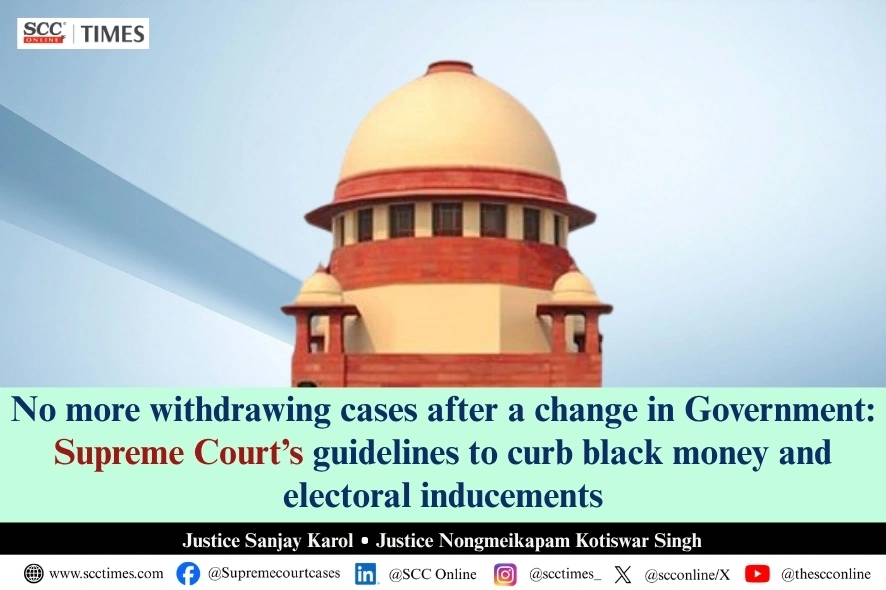
Supreme Court: In a matter concerning the integrity of the electoral process and the prevention, investigation and prosecution of election-related offences, the Division Bench of Sanjay Karol* and Nongmeikapam Kotiswar Singh, JJ. emphasised the need to safeguard free and fair elections and issued a series of directions aimed at curbing the use of black money and other inducements in elections. The Court, inter alia, held that:
-
Free and fair elections are fundamental to the functioning of constitutional democracy, and the use of black money and electoral inducements can seriously undermine that process.
-
Article 324 confers wide powers upon the Election Commission to preserve the integrity of elections, particularly in areas not occupied by legislation, but such powers must operate within the constitutional and statutory framework.
-
Seizure of cash or other valuables during elections must be accompanied by adequate procedural safeguards, including recording of written reasons establishing a prima facie nexus with a suspected electoral offence.
-
Election-related criminal investigations should be pursued expeditiously, with an endeavour to complete investigation within 1 year and periodic reporting to the Election Commission.
-
Election-related prosecutions should, as far as possible, be brought to their logical conclusion before the next election cycle, and High Courts may designate appropriate courts for expeditious disposal.
-
Criminal cases relating to candidates in a particular election cycle cannot be withdrawn merely as a consequence of a change in political government. Withdrawal requires judicial scrutiny, and approval of the High Court concerned is mandatory.
Background
The proceedings arose from an incident during the 2014 Lok Sabha bye-election for the Bellary constituency in Karnataka. During the election period, the residence and business premises of the respondent were searched by an Election Commission flying squad acting upon an anonymous complaint alleging possession of counterfeit currency intended to be used for bribing voters.
During the search, the authorities seized a laptop, cheque books, loose cheque leaves, a pen drive and cash amounting to ₹20,48,355. An FIR was registered on 11 April 2014 under Sections 171-E and 188, Penal Code, 1860 on the allegation that the respondent was possessing money for distribution among voters.
The respondent approached the Karnataka High Court seeking quashing of the FIR. The High Court, by order dated 12 February 2015, quashed the FIR on the ground that the complaint did not specify the persons whom the respondent allegedly intended to bribe or the manner in which the alleged bribery was to be carried out.
The State of Karnataka challenged the High Court’s decision before the Supreme Court. During the proceedings, the Supreme Court became concerned with the broader issue of the use of black money and other inducements during elections and the effectiveness of the mechanisms employed by the Election Commission of India to prevent, investigate and prosecute election-related offences.
By order dated 5 September 2017, the Supreme Court issued notice to the Election Commission of India and the Union of India. The Court noted that although the Election Commission possessed wide powers under Article 324 of the Constitution, those powers operated within the framework of statutory law.
The Court was also informed that numerous criminal cases arising from election-related offences were not being effectively pursued because prosecution was largely left to the respective State Governments. The Court therefore directed the Election Commission to place its guidelines concerning flying squads and other authorities involved in search, seizure and prosecution before the Court.
On 5 April 2019, all State Governments and Union Territories were directed to participate in the proceedings so that information could be obtained concerning the investigation and prosecution of election-related offences.
Subsequently, the Court considered the framing of guidelines to ensure free and fair elections and to prevent the use of black money.
Analysis and Decision
The Court emphasised that democracy, the rule of law, and free and fair elections are closely interconnected. Elections provide citizens with the opportunity to express their political choice and determine who will exercise governmental power.
“The choice exercised by the people once influenced by external factors is no longer a choice of their own. It is somebody else’s choice being thrust upon them.”
The Court observed that if a voter’s choice is influenced by external factors such as cash, liquor, gifts or other inducements, the choice ceases to be genuinely free. Such influence therefore affects not merely an individual voter but the very foundation of representative democracy.
Relying upon earlier constitutional decisions, including Indira Nehru Gandhi v. Raj Narain, 1975 Supp SCC 1, the Court reiterated that free and fair elections are an essential component of democracy. Democracy cannot function effectively where elections are manipulated through money power, coercion or other unfair means.
The Court further referred to Anoop Baranwal v. Union of India, (2023) 6 SCC 161, emphasising that the ballot provides citizens with a peaceful constitutional mechanism to change governments. The integrity of that mechanism must consequently be protected.
Constitutional role of the Election Commission
The Court examined Article 324 of the Constitution, which vests in the Election Commission the superintendence, direction and control of elections and the preparation of electoral rolls.
The Court recognised that Article 324 confers wide powers upon the Election Commission to ensure the smooth and fair conduct of elections. These powers include measures directed towards preventing the distribution of cash, liquor, gifts and other inducements.
However, the Court reiterated that the powers under Article 324 are not unlimited or plenary in every situation. Where Parliament or a State Legislature has enacted valid legislation occupying a particular field, the Election Commission must act consistently with that legislation. Where the law is silent, Article 324 operates as a reservoir of power enabling the Commission to issue appropriate directions to preserve the purity of elections.
The Court relied upon decisions including Mohinder Singh Gill v. Election Commission of India, (1978) 1 SCC 405, A.C. Jose v. Sivan Pillai, (1984) 2 SCC 656 and Union of India v. Assn. for Democratic Reforms, (2002) 5 SCC 294 to explain the nature and limits of the Commission’s constitutional powers.
Money Power and Black Money in Elections
The Court treated the use of black money and excessive financial resources in elections as a longstanding problem. It referred to judicial decisions, governmental reports and electoral reform recommendations demonstrating that money power can distort the electoral process.
In Kanwar Lal Gupta v. Amar Nath Chawla, (1975) 3 SCC 646, the Court had recognised that disproportionate financial resources could provide one candidate or political party with an unfair advantage over others. Excessive expenditure could therefore undermine the principle of equal political participation.
The Court also referred to the Goswami Committee on Electoral Reforms, the Vohra Committee Report, observations of President K.R. Narayanan, the Law Commission’s 255th Report on Electoral Reforms, and parliamentary material concerning political funding.
These materials demonstrated that the use of money power, including cash, liquor and gifts, has repeatedly been identified as a threat to the purity of elections.
Election Commission’s Data and Existing Mechanisms
The Election Commission placed before the Court its standard operating procedures concerning flying squads, static surveillance teams, seizure of cash and reporting of election expenditure.
The data placed before the Court showed a substantial number of FIRs and enforcement actions during the 2019 and 2024 Lok Sabha elections and various State Assembly elections.
The Commission also disclosed significant pendency in investigation and trial of election-related offences. The Court considered such pendency problematic because an unresolved election-related prosecution may continue for years and may not provide voters with timely information about the conduct of a candidate.
The Court observed that the effectiveness of electoral regulation does not depend merely upon registering FIRs or making seizures. Investigation and prosecution must ultimately reach their logical conclusion.
ECI’s Data on FIRs, Convictions and Pendency
The Election Commission placed specific figures before the Court. During the 2019 Lok Sabha elections, states such as Gujarat (35,144 FIRs), Uttar Pradesh (19,209) and Maharashtra (18,928) registered the highest numbers of election-related FIRs; by the 2024 Lok Sabha elections, these figures had risen substantially, with Gujarat alone recording 52,820 FIRs. Across a combined dataset spanning the 2019 and 2024 Lok Sabha elections and State Assembly elections held between 2019 and 2025, the Commission’s supplementary affidavit disclosed that a total of 144,030 FIRs had been filed, of which only 37,215, roughly 25.8%, resulted in convictions, while 44,387 cases, or nearly 31%, remained pending trial even after five or more years. The Court found this pendency rate to be a matter of considerable concern, particularly given that an unresolved election-related prosecution may continue for years without providing voters timely information about a candidate’s conduct.
Safeguards Regarding Seizure of Cash
The Court examined the Election Commission’s procedures concerning Flying Squads and Static Surveillance Teams.
The existing procedures required, among other things, recording of seizure proceedings, preparation of panchnamas, video recording, involvement of an Executive Magistrate in appropriate cases and registration of complaints or FIRs within 24 hours.
The Court held that the existence of suspicion or a belief that cash or other material may be connected with an electoral offence must not result in arbitrary action against citizens.
Accordingly, the authority making the seizure must record reasons in writing, including the information which led to the action and the prima facie connection between the seized material and the suspected electoral offence.
The requirement of recording reasons was considered an important safeguard against arbitrary seizure and an important mechanism for demonstrating accountability.
Real-Time Tracking of Seizures
The Amicus Curiae suggested that every seizure should be assigned an identification number and that its status should be capable of being tracked digitally.
The Court found the suggestion justified because such a mechanism would improve transparency and accountability.
However, instead of mandating immediate nationwide implementation, the Court contemplated that such a system could initially be developed as a pilot or private project and subsequently implemented in stages, taking into account logistical requirements.
Investigation of Election-Related Offences
The Election Commission suggested that investigations into election-related offences should ordinarily be completed within 1 year from registration of the FIR.
The Court agreed with the underlying principle that investigations should not remain pending indefinitely. Prolonged investigation can unfairly prejudice both an accused person who may be innocent and the public interest in knowing whether a candidate was involved in electoral malpractice.
The Court therefore directed investigating officers to make every possible endeavour to complete investigations within 1 year. Where the investigation cannot be completed within that period, reasons must be recorded and communicated to the Election Commission.
The investigating officer must also submit quarterly status reports concerning the investigation to the Election Commission through the designated nodal officer and after approval by the senior police authorities concerned.
Expeditious Trial and Special Courts
The Court recognised the recurring nature of elections and the importance of resolving election-related prosecutions before the next election cycle wherever possible.
A prolonged criminal case may prevent voters from obtaining relevant information concerning the conduct of a candidate when they are called upon to make a subsequent electoral choice.
The Court therefore found merit in the suggestion that High Courts should designate appropriate courts for the prompt hearing and disposal of cases concerning candidates, sitting MPs and MLAs.
However, the Court declined to prescribe a rigid universal timeline for the disposal of every such case, recognising the practical realities of the criminal justice system.
Withdrawal of Election-Related Criminal Cases
The Election Commission informed the Court that State Governments sometimes seek withdrawal of election-related criminal cases after elections, particularly where the accused is associated with the ruling political formation.
The Court considered such a practice highly problematic because withdrawal of prosecution merely because a change in political power can undermine public confidence in the electoral and criminal justice systems.
The Court relied upon State of Kerala v. K. Ajith, (2021) 17 SCC 318 and reiterated that the Public Prosecutor must independently apply his or her mind before seeking withdrawal under Section 321, Criminal Procedure Code, 1973. The court must also scrutinise whether the withdrawal is genuinely in the interest of public justice and is not motivated by improper or political considerations.
Requirement of High Court Approval
The Court further referred to Ashwini Kumar Upadhyay v. Union of India, (2021) 20 SCC 599 where the withdrawal of cases against sitting MPs and MLAs was made subject to the leave of the High Court.
Applying the same principle to election-related prosecutions against candidates, the Court held that withdrawal of cases against candidates in a particular election cycle requires the approval of the High Court concerned.
This requirement was intended to prevent political changes in government from automatically resulting in the abandonment of prosecutions concerning electoral offences.
Final Directions of the Court
The Court issued the following directions:
-
Seizure reporting: Whenever cash or other assets are seized, the authority making the seizure must, within 24 hours, report it to the District Magistrate, Additional District Magistrate or competent court, together with written reasons disclosing the prima facie nexus between the seized material and the suspected electoral offence.
-
Completion of investigation: Investigating officers must make every possible endeavour to complete investigations into election-related FIRs within 1 year of registration. If this is not possible, reasons must be recorded and communicated to the Election Commission of India.
-
Quarterly reporting: Investigating officers must submit quarterly investigation-status reports to the Election Commission through the Nodal Officer concerned, after approval by the Senior Superintendent of Police/Deputy Commissioner of Police of the district concerned.
-
Income-tax authorities: Where Static Surveillance Teams detect cash exceeding ₹10 lakhs, information regarding the same must be forwarded to the income-tax authorities.
-
Expeditious trials: High Courts may designate courts for the prompt hearing and disposal of cases against candidates, sitting MPs and MLAs, keeping in view the recurring nature of elections.
-
Withdrawal of cases: Withdrawal of cases against candidates in a particular election cycle requires the approval of the High Court concerned, consistent with the principles laid down in State of Kerala v. K. Ajith and Ashwini Kumar Upadhyay.
-
Pending cases: Courts concerned should make all efforts to bring pending election-related prosecutions to their logical conclusion with utmost expedition.
-
Compliance report: The Election Commission of India and the respective State Governments were directed to file a compliance report on or before 18 November 2026.
[State of Karnataka v. Prathik Parasrampuria, 2026 SCC OnLine SC 1587, decided 17-8-2026]
*Judgment Authored by: Justice Sanjay Karol