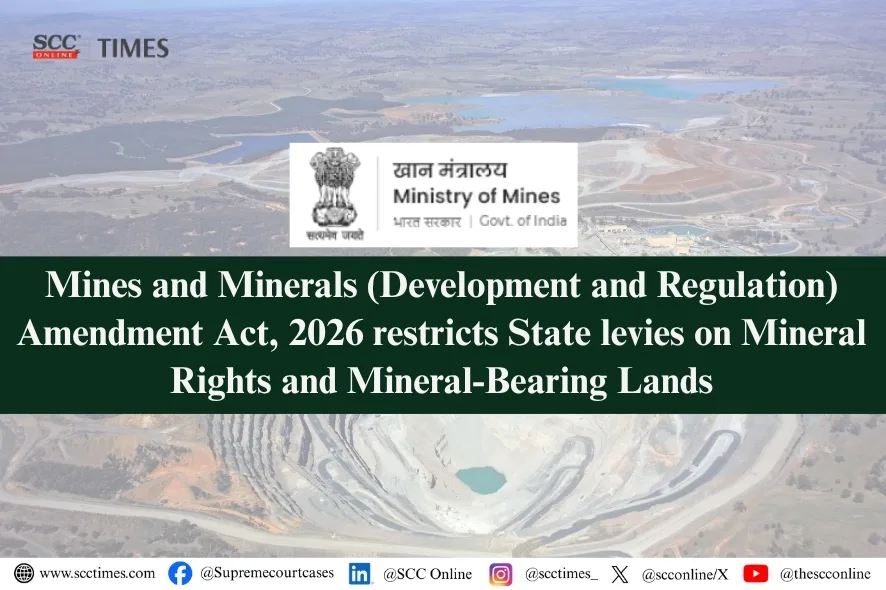
On 17 August 2026, the President assented to the Mines and Minerals (Development and Regulation) Amendment Act, 2026, introducing significant changes to the regulatory framework governing mineral rights and mineral-bearing lands.
Key Points:
-
The Mines and Minerals (Development and Regulation) Amendment Act, 2026 further amends the Mines and Minerals (Development and Regulation) Act, 1957.
-
Section 2 has been amended to expand the Union declaration from the regulation of mines to the regulation of mines and mineral-bearing lands.
-
A new definition of ‘mineral bearing land’ has been inserted in Section 3, covering land having mineral contents in accordance with parameters prescribed under Section 5 of the Act.
-
A new Section 9D has been inserted imposing restrictions on the imposition of taxes, cesses and other levies by State Governments on mineral rights and mineral-bearing lands.
-
State Governments cannot impose any tax, cess or other levy on mineral rights or mineral-bearing lands, whether based on mineral quantity, mineral value, royalty payable or otherwise, except in accordance with conditions or restrictions prescribed by the Central Government.
-
The Central Government is empowered to prescribe conditions and restrictions governing the imposition of such taxes, cesses and levies.
-
Any tax, cess or other levy imposed by a State Government on mineral rights or mineral-bearing lands that had not been deposited with or recovered by the State before the commencement of the Amendment Act shall be deemed invalid at all material times.
-
The invalidation applies notwithstanding anything contained in any other law or any judgment, decree or order of a court.
-
Taxes, cesses or other levies already deposited with or recovered by a State Government before the commencement of the Amendment Act will not be refundable.
-
Section 13 has been amended, by inserting clause (ta), to empower the Central Government to frame rules prescribing conditions and restrictions on the imposition of taxes, cesses and other levies under Section 9D.
Ed. Note: In Supreme Court’s July 2024 ruling in Mineral Area Development Authority v. SAIL, (2024) 10 SCC 1, a nine-judge Constitution Bench held that State Legislatures possess the legislative competence to levy tax on mineral rights, and that royalty payable under the MMDR Act does not constitute a tax. The Court’s subsequent ruling also permitted States to recover such dues retrospectively. The newly inserted Section 9D appears directed at this space, conditioning the exercise of State taxing power on mineral rights and mineral-bearing lands, and deeming invalid, with retrospective effect, any such levy not already deposited with or recovered by the State before the amendment’s commencement.
Also Read: Supreme Court on Parliament’s power to impose limitations on State to levy tax on mineral rights
[Mines and Minerals Amendment Act 2026, dated 17-8-2026]