








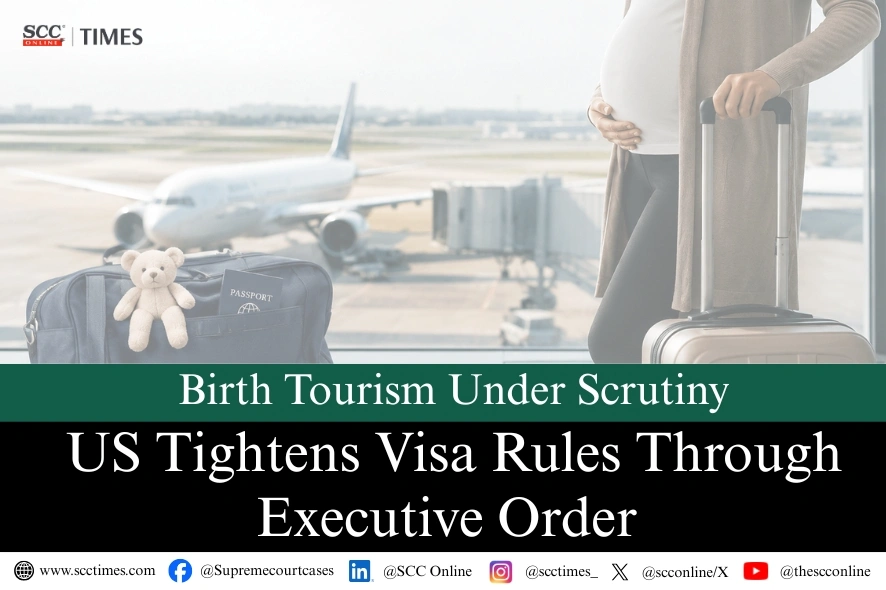
On 6 August 2026, the White House announced an executive order aimed at curbing birth tourism and strengthening enforcement of immigration rules governing temporary visa categories.
Background:
The order follows the U.S. Supreme Court’s decision in Trump v. Barbara1 and directs the Secretary of State and the Secretary of Homeland Security to take measures against individuals and entities facilitating birth tourism.
The White House stated that the measure forms part of broader efforts to address perceived misuse of immigration pathways. In Trump v. Barbara, 609 U.S. ___ (2026), decided on 30 06 2026, the Supreme Court held that children born in the United States to parents who are unlawfully or temporarily present in the country are citizens at birth under the Citizenship Clause of the Fourteenth Amendment. The Administration has nevertheless stated that the executive order is aimed at preventing what it describes as abuse of temporary visa classifications through birth tourism.
Key Highlights:
-
The executive order defines “birth tourism” under Section 3, as entry into the United States on a non-immigrant visa for the purpose of giving birth on American soil, as well as efforts to facilitate such entry.
-
Authority under U.S. immigration law has been delegated to the Secretary of State and the Secretary of Homeland Security to implement the order.
-
Federal agencies have been directed to update rules, policies, operational guidance and procedures necessary to implement the order.
-
The order permits authorities to take action against individuals seeking entry into the United States for the purpose of engaging in birth tourism.
-
Measures contemplated under the order include denial of visas or travel authorisations, revocation of existing permissions, denial of entry and, in appropriate cases, permanent bars on entry for persons engaging in birth tourism.
-
The order also authorises action against entities, organisations or individuals involved in facilitating birth tourism schemes.
-
Other executive departments and agencies are required to provide records and information necessary for implementation of the order, subject to applicable law.
-
The Secretary of State and the Secretary of Homeland Security may grant exemptions on humanitarian grounds or where entry is considered to be in the national interest.
-
The order contains a severability clause providing that if any provision is held invalid, the remaining provisions will continue to operate.
-
The Administration stated that the objective of the order is to ensure that non-immigrant visa categories are used only for their intended purposes and not as a means of obtaining immigration-related benefits through temporary admission.
1. https://www.supremecourt.gov/opinions/25pdf/25-365_4hdj.pdf






0 replies