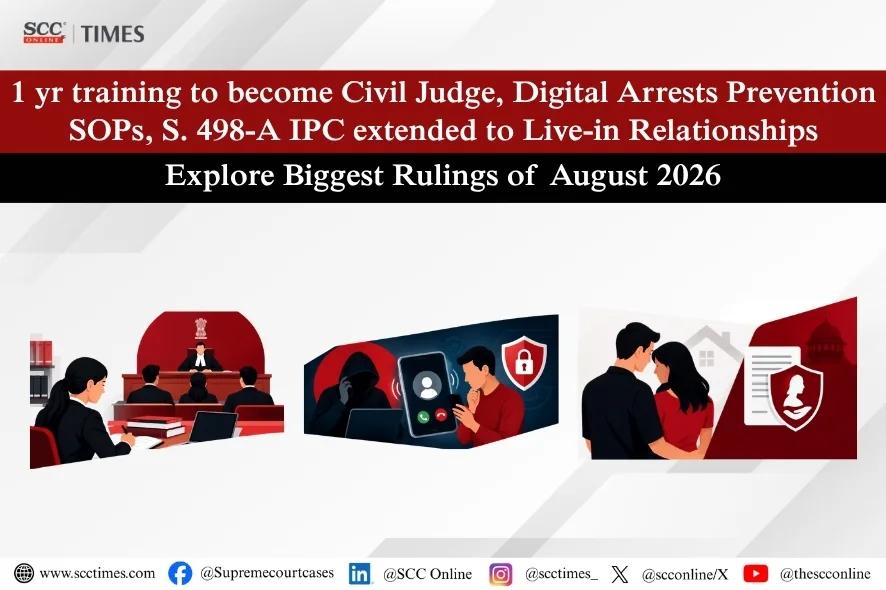
It was judgements galore for the Supreme Court in August 2026. The Court delivered key judgments on eligibility requirement for Civil Judge appointments, SOPs for prevention of digital arrests, extension of Section 498-A IPC to live-in relationships, guidelines for streamlining dowry cases. Furthermore, the Supreme Court displayed its proactivity in dealing with assault allegations in 2026 NEET exam protests, concerns within the judicial mechanism and lack of legal mechanism to deal with private investigators.
This Supreme Court August 2026 Roundup highlights not only the month’s most important judgments and key legal developments, but it also features the latest judicial appointments, collegium recommendations and details on case pendency in the Supreme Court. Do not miss out on the latest Supreme Court Judgments published in SCC Weekly and the Know Thy Judge series!
Top Stories of August 2026
In a batch of matters concerning the eligibility requirement of prior practice at the Bar for appointment to the post of Civil Judge (Junior Division), a three-Judge Bench of Surya Kant CJ, Augustine George Masih and K. Vinod Chandran, JJ., in a 2:1 verdict reconsidered the directions issued in its judgment dated 20 May 2025 restoring the requirement of 3 years’ practice at the Bar. The Court, while upholding the underlying need for prior exposure to the working of courts, held that the requirement had to be implemented in a manner which was fair to fresh and recent law graduates and did not unnecessarily narrow the field of candidates available to the subordinate judiciary. Holding that 3 years’ conventional practice at the Bar was not the sole means of securing meaningful courtroom experience, the Court modified the judgment under review and devised a transitional regime permitting all law graduates to apply until 31 March 2027, followed by 1 year of intensive training at the State Judicial Academy and 1 year of structured Law Clerkship. For recruitments from 1 April 2027, the Court prescribed 1 year of actual practice before appearing for the examination, while retaining the requirement of 1 year of institutional training and 1 year of Law Clerkship after selection. The Court also directed that the scheme would remain in force for 5 years and thereafter be placed before the Court for review on the basis of empirical material concerning its efficacy. [Bhumika Trust v. Union of India, 2026 SCC OnLine SC 1687]
From RBI SOPs to a Call “Kill Switch”: SC’s Plan Against Digital Arrest Scams
In a suo motu proceeding concerning victims of digital arrest scams and the wider institutional response required to combat such cyber-enabled fraud, the three-Judge Bench of Surya Kant, CJ., Joymalya Bagchi and V. Mohana, JJ., while noting an encouraging decline in reported digital-arrest complaints, emphasised that “continued monitoring remains indispensable” and issued further interim directions to strengthen mechanisms for prevention, investigation, grievance redressal and speedy restoration of defrauded money to victims. [Victims of Digital Arrest Related to Forged Documents, In re, 2026 SCC OnLine SC 1532]
Not Married, But Still Protected: Supreme Court Extends Section 498-A IPC to Live-In Relationships
In a landmark judgment raising an important question whether Section 498-A, Penal Code, 1860 (IPC) extends to a man in a live-in relationship, while harmonising the principles of strict interpretation of penal statutes with purposive construction of socially beneficial legislation, the Division Bench of Sanjay Karol* and N. Kotiswar Singh, JJ., held Section 498-A to be applicable to “live-in relationships” that qualify as “relationships in the nature of marriage” with the intent to marry being established as an intrinsic part thereof. The protection extends only to relationships between 2 consenting adults. The proposition of law as laid down should be limited to Section 498-A IPC only, and this extended interpretation shall not affect any other provision. The safeguards against arrest laid down in Arnesh Kumar v. State of Bihar, (2014) 8 SCC 273, shall be strictly followed. No live-in partner or relative should be arrested without the mandated preliminary safeguards. [Lokesh B.H. v. State of Karnataka, 2026 SCC OnLine SC 1470]
In a press release issued concerning vacant positions of Chief Justice in several High Courts, CJI Surya Kant has assured that the Collegium is already working on the appointment of Chief Justices in the remaining High Courts. CJI Surya Kant further assured that concerns raised in letters written by sitting Judge of Supreme Court, Justice Sandeep Mehta, have already been taken note of and emphasised that allegations against a sitting judge must be dealt with strictly through the established institutional mechanism. As of 1 August 2026, position of Chief Justice for seven High Courts lie vacant and they are being administered by their Acting Chief Justices. Furthermore, the Supreme Court Collegium has recommended appointment of Chief Justices of four High Courts, namely- Patna High Court, Calcutta High Court, Bombay High Court, and Punjab and Haryana High Court
Husband Must Prove Wife’s Adultery “Ex-Facie” to Deny Interim Maintenance: Supreme Court Clarifies Scope of S. 125(4) CrPC
While deciding a case wherein the Court had to consider the husband’s obligation to pay maintenance on account of wife’s adultery, the Division Bench of Sanjay Karol* and Vipul M. Pancholi, JJ., clarified that since the stipulation in Section 125(4), Criminal Procedure Code, 1973 (CrPC) is that if adultery is proved, then the wife would neither be entitled to interim nor final maintenance; therefore, Court opined that if a husband files an application under Section 125(4) CrPC and is, at the first instance, able to establish the charge of adultery through evidence ex facie, then only, there can be said to be a bar to interim maintenance.
While deliberating over this writ petition challenging the constitutionality of Section 354(5), Criminal Procedure Code, 1973 (CrPC) insofar as it prescribes hanging as the sole method of execution, the Division Bench of Vikram Nath and Sandeep Mehta*, JJ., declined to refer Deena v. Union of India, (1983) 4 SCC 645, decided by three-Judge Bench of the Supreme Court, to a larger Bench for reconsideration of the Constitutional validity of Section 354(5) CrPC [corresponding to Section 393(5), Nagarik Suraksha Sanhita, 2023 (BNSS)]. The Court deemed it necessary to clarify that dismissal of the present writ petition on this subject should not be understood as foreclosing future constitutional scrutiny, should compelling scientific, medical or empirical evidence emerge demonstrating that ratio in Deena can be materially displaced by subsequent developments. [Rishi Malhotra v. Union of India, 2026 SCC OnLine SC 1602]
Saradha Chit Fund Scam | Supreme Court grants bail to Sudipta Sen after nearly a decade in custody
In a petition challenging the Gauhati High Court’s order dated 20 January 2025 refusing bail application filed by the appellant, former Chairman and Managing Director of the Saradha Group in connection with multi-crore Saradha chit fund scam, the Division Bench of Sanjay Karol and Augustine George Masih, JJ., granted bail. The Saradha chit-fund scam was a multi-crore financial fraud in West Bengal that collapsed in 2013, affecting over 1.7 million depositors. The Saradha Group had allegedly raised approximately ₹2500 crore from lakhs of investors in West Bengal, Odisha and the North-Eastern States through various investment schemes, often under the guise of sale of products and services, by promising lucrative returns. Approximately ₹1900 crore allegedly remained unpaid. In 2013, the principal promoter and other accused persons allegedly shut down their offices and absconded before their arrest. [Sudipta Sen v. CBI, 2026 SCC OnLine SC 1659]
The present proceeding initially concerned with a narrow question, whether the vehicle stated to have caused a motor accident was in fact the vehicle involved in the accident, however, subsequently revealed a much wider concern, i.e., allegations of fraudulent motor accident claims being lodged in a recurring and organised pattern, including instances where the same vehicle was shown as having been involved in multiple accidents. Describing the suspected fraud as being of “enormous proportion” and expanding the proceedings to examine mechanisms for detecting and investigating such claims pan India, the Division Bench of Ahsanuddin Amanullah and Prasanna B. Varale, JJ., directed all the States to constitute a special dedicated SIT at the State level for dealing with suspected fraudulent insurance claims and issued fresh directions. [Oriental Insurance Co. Ltd. v. Tuni Pati, 2026 SCC OnLine SC 1710]
NEET Paper Leak Protest Violence: SC sets up 5-Member Enquiry Committee
While considering this writ petition concerning inter alia the alleged excessive and disproportionate use of force by the police, paramilitary forces, and other security personnel against peaceful protestors assembled at Jantar Mantar, New Delhi, and at various other locations across the country in connection to NEET Examination 2026 protests, a three-Judge Bench of Surya Kant, CJI, Joymalya Bagchi and V. Mohana, JJ., constituted a five-Member High Powered Enquiry Committee (HPEC) for an independent and impartial investigation into the incidents of violence. The HPEC is to be led by Justice R. Subhash Reddy, former Judge, Supreme Court. [Shailendra Mani Tripathi v. Union of India, 2026 SCC OnLine SC 1683]
In a matter concerning the integrity of the electoral process and the prevention, investigation and prosecution of election-related offences, the Division Bench of Sanjay Karol* and Nongmeikapam Kotiswar Singh, JJ. emphasised the need to safeguard free and fair elections and issued a series of directions aimed at curbing the use of black money and other inducements in elections. [State of Karnataka v. Prathik Parasrampuria, 2026 SCC OnLine SC 1587]
What began as a challenge to demolition proceedings against an unauthorised construction in Chennai evolved into a pan-India drive against illegal constructions and blatantly violation of the sanctioned land use prescribed under the Master Plan. The Court uncovered a pattern of administrative inaction, official connivance, rampant unauthorised constructions, and illegal conversion of residential areas for commercial use. Treating the issue as one of national importance, the Division Bench of Ahsanuddin Amanullah and R. Mahadevan, JJ., expanded the proceedings to include all States, Union Territories, municipal corporations and planning authorities and issued comprehensive directions for strict enforcement of building bye-laws and Master Plans. [Loganathan v. State of T.N., 2026 SCC OnLine SC 1514]
On 12 August 2026, the report of the Inquiry Committee constituted under the Judges (Inquiry) Act, 1968 in relation to Justice Yashwant Varma was laid before the Lok Sabha, along with the oral and documentary evidence recorded during the inquiry. The Inquiry Committee found all three Articles of Charge against Justice Yashwant Varma proved, concluding that substantial unexplained currency notes were present within his official residential premises, material evidence was not preserved, and the explanations furnished by him were evasive and unsatisfactory.
The Inquiry Committee comprised of:
-
Justice Aravind Kumar, Judge, Supreme Court of India (Presiding Officer);
-
Justice Shree Chandrashekhar, Chief Justice of the Bombay High Court (as he was then)
-
Senior Advocate B.V. Acharya, Karnataka High Court.
Notable Judgments of August 2026
Advocate-Client Relationship
The present appeal, where both litigants approached the Court expecting vindication, yet “neither of whom has been candid with it”, presents a striking reminder that the machinery of justice cannot be permitted to become a forum for settling personal scores or securing advantage from a controversy of the parties’ own making. While examining the respondent-advocate’s disclosure of confidential communications and recorded conversations of his former client in television interviews, a three-Judge Bench of Vikram Nath, Sandeep Mehta and Vijay Bishnoi, JJ., held that “an advocate cannot use information received in confidence against his client”, even after the professional relationship has ended. At the same time, the Court refused to enhance the punishment at the appellant’s instance, finding that she too had not approached the Court with complete candour. [Rehana Khan v. Rizwan Siddhiquee, 2026 SCC OnLine SC 1686]
Arbitration
In an appeal while examining the validity of a contractual clause requiring a contractor to deposit 10 per cent of the claim amount as a precondition for invoking arbitration, the Division Bench of Manoj Misra and Manmohan*, JJ., expressed doubts about the continuing authority of S.K. Jain v. State of Haryana, (2009) 4 SCC 357, holding that a pre-deposit condition cannot make the right to sue “illusory or nugatory”. [Santosh Associate (P) Ltd. v. Haryana State Industrial and Infrastructure Development Corpn. Ltd., 2026 SCC OnLine SC 1584]
Armed Forces
Invoking its powers under Article 142 of the Constitution, the Division Bench of K.V. Viswanathan and Arun Palli, JJ., extended extraordinary pensionary benefits under Category “C”, CCS (Extraordinary Pension) Rules, 1939 from the date of death to the widow of a General Reserve Engineering Force (GREF) employee who had made the “supreme sacrifice” while saving fellow workers and equipment and was posthumously awarded the Shaurya Chakra. Holding that the relief ought not to be confined to 3 years preceding the filing of the writ petition, the Court directed the Union of India to pay a consolidated sum of ₹10 lakhs for the period from 13 July 2000 to 12 July 2015. [Kuldeep Kaur v. Union of India, 2026 SCC OnLine SC 1540]
Consumer Protection
In a special leave petition raising a substantial question as to whether jurisdiction of the consumer fora would depend on the value of the goods or services paid as consideration or will depend on the amount of compensation claimed, the Division Bench of K.V. Viswanathan and Arun Palli, JJ., found it appropriate to first obtain the Union of India’s response to the formulated anomalies, including disputes involving fixed deposits, savings accounts, subsidised medical services, defects in fixtures and fittings, and defective components of high-value vehicles and therefore, directed the Union of India to file an appropriate affidavit within 6 weeks responding to the same. The Court directed to address the reduction of the National Commission’s pecuniary jurisdiction from ₹10 crore to ₹2 crore. [Avon Elastomers (India) v. Bajaj Allianz General Insurance Co. Ltd., 2026 SCC OnLine SC 1669]
In a significant judgment addressing the standard of care owed by manufacturers and maintenance contractors of passenger elevators in the context of consumer protection and tort liability, the Division Bench of Pamidighantam Sri Narasimha and Alok Aradhe, JJ., held that passenger elevators constitute a mode of vertical transportation and must be treated as common carriers, thereby attracting a heightened duty of care towards their users. Distinguishing the cause of the accident from the cause of action for deficiency in service, the Court affirmed that a manufacturer who undertakes comprehensive maintenance cannot evade liability by attributing the immediate cause of the accident to human error when persistent defects remained unrectified despite repeated notice. Having identified the defect and proposed the remedy, appellant’s OTIS Elevator Company (India) Ltd. (OTIS) failure to implement the remedial measure or otherwise ensure the lift’s safety amounted to deficiency in service. [OTIS Elevator Co. (India) Ltd. v. Rashmi Handa, 2026 SCC OnLine SC 1407]
Criminal Law
In an appeal arising from the conviction of appellant under Section 302 read with Section 34, Penal Code, 1860 (IPC), for the murder arising from a witchcraft allegation, the Division Bench of Prashant Kumar Mishra* and N.V. Anjaria, JJ., dismissed the appeal and affirmed the conviction and sentence of life imprisonment, on finding the testimony of PW3, deceased’s daughter and sole eyewitness, to be reliable and sufficiently corroborated by medical evidence. The Court strongly condemned witch-hunting as contrary to human dignity, constitutional morality, and the Rule of Law. [Balku Oram v. State of Odisha, 2026 SCC OnLine SC 1568]
In a special leave petition concerning the issue of missing persons, in which a Committee constituted by the Court and headed by Senior Advocate Mukta Gupta has been undertaking an exercise in coordination with the authorities and stakeholders concerned, the Division Bench of Ahsanuddin Amanullah and R. Mahadevan, JJ., directed all States and Union Territories to strictly comply with its order dated 22 May 2026 requiring registration of an FIR upon receipt of information regarding any missing person, irrespective of age or gender. [G. Ganesh v. State of T.N.1]
In a case concerning grant and cancellation of bail in a murder case arising out of an alleged pre-planned attack in which the deceased-complainant was set ablaze, a Division Bench of Vikram Nath and Sandeep Mehta*, JJ., held that the circumstances of the case, including the repeated threats extended by the accused persons, their arrival together at the crime scene in a four-wheeler carrying petrol, and the subsequent act of pouring inflammable fluid over the deceased and setting him ablaze, prima facie indicated that the accused persons were acting in concert and in furtherance of a common intention. [Yash Mahesh Gaikwad v. State of Maharashtra, 2026 SCC OnLine SC 1696]
In a case concerning the interpretation of Section 12, Uttar Pradesh Gangsters and Anti-Social Activities (Prevention) Act, 1986 (Gangsters Act) and its effect on a pending sessions trial, a Division Bench of K.V. Viswanathan* and Arun Palli, JJ., held that Section 12 does not contemplate keeping other criminal proceedings in abeyance until conclusion of the proceedings under the Gangsters Act. The Court clarified that the provision is intended only to resolve a clash of dates, in which event proceedings under the Gangsters Act are to be given preference. Emphasising the mandate of Section 346, Nagarik Suraksha Sanhita, 2023 (BNSS) for expeditious conclusion of trials and the victim’s right to speedy trial under Article 21, the Court held that Section 12 cannot be construed to permit indefinite deferment of other criminal proceedings. Finding that there was no clash of dates in the present case, as the sessions trial had substantially progressed while the Gangsters Act proceedings had not even commenced, the Court set aside the Allahabad High Court’s order directing the trial to be kept in abeyance. The appeal was accordingly allowed. [Keshvendra Singh v. Shankar Singh, 2026 SCC OnLine SC 1588]
In an appeal case arising from a goods and services tax (GST) investigation in which the respondent was summoned under Section 70, Central Goods and Services Tax Act, 2017 (CGST Act) and subsequently sought anticipatory bail which was rejected by Bombay High Court, but it nevertheless granted him 1-week’s protection from arrest upon communication of a future order under Section 69, CGST Act, the Division Bench of Dipankar Datta* and Sheel Nagu, JJ., affirmed the rejection of respondent’s application for pre-arrest bail and set aside the 1-week protection from arrest to the respondent vide para 6 of the impugned order. [Union of India v. Sunil Biyani, 2026 SCC OnLine SC 1544]
In a case highlighting the importance of meaningful access to justice for convicted prisoners and the duty of Constitutional Courts to adopt a liberal approach in condoning delays in criminal appeals, a Division Bench of J.B. Pardiwala and K. Vinod Chandran, JJ., set aside the conviction of a man who had spent 22 years in prison after finding the prosecution case to be shrouded in a “pall of incredulity“. The Court held that the High Court had erred in refusing to condone the delay in filing the jail appeal and, upon examining the merits, found that the conviction rested solely on an unreliable eyewitness account, unsupported by credible corroborative evidence. [Arjun Jani v. State of Orissa, 2026 SCC OnLine SC 1480]
When a Co-Accused’s Trial Evidence Can Be Used Against an Absconding Accused? Supreme Court Interprets Section 299 CrPC
In an appeal challenging the conviction which was based on testimony of deceased witness recorded during a separate trial of co-accused while he was evading prosecution, the Division Bench of J.B. Pardiwala and K. Vinod Chandran*, JJ., held that only an order passed, finding proof of both the jurisdictional facts, i.e., one that the accused is absconding and the other that there is no immediate prospect of arresting him, would enable testimony of the witness recorded at that stage to be relied on at a later stage. Accordingly, the Court acquitted the accused for lack of an order under Section 299, Criminal Procedure Code, 1973 (CrPC). The appeal was allowed. [Mahendra Singh v. State of Chhattisgarh, 2026 SCC OnLine SC 1463]
Corporate Law
In an appeal challenging the Kerala High Court’s order entertaining a writ petition against an National Company Law Tribunal (NCLT) order passed during liquidation proceedings, the Division Bench of Manoj Misra and Vijay Bishnoi, JJ., held that where an NCLT order passed under the Insolvency and Bankruptcy Code, 2016 (IBC) is appealable under Section 61, the High Court should ordinarily refrain from entertaining a writ petition challenging that order and direct the aggrieved party to pursue the statutory appellate remedy. [Davis Koottala Varkey v. Samson T. George, 2026 SCC OnLine SC 1560]
Custodial Death
In a case concerning the custodial death of a man arrested for allegedly possessing 6 litres of raw Mahua liquor, a Division Bench of Vikram Nath and Sandeep Mehta*, JJ., directed the CBI to register a regular criminal case and investigate the circumstances leading to his death, while directing the State of Chhattisgarh to pay ₹25 lakhs as interim compensation to his legal heirs. Taking serious exception to the stand of the State authorities, particularly the DGP, DG (Prisons) and Principal Secretary (Home), that no FIR could be registered as the judicial inquiry report under Section 176, Criminal Procedure Code, 1973 (CrPC) had not been received by the police, the Court termed the explanation a “cover-up story” and an attempt to mislead the Court. [Lahra Bai Tamre v. State of Chhattisgarh, 2026 SCC OnLine SC 1550]
Environmental Law
In an appeal challenging the National Green Tribunal’s (NGT) dated 7 December 2017 in Manoj Misra v. DDA, 2017 SCC OnLine NGT 966, wherein the appellant, the organiser of the 2016 World Culture Festival, “Vyakti Vikas Kendra, India” or as per NGT “Art of Living International Centre”, was held liable for environmental damage allegedly caused to the Yamuna floodplain, the Division Bench of Satish Chandra Sharma* and Nongmeikapam Kotiswar Singh, JJ., found that the floodplain was already in a damaged condition before the site was handed over to the appellant and that the evidence relied on by the NGT did not establish that the appellant caused additional damage. [Vyakti Vikas Kendra India v. Manoj Misra, 2026 SCC OnLine SC 1694]
Evidence Law
In a case concerning the admissibility of portions of examination-in-chief affidavits filed by Reliance Industries Ltd. (RIL) in its long-pending contractual dispute with National Thermal Power Corporation Ltd. (NTPC Ltd.), a Division Bench of Pamidighantam Sri Narasimha and Alok Aradhe, JJ., upheld the Bombay High Court’s redaction of portions seeking to introduce through oral evidence the contents of internal documents and communications already held irrelevant and excluded from the record. Reiterating its earlier judgment dated 28 February 2019, the Court held that while the contents of excluded documents or communications could not be introduced through oral evidence, a witness could depose about the factum of a meeting or discussion and his own perception of events. Finding that the High Court had correctly applied this mandate, the Court dismissed the appeal and imposed costs of ₹10 lakhs on RIL, while directing expeditious disposal of the suit which had remained pending since 2005. [Reliance Industries Ltd. v. NTPC Ltd., 2026 SCC OnLine SC 1579]
Family and Personal Laws
In a significant ruling, the Division Bench of Sanjay Karol and Augustine George Masih, JJ., while taking note of affidavits and data filed by several High Courts, States and Union Territories in pursuance of orders passed by the Court in State of U.P. v. Ajmal Beg, 2025 SCC OnLine SC 2801, passed another set of important directions addressing the systemic delay and ineffective implementation attending prosecutions under Sections 304-B, Section 498-A, Penal Code, 1860 (IPC) and the
In a significant judgment examining whether the fact that the mother was gainfully employed could, by itself, justify reducing the father’s contribution towards the interim maintenance of their minor daughters, the Division Bench of Vikram Nath* and Sandeep Mehta, JJ., held that “wife earns is not, by itself, a reason to halve the father’s liability” as the obligation to maintain the children is shared by both parents, it “cannot be divided by arithmetic alone”. Accordingly, the Court restored the Family Court’s award of ₹30,000 per month to each daughter, emphasising their needs, the father’s earning capacity, and the mother’s substantial contribution towards their daily care and upbringing. [Sujata Kumari v. Rahul Kumar, 2026 SCC OnLine SC 1675]
In an appeal, arising from the Kerala High Court’s dismissal of the appellant-husband’s petition seeking quashing of the proceedings initiated under the Protection of Women from Domestic Violence Act, 2005 (DV Act), raising a substantial question as to whether monetary and maintenance claims that had been expressly relinquished by the wife under a settlement agreement and reaffirmed before the Family Court could subsequently be revived through proceedings under the DV Act, the Division Bench of Sandeep Mehta and Manmohan*, JJ., set aside the impugned judgment and quashed the DV proceeding, holding that a wife’s waiver of maintenance claims under a matrimonial settlement bars their revival through subsequent DV proceedings. However, the Court clarified that since the daughter, who had attained majority before the settlement was executed, was not a party to the settlement agreement, her independent rights survived. [Reji Baby v. Subi Mary, 2026 SCC OnLine SC 1697]
In a custody and visitation dispute concerning the minor daughter of the parties, while also taking serious exception to the manner in which the Family Court dealt with the mother’s application seeking restoration of custody, the Division Bench of K.V. Viswanathan and Arun Palli, JJ., was “astonished” that, despite the High Court having expressly taken note of the mother’s relocation to Pune while modifying the visitation arrangement, the Family Court acted “in the teeth of the express directions of the High Court” and proceeded on findings that disregarded that position. Accordingly, the Court declined to interfere with the High Court’s order and directed the father to comply with the High Court’s directions. The Court stated that the judicial officer was expected “to be more cautious in future”. [Sandeep R. v. Manpreeth R., 2026 SCC OnLine SC 1733]
In a case concerning determination of just and adequate maintenance for a wife undergoing cancer treatment and 2 minor children, a Division Bench of Nongmeikapam Kotiswar Singh* and Sanjay Karol, JJ., reconsidered the quantum of maintenance awarded by the Delhi High Court. The Court held that deductions towards Provident Fund (PF) and Employee Stock Purchase Plans (ESPPs), unlike mandatory deductions such as income tax and professional tax, ultimately accrued as benefits to the husband and could not be treated as permanent charges. Taking into account the wife’s cancer treatment expenses and her responsibility of caring for the 2 children, the Court enhanced her monthly maintenance to ₹30,000 and the children’s maintenance to ₹75,000 each, totalling ₹1,50,000 per month with effect from 1 January 2025. [Harpreet Sawhney v. Puneet Sharma, 2026 SCC OnLine SC 1526]
In an appeal from an order of the Patna High Court, which upheld the rejection of the appellants’ request for compassionate appointment of her daughter following the death of her husband, the Division Bench of MM Sundresh and Prasanna B. Varale, JJ. held that a policy restricting compassionate appointment to only divorced or deserted daughters is violative of Article 14 of the Constitution. The Court observed that a married daughter cannot be excluded from consideration based on stereotypical assumptions that marriage severs her relationship with her parental family. It reiterated that any classification between sons and daughters based solely on gender or marital status is constitutionally impermissible and that a daughter’s entitlement to consideration for compassionate appointment cannot be denied merely because she is married. [Sayara Khatoon v. State of Bihar, 2026 SCC OnLine SC 1466]
Food Safety
In an application arising from a previous judgment concerning Front-of-Package Labelling (FOPL) for packaged foods and a proposed regulatory framework for the same, the Division Bench of J.B. Pardiwala and K. Vinod Chandran, JJ., directed that, “The Union in consultation with the experts may arrive at the decision on visual appearance (coloured indicators, interpretive words, numbers, letters or symbols, numerical information, percentage) of the FOPL.” [3S and Our Health Society v. Union of India, 2026 SCC OnLine SC 1656]
Also read: Food safety in India: From adulteration to misleading labels, what does the law say?
Labour Law
Nine-Judge Bench on definition of “Industry”
A nine-Judge bench comprising of Surya Kant, CJI, B.V. Nagarathna, P.S. Narasimha, Dipankar Datta, Ujjal Bhuyan, Satish Chandra Sharma, Joymalya Bagchi, Alok Aradhe, Vipul M. Pancholi, JJ., deliberated over the definition of “industry” as defined under Section 2(j) of the Industrial Disputes Act, 1947, its changes in the labour law landscape due to enactment of the Industrial Relations Code, 2020 and whether or not the triple tests and the accompanying guidelines formulated in Bangalore Water Supply and Sewerage Board v. A. Rajappa, (1978) 2 SCC 213, requires further modification or refinement. [State of U.P. v. Jai Bir Singh, 2026 SCC OnLine SC 1684]
Land Acquisition and Requisition
While considering whether an appeal under Section 54, Land Acquisition Act, 1894, challenging only the statutory benefits awarded under Sections 23(1-A), (2) and 28, attracts ad valorem court fee under Section 8, Court Fees Act, 1870, a Division Bench of R. Mahadevan* and Manmohan, JJ., held that the additional amount, solatium and statutory interest are integral and inseparable components of compensation and cannot be treated as independent statutory claims for the purpose of court fees. [Tehri Hydro Development Corpn. Ltd. v. S.P. Singh, 2026 SCC OnLine SC 1459]
Law of Torts
The appeals arose from Karnataka High Court judgments awarding compensation to victims of electrocution, with the High Court treating the liability as absolute and adopting the multiplier method under the Motor Vehicles Act, 1988 (MV Act) for quantifying compensation. While examining the maintainability of writ petitions under Article 226, Constitution of India in cases of electrocution and clarifies the nature of liability imposed on electricity authorities, the Division Bench of Sanjay Karol* and N. Kotiswar Singh, JJ., held that an electrocution claim against a State electricity authority attracts strict liability, not absolute liability. Further, where material facts are disputed, the appropriate remedy ordinarily lies before the competent adjudicatory forum and not before High Court under Article 226 of the Constitution. The Court clarified that compensation in electrocution cases must be assessed on the basis of “just and reasonable, fair compensation”, rather than by mechanically applying the multiplier method prescribed under the MV Act. [Karnataka Power Transmission Corpn. Ltd. v. Rekha, 2026 SCC OnLine SC 1545]
Motor Vehicle Accidents
In an appeal examining the entitlement of the wife and children of a motor accident victim to compensation for the loss of consortium, particularly the children’s entitlement to parental consortium, the Division Bench of N. Kotiswar Singh and N.V. Anjaria*, JJ., reaffirmed that a spouse is entitled to spousal consortium and each eligible child is entitled to parental consortium for the premature loss of a parent and these amounts forms part of “just compensation” in a motor accident claim. Accordingly, the Court enhanced the compensation to ₹12,47,272, with the additional amount carrying interest at 7.5 per cent per annum from the date of filing of the claim petition until realisation. [Sameem Begum v. K. Venkat Swamy, 2026 SCC OnLine SC 1577]
While considering an appeal against the Punjab and Haryana High Court’s decision relegating the claimants to a civil suit in a compensation claim arising from a fatal stray bull attack, a Division Bench comprising of Sanjay Karol* and N. Kotiswar Singh, JJ., held that after the efflux of nearly 2 decades, directing the claimants to pursue a civil remedy would leave them “remediless”, rendering such a course unjust, unfair and inequitable. [Nisha v. Municipal Council Sangrur, 2026 SCC OnLine SC 1464]
NEET 2026 Protests
While considering petitions under Article 32 of the Constitution concerning the violence occurred during the NEET Examination 2026 protests and the subsequent clarification sought in respect of its interim order dated 28 July 2026 in Shailendra Mani Tripathi v. Union of India, 2026 SCC OnLine SC 1409, a three-Judge Bench of Surya Kant, CJ, Joymalya Bagchi and V. Mohana, JJ., clarified that the expression “criminal antecedents” used in clauses (iv) and (v) of Para 8 of the earlier order shall mean “grave and heinous offences”. The Court further clarified that NCT of Delhi or any other State shall be at liberty to take an appropriate decision regarding the closure or withdrawal of the FIRs lodged in various cases, in accordance with law. The matter was directed to be listed on 18 August 2026, with the respondent-States directed to file their respective counter affidavits before the next date of hearing. [Shailendra Mani Tripathi v. Union of India, 2026 SCC OnLine SC 1494]
Practice and Procedure
In an appeal challenging the High Court’s finding that 2 separate appeals ought to have been filed against a common judgment adjudicating a suit and counterclaim, the Division Bench of J.B. Pardiwala and K. Vinod Chandran*, JJ., held that a composite appeal can be filed against the suit and counterclaim, irrespective of whether 1 or 2 decrees are drawn up, provided separate grounds are raised against the decree in the suit and the decree in the counterclaim, and the appeal is valued as 2 separate appeals with court fees paid accordingly. The Court further directed restoration of the first appeal in the present case and permitted the appellant to file a fresh memorandum with separate grounds and pay court fees for the additional appeal. [Basudev v. Sanjay Kumar, 2026 SCC OnLine SC 1534]
Prevention of Corruption
Describing the case as one where “political dictate is blatantly displayed”, the Court observed that the decision-making process under Section 19, Prevention of Corruption Act, 1988 (the Act), cannot resemble the dilemma in Hamlet’s Soliloquy, i.e., “to be or not to be” and reiterated that sanction is intended to protect honest public servants from false, frivolous and vexatious prosecution, not to shield the guilty. [State of Rajasthan v. Dev Kant Meena, 2026 SCC OnLine SC 1401]
Securities, Markets and Exchanges
Purpose of the trade is irrelevant once UPSI possession and trading are established: Supreme Court
In an appeal filed under Section 15-Z, Securities and Exchange Board of India Act, 19921 (SEBI Act) challenging the judgment and order dated 19 April 2022 passed by the Securities Appellate Tribunal, Mumbai (SAT), whereby the SAT, while allowing the said appeal, quashed and set aside the order dated 24 May 2021 passed by the whole-time member (WTM), SEBI holding the respondents guilty of insider trading under the SEBI Act, the Division Bench of Sanjay Karol* and Nongmeikapam Kotiswar Singh, JJ., set aside the SAT’s order holding that where an insider trades in securities while in possession of unpublished price sensitive information (UPSI), Regulation 4(1), SEBI (Prohibition of Insider Trading) Regulations, 2015 (2015 PIT Regulations) creates a presumption that the trade was motivated by the UPSI. Once possession of UPSI and trading during its currency are established, the reasons for undertaking the trade or the purposes to which the sale proceeds are applied are not relevant for determining insider trading. The Court further held that the defences specifically enumerated in Regulation 4(1) are not exhaustive, but any additional defence must be of the same or similar nature as those expressly provided. [SEBI v. Rajeev Vasant Sheth, 2026 SCC OnLine SC 1539]
Service Law
In an appeal arising from a challenge to the Combined State/Upper Subordinate Services (General Recruitment) Examination, 2016 (General Recruitment Examination 2016) and Combined State/Upper Subordinate Services (Special Recruitment) Examination, 2016 (Special Recruitment Examination 2016), wherein the Allahabad High Court, by judgment and order dated 9 December 2016, had directed the U.P. Public Service Commission (UPPSC) to re-evaluate answer scripts, delete certain questions and award full marks for another, followed by consequential steps in the recruitment process, the Division Bench of Dipankar Datta and Sheel Nagu, JJ., set aside impugned judgment and order of High Court, reiterating that while judicial review of academic matters, courts cannot act as “expert of experts” and directs re-evaluation of examination papers. Relying on the principles laid down in Ran Vijay Singh v. State of U.P., (2018) 2 SCC 357, the Court emphasised that academic matters are best left to experts and that judicial interference in answer-key disputes is warranted only in rare and exceptional cases where a material error is clearly established. [U.P. Public Service Commn. v. Sunil Kumar Singh, 2026 SCC OnLine SC 1571]
In a case concerning continuation of contractual Junior Engineers (Civil) appointed under a World Bank-funded project, a Division Bench of Sanjay Karol and Sanjeev Sachdeva, JJ., dismissed the Special Leave Petition challenging the Himachal Pradesh High Court’s refusal to modify the interim protection granted to the employees. The High Court had permitted the employees, whose services had been extended from time to time, to continue in service on the same terms and conditions, while noting that they had worked diligently for about seven years and “cannot be left in limbo”. The Supreme Court, having considered the contentions made across the Bar, found no reason to grant Special Leave to Appeal against the impugned order dated 3 July 2026 passed in CMP No. 12572 of 2026 and accordingly dismissed the SLP on merits. [State of H.P. v. Nitin Thakur, 2026 SCC OnLine SC 1712]
In a case concerning termination of employment on the ground of alleged suppression of criminal antecedents, a Division Bench of Sanjay Karol and Augustine George Masih*, JJ., set aside the termination of a Technician (Process) employed with Fertilizers and Chemicals Travancore Ltd., holding that non-disclosure of a criminal antecedent cannot, by itself, constitute an automatic ground for termination. Reiterating the principles laid down in Avtar Singh v. Union of India, (2016) 8 SCC 471, the Court held that the employer must undertake a two-pronged enquiry; first, whether there was, in fact, any suppression or furnishing of false information having regard to the candidate’s knowledge at the relevant time; and second, whether the nature of the antecedent and other relevant circumstances warranted termination. [Shatrughn Yadav v. Fertilizers and Chemicals Travancore Ltd., 2026 SCC OnLine SC 1537]
In an appeal arising out of judgment and order passed by the Delhi High Court, whereby the High Court dismissed the writ petition filed by the appellant and upheld the orders of compulsory retirement passed against him, the Division Bench of Prashant Kumar Mishra* and Shree Chandrashekhar, JJ., upheld the order of compulsory retirement as well as the Delhi High Court’s judgment, holding that the impugned judgment and order did not suffer from arbitrariness, mala fides or perversity. [Sushil Sharma v. Union of India, 2026 SCC OnLine SC 1501]
In an appeal filed by the Government of India, against the Karnataka High Court’s order directing the Government of India to pay the subvention amount in respect of students admitted up to the Academic Year 2002—2003, for 5 years or until completion of the course, whichever was earlier, the Division Bench of Dipankar Datta and Sheel Nagu*, JJ., held that the subvention scheme ceased to operate upon the final decision in T.M.A. Pai Foundation v. State of Karnataka, (2002) 8 SCC 481, pronounced on 31 October 2002. The scheme could not be treated as continuing for the entire 5-year course merely because the students had been admitted while the interim scheme was in force. [Union of India v. Sri Devraj URS Medical College, 2026 SCC OnLine SC 1479]
In an appeal, arising out of disciplinary proceedings against the appellant, an Administrative-cum-Finance Officer of the Maulana Abul Kalam Azad Institute of Asian Studies (MAKAIAS), challenging the Division Bench of the Calcutta High Court’s judgment restoring the penalty of compulsory retirement, the Division Bench of Pamidighantam Sri Narasimha and Alok Aradhe, JJ., without examining the merits of the disciplinary action and impugned judgment, encouraged an amicable resolution, culminating in the conversion of the penalty into a “golden handshake” and a full and final settlement of ₹20.14 lakhs to the appellant. [Dipak Kumar Dutta v. Union of India, 2026 SCC OnLine SC 1503]
Supreme Court Case Disposal and Pendency Status2
Pending cases
|
Case Type |
Numbers |
|
Civil Cases |
72674 |
|
Criminal Cases |
21931 |
|
Total |
94605 |
Coram-wise Case Pendency3
|
Coram |
Pending Cases |
|
3-Judge Bench |
1,234 |
|
5-Judge Bench |
175 |
|
7-Judge Bench |
34 |
|
9-Judge Bench |
46 |
Case Disposal Status
|
Civil Cases |
Criminal Cases |
Total Cases |
|
|
Disposal in last month |
6,074 |
2,181 |
8,255 |
|
Disposal in current year |
36,466 |
16,063 |
52,529 |
SC Collegium Recommendations, Appointments and Transfers in August
-
President appoints 9 Advocates as Judges of Punjab & Haryana High Court
-
SC Collegium recommends appointment of Judicial Officers and Advocates as Judges of 3 High Courts
SCC Weekly
-
2026 SCC Vol. 6 Part 2: Key Supreme Court Cases on Constitution, CPC, Human and Civil Rights, Specific Relief, & more
-
2026 SCC Vol. 6 Part 3: Key Supreme Court Cases on Companies Act, CrPC, IBC, Negotiable Instruments, & more
-
2026 SCC Vol. 6 Part 4: Key Supreme Court Cases on Competition Law, IBC, Criminal Law, & more
-
2026 SCC Vol. 6 Part 5: Key Supreme Court Cases on Constitution, Criminal Law, SARFAESI, & more
-
2026 SCC Vol. 7 Part 1: Key Supreme Court Cases on Constitution and Competition Law
Know Thy Judge
1. SLP (Crl.) No. 11263 of 2025
2. https://scdg.sci.gov.in/scnjdg/
3. Numbers include both main and connected matters