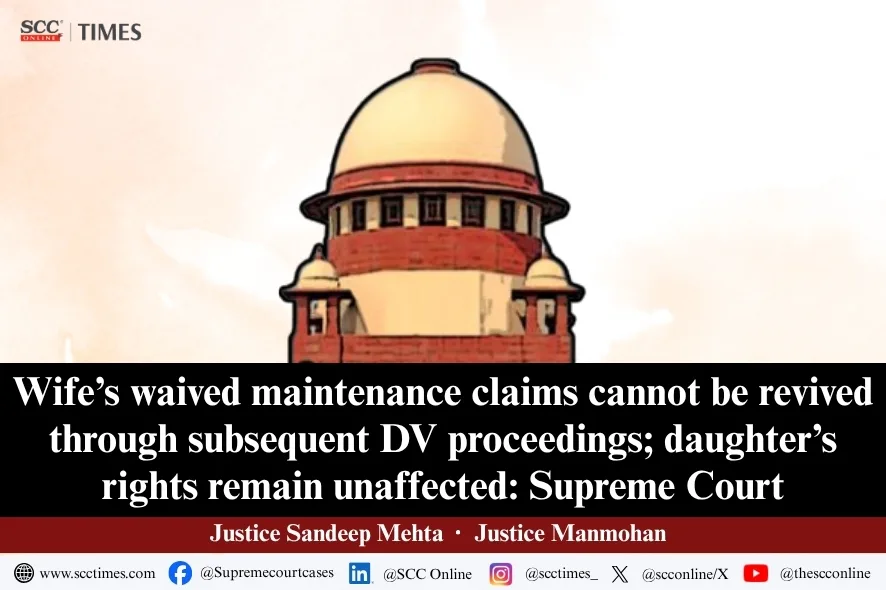
Supreme Court: In an appeal, arising from the Kerala High Court’s dismissal of the appellant-husband’s petition seeking quashing of the proceedings initiated under the Protection of Women from Domestic Violence Act, 2005 (DV Act), raising a substantial question as to whether monetary and maintenance claims that had been expressly relinquished by the wife under a settlement agreement and reaffirmed before the Family Court could subsequently be revived through proceedings under the DV Act, the Division Bench of Sandeep Mehta and Manmohan*, JJ., set aside the impugned judgment and quashed the DV proceeding, holding that a wife’s waiver of maintenance claims under a matrimonial settlement bars their revival through subsequent DV proceedings.
However, the Court clarified that since the daughter, who had attained majority before the settlement was executed, was not a party to the settlement agreement, her independent rights survived.
Factual Matrix
The parties had entered into a settlement agreement dated 23 July 2016 for resolving their disputes. Under the settlement, the wife agreed not to pursue monetary claims against the appellant, including a claim for maintenance. The settlement expressly recorded that all monetary transactions between the parties had come to an end and that neither party would make any monetary claim against the other in future.
Following the settlement, the appellant and Respondent 1 jointly instituted divorce proceedings under Section 10-A, Divorce Act, 1869. A decree of divorce was subsequently granted on 30 January 2017. Before the Family Court, the wife also filed an affidavit dated 24 January 2017 reaffirming that all claims and liabilities between the parties had been settled and that she had relinquished her claim for maintenance. She further stated that there would be no future claims or liabilities arising from their marital relationship and that the divorce petition had been filed voluntarily, without coercion or undue influence.
Despite the settlement and divorce, proceedings under the DV Act were initiated. The appellant approached the High Court seeking quashing of those proceedings. The High Court dismissed his petition on 26 October 2018, leading to the present appeal before the Supreme Court.
Parties’ Contentions
The appellant contended that the proceedings under the DV Act were instituted after the parties had already settled their disputes through the settlement agreement. Further, it was contended that Respondent 2, daughter had been given 2 properties, which had subsequently been sold by her.
The respondents accepted that Respondent 1 had agreed to relinquish her monetary claims, but argued that the settlement had been entered into under duress. It was submitted that the respondents were anxious for a speedy conclusion of the divorce proceedings because they intended to migrate to the United States. According to them, this circumstance had compelled Respondent 1 to accept the appellant’s terms and surrender her monetary claims.
It was further argued that the absence of consideration or maintenance under the settlement demonstrated coercion and a settlement that waived statutory and fundamental rights was contrary to public policy and therefore void. Also, Respondent 2 had not received any properties from the appellant, as the 2 properties relied upon by him were already standing in her name.
Issues for Consideration
-
Whether the wife could revive monetary and maintenance claims through proceedings under the DV Act after voluntarily relinquishing those claims under a settlement agreement and subsequently obtaining a divorce by mutual consent.
-
Whether allegations that the settlement was executed under duress, without a separate legal challenge to the settlement or divorce decree, were sufficient to invalidate the settlement for the purpose of maintaining the subsequent DV proceedings.
-
Whether Respondent 2, who was not a party to the settlement agreement and had already attained majority before its execution, could be treated as having waived her own monetary claims?
Analysis and Reasoning
The Court held that the proceedings under the DV Act, insofar as they sought to revive the wife’s relinquished claims, constituted an abuse of process. The Court held that once the wife had voluntarily relinquished all monetary claims, including maintenance, revival of such claims through subsequent proceedings cannot be permitted.
The Court asserted that the wife had not merely signed the settlement agreement but had subsequently reaffirmed the waiver in an affidavit filed before the Family Court. The settlement agreement expressly stated that the parties would not make monetary claims against each other in future and that the wife would not claim maintenance from the husband. Further, in the affidavit, the wife declared that all claims and liabilities had been settled, that she had relinquished her maintenance claim, and that there would be no future claims arising from the marital relationship. She also expressly stated that the mutual-consent divorce was being pursued of her own free will and that there was no coercion or undue influence.
The Court noted that the respondents had not pleaded any fresh cause of action arising after the divorce. The allegations of domestic violence related to acts that had occurred before the settlement agreement. Thus, the proceedings were not founded upon a new post-settlement or post-divorce occurrence but sought to reopen matters that had already been settled.
The Court noted that the respondents sought to challenge the settlement and divorce on the ground that the wife had entered into the arrangement under duress. However, the wife had not instituted any independent proceedings to set aside the divorce decree or obtain a declaration that the settlement agreement was invalid.
Therefore, the Court held that a mere allegation of coercion, without a corresponding legal challenge to the settlement or decree, could not by itself undo the consequences of the documents voluntarily executed by the parties.
The Court also considered it relevant that the parties were well educated and aware of their rights. In these circumstances, it would be regarded that they had consciously and voluntarily executed the settlement agreement and the joint divorce petition.
The Court relied on Dhananjay Rathi v. Ruchika Rathi, 2026 SCC OnLine SC 587, wherein the Court deprecated the practice of initiating proceedings under the DV Act, despite a valid compromise. It was held that a settlement agreement binds the parties to its terms; any subsequent violation may give rise to appropriate consequential remedies, but the settlement itself cannot simply be ignored.
However, the Court opined that the settlement agreement had been executed only between the husband and wife and the daughter, who had attained majority before the settlement was executed, was not a party to it and therefore, it cannot be said that the daughter had waived her right to monetary claims.
Decision
The Court allowed the appeal, set aside the impugned judgment and order dated 26 October 2018 and quashed the proceedings pending before the Judicial First Class Magistrate Court, Kalamassery.
However, the Court clarified that Respondent 2 could initiate fresh proceedings seeking monetary reliefs against the appellant in accordance with law.
[Reji Baby v. Subi Mary, 2026 SCC OnLine SC 1697, decided on 24-8-2026]
*Judgment Authored by Justice Manmohan
Advocates who appeared in this case:
For the Appellant: Mr. M. Gireesh Kumar, Adv. Mr. Sanjay Singh, Adv. Ms. Sneha Mathew, Adv. Mr. Ankur S. Kulkarni, AoR
For the Respondents: Mr. Wills Mathews, Adv. Mr. Briston George, Adv. Ms. Shivangi Ranjan, Adv. Mr. Dhanesh M. Nair, Adv. Mr. Paul John Edison, Adv. Mr. Rakesh Garg, Adv. Mr. Ashish Gopal Garg, Adv. Ms. Shweta Garg, AoR Mr. Nishe Rajen Shonker, AoR Mr. Zulfiker Ali P.S., AoR Ms. Lebina Baby, Adv. Ms. Anna Oommen, Adv.