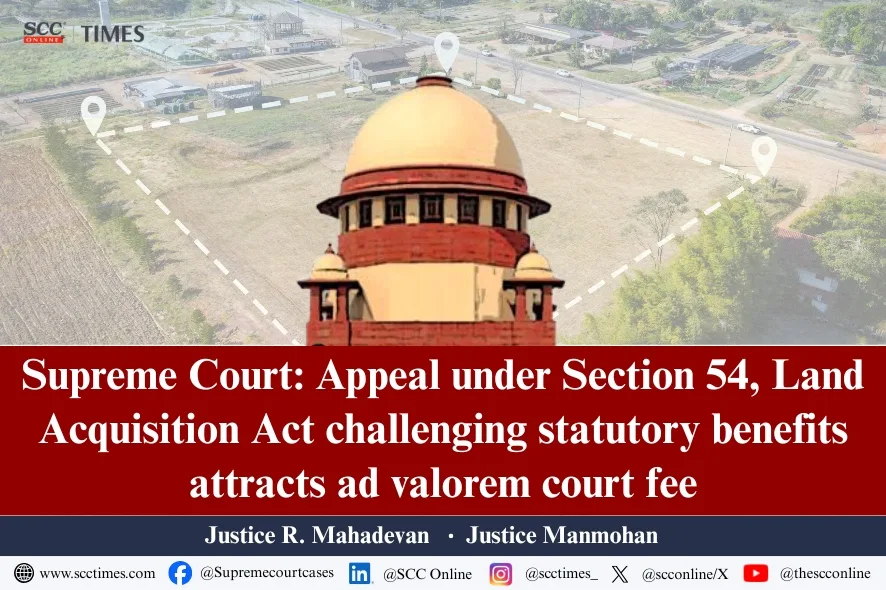
Supreme Court: While considering whether an appeal under Section 54, Land Acquisition Act, 1894, challenging only the statutory benefits awarded under Sections 23(1-A), (2) and 28, attracts ad valorem court fee under Section 8, Court Fees Act, 1870, a Division Bench of R. Mahadevan* and Manmohan, JJ., held that the additional amount, solatium and statutory interest are integral and inseparable components of compensation and cannot be treated as independent statutory claims for the purpose of court fees.
Observing that an appeal seeking reduction or exclusion of these statutory benefits is, in substance, an appeal against the decree relating to compensation, the Court held that such an appeal necessarily attracts ad valorem court fee under Section 8, Court Fees Act, 1870. The Court further clarified that acceptance of deficient court fee by the Registry or the Court does not override the statutory mandate, and in the absence of any legislative amendment exempting statutory benefits from computation of court fee in the State of Uttarakhand, no such exemption can be judicially read into the statute. Consequently, the Court upheld the Uttarakhand High Court’s direction requiring payment of ad valorem court fee and dismissed the appeal.
Background
The dispute arose from land acquired by the State Government for the rehabilitation of Tehri Dam oustees pursuant to a notification issued under Section 4, Land Acquisition Act, 1894. Although the landowners claimed that compensation had not been awarded for the entire acquired area, the Reference Court rejected their plea for enhancement of compensation but granted them statutory benefits under the Act, including the additional amount under Section 23(1-A), solatium under Section 23(2), and statutory interest under Section 28. Aggrieved only by the grant of these statutory benefits, the State preferred a first appeal before the Uttarakhand High Court under Section 54 of the Act. Since the appeal did not challenge the determination or quantum of compensation, the State paid a fixed court fee of ₹10, contending that no ad valorem court fee was payable.
During the pendency of the appeal, the Stamp Reporter opined that the fixed court fee was sufficient as the appeal was confined to the challenge against statutory benefits. However, the High Court disagreed and, by its order dated 25 October 2017, directed the State to pay ad valorem court fee on the decretal amount of ₹2,34,03,602.05, holding that the amount under challenge attracted such payment. Aggrieved by the direction requiring payment of ad valorem court fee despite the appeal being limited to statutory benefits, the State preferred the present civil appeal before the Court.
Analysis
The Supreme Court held that the short question for consideration was whether an appeal under Section 54, Land Acquisition Act, 1894, challenging only the statutory benefits awarded under Sections 23(1-A), (2) and 28, attracts ad valorem court fee under Section 8, Court Fees Act, 1870. Answering the question in the affirmative, the Court observed that Section 8 makes no distinction between the various constituents of compensation and mandates computation of court fee on the difference between the amount awarded and the amount claimed by the appellant. It further held that the scheme of the Land Acquisition Act, 1894 treats the market value, additional amount, solatium and statutory interest as mandatory and inseparable components of compensation, resulting in one composite award.
Relying on Narain Das Jain v. Agra Nagar Mahapalika, (1991) 4 SCC 212, Shree Vijay Cotton & Oil Mills Ltd. v. State of Gujarat, (1991) 1 SCC 262, Periyar & Pareekanni Rubbers Ltd. v. State of Kerala, (1991) 4 SCC 195, the Constitution Bench decisions in Sunder v. Union of India, (2001) 7 SCC 211, and Gurpreet Singh v. Union of India, (2006) 8 SCC 457, as well as Indore Development Authority v. Tarak Singh, (1995) Supp (3) SCC 25, the Court reiterated that statutory benefits are integral to compensation and cannot be compartmentalised for the purpose of court fees. Consequently, an appeal seeking deletion or reduction of such statutory benefits is an appeal against the decree relating to compensation and necessarily attracts ad valorem court fee under Section 8, Court Fees Act, 1870.
Rejecting the appellant’s reliance on earlier High Court decisions, the Court held that those judgments no longer lay down good law in view of the subsequent authoritative pronouncements of the Supreme Court. It further observed that the Court Fees Act, 1870 is a fiscal statute requiring strict construction and that there can be no estoppel against a statute; therefore, acceptance of deficient court fee by the Registry or the Court does not dispense with compliance with the statutory mandate. Noting that the State of Uttarakhand had not enacted any amendment excluding statutory benefits from the computation of court fee, the Court held that no exemption could be read into the statute by judicial interpretation. Applying these settled principles, the Court concluded that the additional amount under Section 23(1-A), solatium under Section 23(2) and statutory interest under Section 28 formed an integral part of the decretal compensation, and the appellant was therefore liable to pay ad valorem court fee on the value of the relief claimed. The Court observed that other States, such as Maharashtra and Haryana, have introduced specific statutory amendments either excluding statutory benefits from computation of court fee or prescribing a fixed court fee for such appeals, reinforcing that any such exemption must flow from an express legislative provision rather than judicial interpretation.
Decision
Finding no error in the High Court’s view, the Supreme Court dismissed the appeal and directed the High Court to proceed with the pending first appeal in accordance with law, while ordering transfer of the amount deposited pursuant to its interim directions to the High Court.
Also Read: Bom HC criticises State over systemic failure in land acquisition proceedings | SCC Times
[Tehri Hydro Development Corpn. Ltd. v. S.P. Singh, 2026 SCC OnLine SC 1459, decided on 31-7-2026]
*Judgment Authored by: Justice R. Mahadevan