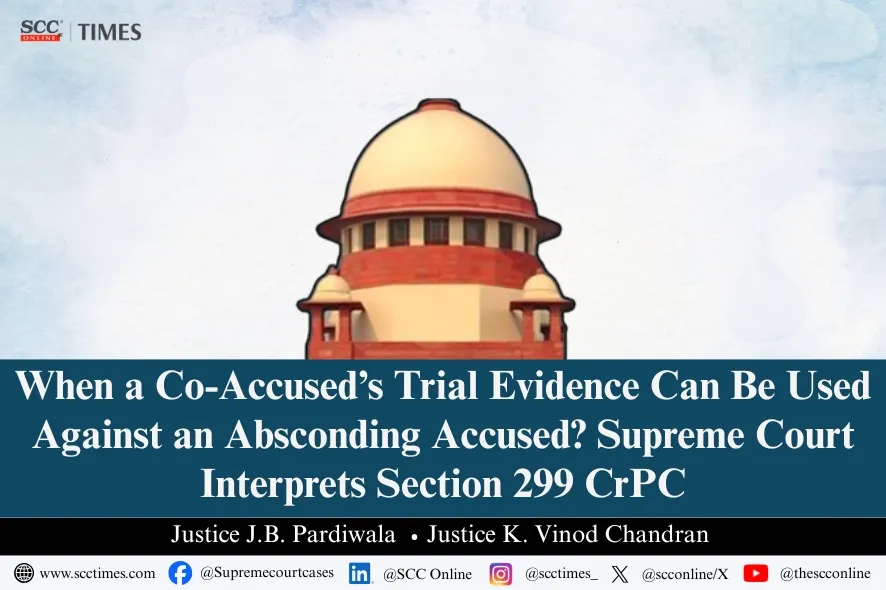
Supreme Court: In an appeal challenging the conviction which was based on testimony of deceased witness recorded during a separate trial of co-accused while he was evading prosecution, the Division Bench of J.B. Pardiwala and K. Vinod Chandran*, JJ., held that only an order passed, finding proof of both the jurisdictional facts, i.e., one that the accused is absconding and the other that there is no immediate prospect of arresting him, would enable testimony of the witness recorded at that stage to be relied on at a later stage. Accordingly, the Court acquitted the accused for lack of an order under Section 299, Criminal Procedure Code, 1973 (CrPC). The appeal was allowed.
Question before the Court
The question before the Court was whether evidence recorded in a trial against one of the accused; the case against the absconding accused having been split up, can be used against that accused when he is arrested later and a fresh trial is conducted.
Discussion on Section 299 CrPC
The Court observed that the issue was no longer res integra and proceeded to examine the decisions interpreting Section 299 CrPC.
The Court first referred to Nirmal Singh v. State of Haryana, (2000) 4 SCC 41, where 2 accused had absconded and the Magistrate recorded the statements of 27 witnesses under Section 299 CrPC. After the accused were apprehended, the testimony of 5 of those witnesses was relied upon to convict them. The Court noted that in Nirmal Singh, Section 299 was explained as comprising 2 parts. The first deals with the circumstances in which evidence may be recorded in the absence of an accused, while the second concerns the circumstances in which such evidence may be used in a subsequent trial without affording the accused an opportunity of cross-examination. The Court further noted that Nirmal Singh held that before recording evidence under Section 299, the Court must be satisfied that the accused had absconded and that there was no immediate prospect of arresting him. The Court also noted that Section 299 was held to be an exception to Section 33, Evidence Act, 1872.
The Court further noted that, in Nirmal Singh, although the Sessions Judge had not expressly recorded satisfaction regarding the second part of Section 299, the High Court found from the original records that repeated summons issued to the 5 witnesses had been returned with reports that they had died. The Supreme Court, therefore, upheld the use of their earlier testimony.
The Court next referred to Jayendra Vishnu Thakur v. State of Maharashtra, (2009) 7 SCC 104, which dealt with the jurisdictional facts contemplated under Section 299 CrPC. The Court noted that, in that case, evidence was directed to be recorded under Section 299 despite the investigating officer having informed the Designated Court that one of the absconding accused had already been arrested. Referring to the observations in Jayendra Vishnu Thakur, the Court noted that Section 299 requires proof of 2 jurisdictional facts: first, that the accused is absconding; and second, that there is no immediate prospect of arresting him. The Court also noted that Jayendra Vishnu Thakur emphasised that both conditions must be read conjunctively and that the Court must arrive at a categorical finding on the basis of cogent evidence before exercising power under Section 299.
The Court thereafter referred to Sukhpal Singh v. State (NCT of Delhi), 2024 SCC OnLine SC 800, wherein reliance was placed on both Nirmal Singh and Jayendra Vishnu Thakur. The Court noted that, in Sukhpal Singh, after the accused was declared a proclaimed offender, permission was granted to proceed under Section 299 CrPC and the complainant’s testimony recorded under that provision was subsequently relied upon after the accused was apprehended. The Court also noted that Sukhpal Singh reiterated that Section 299 requires proof of the 2 jurisdictional facts relating to the accused’s abscondence and the absence of any immediate prospect of arrest before evidence can be recorded in the accused’s absence.
Analysis and Findings
The Court observed that invocation of Section 299 CrPC is possible only when 2 jurisdictional facts are established: that the accused is absconding and that there is no immediate prospect of arresting him. It observed that proof of these jurisdictional facts gives rise to 2 consequences. The first, in praesenti, is that evidence of witnesses may be recorded in the absence of the accused. The second, in futuro, is that such testimony may be used at the subsequent trial after the accused is apprehended, provided the Court is satisfied that the witness is dead, incapable of giving evidence, cannot be found, or that securing the witness’s presence would involve unreasonable delay, expense or inconvenience.
The Court observed that the object of Section 299 is to ensure that an accused does not frustrate the prosecution by deliberately absconding and jeopardise the criminal justice system. The Court further observed that an accused who deliberately remains absconding cannot claim the benefit of the right of cross-examination under Section 33, Evidence Act, 1872, as the provision is founded on the principle that no person can claim the benefit of a wrong committed by himself.
The Court further held that an order under Section 299 must conclusively record satisfaction regarding both jurisdictional facts at the stage when the accused is found absconding, either before committal or during trial, and not after the accused is subsequently apprehended. The Court also explained that where there are multiple accused and one of them absconds, the trial against the remaining accused may proceed after recording satisfaction regarding the jurisdictional facts. In such a case, the testimony recorded during that trial may subsequently be relied upon in the absconding accused’s trial if the Court finds that the witness cannot be found or produced.
Applying the above principles, the Court noted that the appellant and another accused were charged with murder. While the co-accused was tried and acquitted, the appellant absconded and was arrested only in 2017. During the appellant’s trial, PW 1, a crucial eyewitness examined in the earlier trial, had died. Other eyewitnesses either turned hostile or failed to identify the appellant. The trial court and the High Court, therefore, relied upon PW 1’s testimony recorded in the earlier proceedings.
The Court, however, found that no order under Section 299 CrPC had been passed in 1999 either at the stage of committal or at the commencement of trial. The Court observed that the appellant’s abscondence and the impossibility of his immediate arrest ought to have been urged before that Court and proved to its satisfaction. The Court held that only an order recording satisfaction regarding both jurisdictional facts would enable the testimony recorded at that stage to be relied upon subsequently when the witness was no longer available.
Since no such order had been passed in the earlier trial, the Court held that the prosecution failed against the appellant. Accordingly, the Court acquitted the appellant of the charges, directed that he be released if in custody, and ordered that, if already released on bail, his bail bonds would stand cancelled. The appeal was allowed.
[Mahendra Singh v. State of Chhattisgarh, 2026 SCC OnLine SC 1463, decided on 31-7-2026]
*Judgment authored by Justice K. Vinod Chandran.
Advocates who appeared in this case:
For the petitioner: AOR Jayesh K. Unnikrishnan with Sasmita Tripathy, Ashish Kumar Rai, Ayush Baliarsingh, Somesh Sankhala, Advocates
For the respondent: AOR Siddhartha Sinha with Abhishek Pandey, Advocate