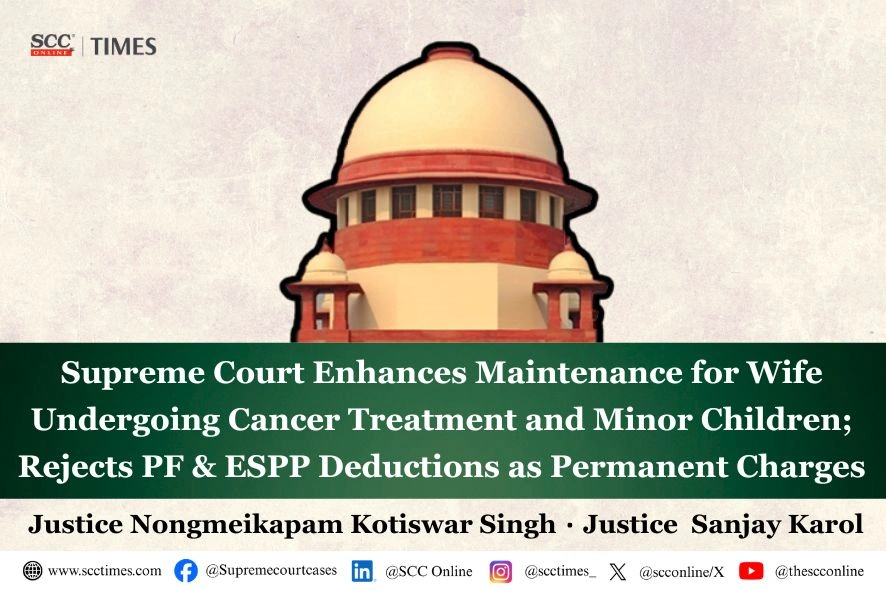
Supreme Court: In a case concerning determination of just and adequate maintenance for a wife undergoing cancer treatment and 2 minor children, a Division Bench of Nongmeikapam Kotiswar Singh* and Sanjay Karol, JJ., reconsidered the quantum of maintenance awarded by the Delhi High Court. The Court held that deductions towards Provident Fund (PF) and Employee Stock Purchase Plans (ESPPs), unlike mandatory deductions such as income tax and professional tax, ultimately accrued as benefits to the husband and could not be treated as permanent charges. Taking into account the wife’s cancer treatment expenses and her responsibility of caring for the 2 children, the Court enhanced her monthly maintenance to ₹30,000 and the children’s maintenance to ₹75,000 each, totalling ₹1,50,000 per month with effect from 1 January 2025.
Background
The marriage between the wife and the husband was solemnised on 9 December 2004 at New Delhi according to Sikh rites. 2 sons were born from the wedlock in 2011 and 2014 respectively. The matrimonial relationship between the parties subsequently deteriorated and the husband left the wife and their 2 minor children on 21 June 2018. The wife thereafter instituted a petition under Section 13(1)(i-a), Hindu Marriage Act, 1955 (HMA), seeking dissolution of marriage. She also sought interim maintenance under Sections 24 and 26 HMA, claiming ₹2,00,000 per month for herself and the children, besides litigation expenses.
By order dated 8 January 2021, the Family Court declined to grant maintenance to the wife but awarded maintenance to the minor children at ₹37,000 per month each, which was subsequently enhanced to ₹ 40,000 per month each with effect from 1 January 2021. The Family Court took into account the respective incomes of the parties, the wife’s liability towards the housing loan EMI and the educational and other expenses of the children. The husband’s challenge to the said order was dismissed by the Delhi High Court on 23 March 2021.
The wife subsequently sought enhancement of the children’s maintenance on account of increased educational and other expenses. By order dated 12 July 2024, the Family Court enhanced the maintenance to ₹50,000 per child per month with effect from April 2024 and held the husband liable to bear the enhanced school fees. During the pendency of the wife’s appeal against the said order, she was diagnosed with aggressive breast cancer on 16 August 2024. Taking note of her medical condition, the Delhi High Court, by order dated 10 December 2024, directed the husband to pay ₹20,000 per month towards her maintenance with effect from 1 December 2024.
The husband’s failure to comply with the maintenance direction led to contempt proceedings before the High Court. His challenge to the order dated 10 December 2024 before the Supreme Court was dismissed on 6 May 2025. Despite the dismissal, the arrears remained unpaid, prompting the High Court to direct his personal appearance and subsequently take steps to secure his presence.
By judgment dated 14 August 2025, the Delhi High Court enhanced the maintenance payable for the 2 minor children to ₹1,25,000 per month with effect from April 2024, observing that the amount awarded by the Family Court was inadequate and that the children were entitled to enjoy facilities commensurate with those available to their parents. The husband also undertook to execute the necessary documents for transfer of the Mahindra XUV500 in favour of the wife. Thereafter, by clarification order dated 2 September 2025, the High Court directed the husband to clear the arrears within 6 months while continuing to pay the enhanced maintenance of ₹1,25,000 per month.
Analysis and Decision
The Court, having considered the submissions and the material placed on record, held that the quantum of maintenance fixed by the High Court required reconsideration. The Court considered the wife’s submission that the deductions from the husband’s salary were voluntary in nature and observed that deductions towards PF and ESPPs ultimately constituted benefits accruing to the husband. Unlike income tax and professional tax, which are mandatory statutory deductions, PF and ESPPs were not permanent charges but would accrue to the husband’s account and could be withdrawn by him in future.
The Court also took into account the expenses incurred towards the wife’s cancer treatment and the fact that she was looking after both minor children residing with her. It noted that the Delhi High Court, by its interim order dated 10 December 2024, had already directed payment of ₹20,000 per month towards the wife’s maintenance, but the same had not been reflected in the final order dated 14 August 2025. Keeping in mind, particularly, the medical expenses, the Supreme Court enhanced the wife’s monthly maintenance to ₹30,000.
With regard to the minor children, the Supreme Court enhanced the monthly maintenance from the amount fixed by the High Court to a total of ₹1,50,000, i.e. ₹75,000 per child, with effect from 1 January 2025. The Court clarified that such enhancement would not preclude the wife from seeking further enhancement as and when there was a change in circumstances.
In relation to the Mahindra XUV500, the Court noted the undertaking given by the husband before the High Court and held that no further direction was required, as the husband was bound to abide by the undertaking. He was directed to do the needful within 3 months from the date of the Supreme Court’s order. With these observations, the civil appeals were disposed of, along with all pending interlocutory applications, if any.
Also Read: All HC: Women’s sacrifice of employment often portrayed as devilish| SCC Times
Also Read: Husband Must Prove Adultery “Ex-Facie” to Deny Maintenance: SC | SCC Times
[Harpreet Sawhney v. Puneet Sharma, Special Leave Petition (Civil) Nos. 31815-31816 of 2025, decided on 10-8-2026]
*Judgement authored by: Justice Nongmeikapam Kotiswar Singh