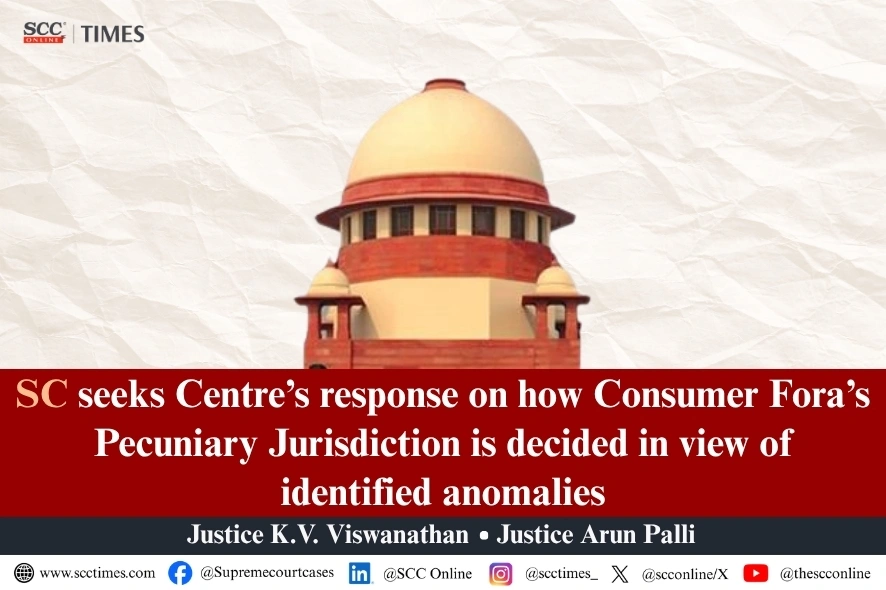
Supreme Court: In a special leave petition raising a substantial question as to whether jurisdiction of the consumer fora would depend on the value of the goods or services paid as consideration or will depend on the amount of compensation claimed, the Division Bench of K.V. Viswanathan and Arun Palli, JJ., found it appropriate to first obtain the Union of India’s response to the formulated anomalies, including disputes involving fixed deposits, savings accounts, subsidised medical services, defects in fixtures and fittings, and defective components of high-value vehicles and therefore, directed the Union of India to file an appropriate affidavit within 6 weeks responding to the same. The Court directed to address the reduction of the National Commission’s pecuniary jurisdiction from ₹10 crore to ₹2 crore.
Background
The petitioner, M/s Avon Elastomers (India) approached the Court challenging the order of the National Disputes Redressal Commission, New Delhi. During the hearing, the Court was presented with competing positions concerning the appropriate basis for determining pecuniary jurisdiction under the consumer-protection framework.
The principal question before the Court was whether the pecuniary jurisdiction of the consumer fora, namely, District Consumer Disputes Redressal Commission (DCDRC), State Consumer Disputes Redressal Commission (SCDRC) and National Consumer Disputes Redressal Commission (NCDRC) is to be determined by the value of the goods or services paid as consideration, or by the amount of compensation claimed.
Petitioner’s Contentions
The petitioner raised concerns about adopting the value of consideration paid for goods or services as the basis of pecuniary jurisdiction. The petitioner advanced that
-
determining jurisdiction on the basis of consideration paid could produce “a whole host of anomalies”.
-
several deficiencies in service could effectively fall outside the practical reach of the appropriate consumer commission if consideration paid were made the decisive criterion.
The petitioner placed several examples before the Court to demonstrate the potential difficulties. It was pointed out that fixed-deposit holders in banks are consumers. However, if a bank were deficient in handling a fixed deposit, it could be difficult to identify consideration paid specifically for the relevant service because, the transaction essentially involves opening a fixed deposit. Similarly, in the case of money lost from a savings bank account, no consideration is paid for the underlying service either.
The petitioner also referred to medical services provided by hospitals where some patients pay charges while others receive services without payment because of subsidy arrangements. Difficulties could arise if the charges actually paid were treated as the basis for determining pecuniary jurisdiction.
Further, for example a consumer who purchased a car worth ₹2.50 crore but complained only about a defective windshield could, on the consideration-based approach, be required to approach the National Commission. Conversely, a consumer who paid an advance of ₹40 lakh for a car and complained of delayed delivery could fall before the District Commission.
Respondent’s Contentions
The Additional Solicitor General submitted that “it is the right of the law-making body to fix the basis for pecuniary jurisdiction”. Further, it was submitted that the validity of the pecuniary-jurisdiction provisions had already been upheld in Rutu Mihir Panchal v. Union of India, 2025 SCC OnLine SC 974.
Respondent 1’s counsel raised an additional point concerning the persons or authorities who may institute proceedings under the Consumer Protection Act, 2019. Referring to Section 2(5), it was pointed out that proceedings before the District, State and National Consumer Commissions are not confined to complaints initiated by individual consumers. Voluntary consumer associations registered under law, the Central Government, State Governments and the Central Authority may also institute proceedings. Further, in cases initiated other than by consumers, the question of paying consideration would not arise at all.
Analysis and Decision
The Court accepted that determining the basis of pecuniary jurisdiction is within the domain of the law-making body. However, it was “anxious to know how the pecuniary jurisdiction will operate” in view of the anomalies identified during the hearing. It expressly clarified that the anomalies discussed are only illustrative and not exhaustive.
The Court found it appropriate to first obtain the Union of India’s response to the anomalies highlighted during the hearing and therefore, directed the Union of India to file an appropriate affidavit within 6 weeks, responding to the anomalies identified by the Court. Further, directed that the affidavit must also explain the rationale for reducing the National Commission’s pecuniary jurisdiction from ₹10 crore under the 2019 Act to ₹2 crore, by Notification dated 30 December 2021.
Having examined Rutu Mihir Panchal, the Court observed that the present case concerns the interpretation of the provisions governing pecuniary jurisdiction. Therefore, for a comprehensive determination, it directed the Ministry of the Union Government concerned to address the issues in its affidavit.
The matter is listed for 8 October 2026.
[Avon Elastomers (India) v. Bajaj Allianz General Insurance Co. Ltd., 2026 SCC OnLine SC 1669, decided on 13-8-2026]
Advocates who appeared in this case:
For the Petitioner: Mr. Gagan Gupta, Sr. Adv. Mr. Anuroop Chakravarti, Adv. Mr. M.s.vishnu Sankaar, Adv. Mr. Aryan Shankar, Adv. Ms. Athira G. Nair, Adv. Mr. Saurabh Gupta, Adv. Mr. Jasbir Singh, Adv. M/s Lawfic, AOR
For the Respondents: Mr. Jagdish Chandra, Adv. Mr. Jagdish Chandra Solanki, Adv. Mr. Vishal Meghwal, AOR (through VC) Ms. Sanskriti Sharma, Adv. Mr. Amit Kumar Singh, AOR Ms. K Enatoli Sema, Adv. Ms. Chubalemla Chang, Adv. Mr. Prang Newmai, Adv. Dr. Surender Singh Hooda, AOR Mr. Vikramjit Banerjee, A.S.G. Mrs. Vanshaja Shukla, Adv. Mr. Bhuvan Mishra, Adv. Mr. Padmesh Mishra, Adv. Mr. Gautam Bhardwaj, Adv. Mr. Gautam Bharadwaj, Adv. Mr. Prashant Rawat, Adv. Ms. Akansha, Adv. Mr. Aditya Kashyap, Adv. Mr. Sahil Bhalotia, Adv. Mr. Amrish Kumar, AOR