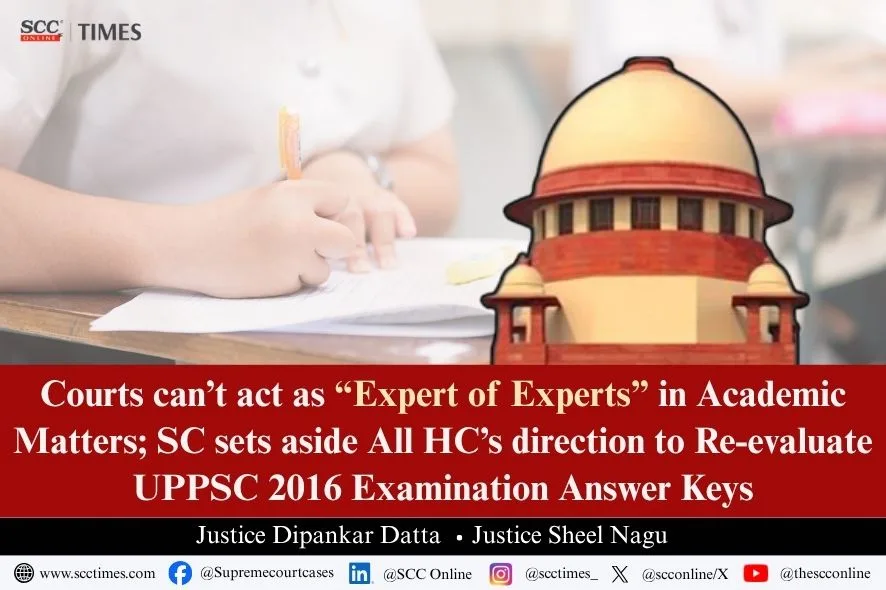
Supreme Court: In an appeal arising from a challenge to the Combined State/Upper Subordinate Services (General Recruitment) Examination, 2016 (General Recruitment Examination 2016) and Combined State/Upper Subordinate Services (Special Recruitment) Examination, 2016 (Special Recruitment Examination 2016), wherein the Allahabad High Court, by judgment and order dated 9 December 2016, had directed the U.P. Public Service Commission (UPPSC) to re-evaluate answer scripts, delete certain questions and award full marks for another, followed by consequential steps in the recruitment process, the Division Bench of Dipankar Datta and Sheel Nagu, JJ., set aside impugned judgment and order of High Court, reiterating that while judicial review of academic matters, courts cannot act as “expert of experts” and directs re-evaluation of examination papers. Relying on the principles laid down in Ran Vijay Singh v. State of U.P., (2018) 2 SCC 357, the Court emphasised that academic matters are best left to experts and that judicial interference in answer-key disputes is warranted only in rare and exceptional cases where a material error is clearly established.
Background
The UPPSC conducted the General Recruitment Examination 2016 and the Special Recruitment Examination 2016. The respondents challenged the examination results before the High Court. The High Court, after considering the statutory framework under the Uttar Pradesh State Public Service Commission (Regulation of Procedure) Act, 1985 (the Act), as well as the procedure followed by the UPPSC in preparing the provisional answer key and considering objections, found discrepancies in certain questions and answers.
Consequently, the High Court directed the UPPSC to:
-
re-evaluate the preliminary examination answer scripts of all candidates after deleting Questions 25, 66 and 92;
-
award full marks for Question 44 to candidates who had exercised options (b) or (c);
-
permit candidates who qualified upon such re-evaluation to appear in the main examination;
-
conduct a fresh main written examination for such candidates;
-
regulate declaration of the results of the main examination already conducted so as to accommodate the candidates qualifying pursuant to re-evaluation; and
-
conduct interviews on the basis of the merit list prepared from the results of both main examinations.
The High Court also directed that candidates who had participated in the first main examination but subsequently failed to qualify in the preliminary examination on account of the re-evaluation would have their candidature cancelled.
While criticising the discrepancies in the question paper and answer key, the High Court observed that the UPPSC should recognise the responsibilities entrusted to it under the Constitution and suggested enhancement of the remuneration paid to experts so that such mistakes were not repeated.
Aggrieved, the UPPSC challenged the High Court’s order before the Supreme Court.
Issue for Determination
Whether the High Court was justified in directing re-evaluation of the preliminary examination answer scripts, deletion of certain questions, award of full marks for another question and consequential conduct of a fresh main examination, thereby interfering with the assessment undertaken by academic experts?
Analysis
The Court examined the High Courts directions in light of the principles reiterated in Ran Vijay Singh v. State of U.P., (2018) 2 SCC 357, and noted that where the applicable statute, rules or regulations do not provide for re-evaluation or scrutiny of answer scripts, judicial intervention can arise only in “rare or exceptional cases” where a material error is demonstrated clearly, without resort to an inferential process of reasoning or rationalisation. The Court had held that “the court should not at all re-evaluate or scrutinise the answer sheets of a candidate—it has no expertise in the matter and academic matters are best left to academics”. It was further emphasised that the answer key should ordinarily be presumed to be correct and that, where doubt persists, the benefit should go to the examination authority rather than the candidate.
Applying these principles, the Court found the High Court had gone beyond the permissible limits of judicial review by scrutinising the allegedly dubious questions in considerable detail “as if it were an expert of experts” and concluded that the directions flowing from such examination were “clearly indefensible”. The Court held that the High Court had “exceeded the jurisdiction of a judicial review court in its interference with the decision of experts in the academic field”.
The Court recorded that, when leave was granted on 7 April 2017, operation of the High Court’s impugned order had been stayed. Consequently, the directions issued by the High Court had not been implemented.
The Court also observed that the writ petition had originally challenged the results of examinations conducted in 2016, and that “much water has flown under the bridge” since then, with fresh examinations likely having been held over the intervening nine years. Noting that the respondents were unrepresented before it, the Court presumed that they had lost interest in the matter.
Decision
The Court set aside the impugned judgment and order of the High Court. Accordingly, allowed the civil appeal and disposed of any pending interlocutory applications.
[U.P. Public Service Commn. v. Sunil Kumar Singh, 2026 SCC OnLine SC 1571, decided on 5-8-2026]
Advocates who appeared in this case:
For the Appellants: Mr. Siddharth, AOR Ms. Himanshi Girdhar, Adv. Mr. Deepanshu Grover, Adv.
For the Respondents: Mr. Satyajeet Kumar, AOR (N/P) Mr. Rajnish Kumar Jha, AOR (N/P) Mr. Satyajeet Kumar, AOR (N/P)