Supreme Court: The present appeal, where both litigants approached the Court expecting vindication, yet “neither of whom has been candid with it”, presents a striking reminder that the machinery of justice cannot be permitted to become a forum for settling personal scores or securing advantage from a controversy of the parties’ own making. While examining the respondent-advocate’s disclosure of confidential communications and recorded conversations of his former client in television interviews, a three-Judge Bench of Vikram Nath, Sandeep Mehta and Vijay Bishnoi, JJ., held that “an advocate cannot use information received in confidence against his client”, even after the professional relationship has ended. At the same time, the Court refused to enhance the punishment at the appellant’s instance, finding that she too had not approached the Court with complete candour.
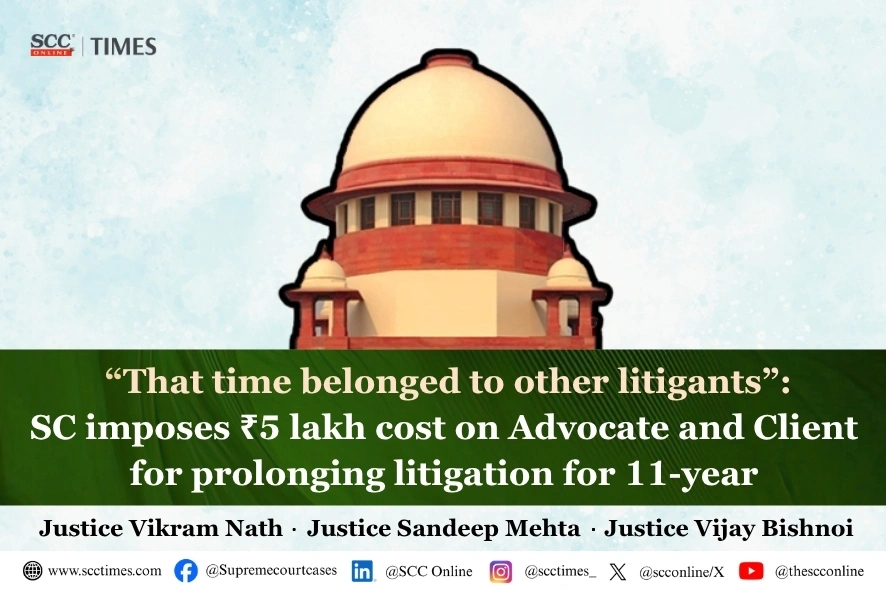
“Each of these parties has come to us complaining of a wrong, and each has been the author of a good part of it. Between them they have occupied the time of the Bar Council of India, a High Court and this Court for eleven years. That time belonged to other litigants, waiting for reliefs they genuinely need.”
Accordingly, the Court dismissed both the appellant and respondent’s appeals and upheld the impugned order passed by the Disciplinary Committee. Recording its strong disapproval of the conduct of both parties of occupying the time of the Bar Council of India, a High Court and this Court for 11 years, which belonged to other genuine litigants waiting for reliefs, the Court imposed costs of ₹5 lakh each, payable to the Supreme Court Legal Services Committee.
Background
The present proceedings arose from a professional-misconduct complaint made by appellant against the respondent, an advocate whom she had engaged as her counsel during 2013—2014. The dispute concerned, principally, the advocate’s disclosure of information and communications arising from the professional relationship to the electronic media.
The appellant alleged that she had approached the respondent in connection with allegations against a senior police official and had shared confidential and sensitive material with him in the course of the engagement. A legal notice was subsequently issued through the respondent’s office to the police official. The parties disputed whether the notice dated 15 July 2014 had been issued with appellant’s authority.
On 24 July 2014, the appellant lodged an FIR against the police official under Sections 376(2), 376-C, 354 and 354-D, Penal Code, 1860 (IPC). The respondent was named in the FIR as a person acting under the influence of the police official. On 28 July 2014, the appellant appeared before the electronic media with her face covered and spoke about her case.
On 5 August 2014, the respondent gave interviews which were broadcast on Aaj Tak and Zee News. During the broadcasts, material concerning his relationship with the appellant, conversations between them and alleged messaging exchanges were placed before the public.
The respondent, for his part, denied that the appellant had ever approached him for the purpose of lodging an FIR against the police official. His case was that the appellant wished to appear on a reality television programme and was seeking to sensationalise the matter to generate publicity and advance her career.
The respondent had, on 4 August 2014, one day before the television broadcast, given his own statement to the Women’s Atrocities Prevention Cell, Crime Branch, addressing the allegations against him.
The appellant further alleged that the respondent had remained in continuous telephonic contact with the police official during the period of his engagement and had met him in person on 18 July 2014, suggesting collusion.
The appellant filed a complaint under Section 35, Advocates Act, 1961 alleging professional misconduct. The matter ultimately came before the Disciplinary Committee of the Bar Council of India. By order dated 11 August 2025, the Disciplinary Committee held that respondents’ action of unauthorised issuance of the legal notice dated 15 July 2014, disclosure of confidential information resulting in appellant’s identification in the media, and derogatory public remarks concerning the appellant, constituted professional misconduct.
The Committee directed that respondent’s name be removed from the roll of advocates for 2 years, during which he was restrained from appearing before any court, tribunal or authority in India and from holding himself out as an advocate. Additionally, it directed payment of ₹3 lakh to the appellant and ₹2 lakh to the Welfare Fund of the Bar Council of India.
Both parties challenged the order, the appellant sought enhancement of the punishment, including permanent removal from the roll and compensation of ₹2 crore and the respondent challenged the finding of misconduct and the disciplinary order itself.
Issues for Determination
-
Whether the finding of professional misconduct against the respondent was sustainable?
-
Whether the punishment imposed by the Disciplinary Committee was so inadequate as to warrant enhancement?
-
Whether the disciplinary proceedings stood vitiated because the final hearing notice had allegedly not been served at his correct and updated address?
Analysis
The Court found no substance in respondent’s contention that he had been denied a reasonable opportunity of hearing. The Court noted that the record shows that he had entered appearance, filed a written statement, was represented by counsel and participated in the recording of evidence. He was aware of the disciplinary proceedings and of the allegations against him throughout their pendency.
Characterising the plea as “flimsy” and an “afterthought”, the Court held that “a party who has been present throughout cannot be heard to say that he was absent, especially one who is himself an advocate”.
On the substantive issue, the Court found that whatever uncertainty surrounded the legal notice dated 15 July 2014, one fact was clear and undisputed that on 5 August 2014 the respondent appeared on television and spoke about his relationship with the appellant, what she had told him and what had passed between them. Recorded conversations and material said to comprise their messaging exchanges were also broadcast.
The Court held that the respondent’s justification could not be accepted merely because the appellant had subsequently named him in the FIR, he was no longer her counsel, or he was facing media accusations.
The Court reiterated the governing principle in unequivocal terms that “an advocate’s duty is not conditional upon the client’s continued good behaviour towards the advocate”. It further held that “an advocate cannot use information received in confidence against his client, and the fact that she has since become his adversary makes no difference”.
The Court further made clear that an advocate who believes himself to have been falsely accused has lawful remedies. He may place his version before the investigating agency or pursue a defamation action. What he cannot do is take his grievance to a television channel and disclose privileged communications, play recorded conversations with former client or publicly describe her complaint as a false case of rape.
Accordingly, the Court held that the finding of professional misconduct on this count was “unassailable” and sufficient by itself to sustain the punishment imposed by the Disciplinary Committee.
Since the finding of professional misconduct concerning the media interview was sustainable, the Court found no ground to interfere with the Disciplinary Committee’s order. Consequently, the respondent’s appeals were dismissed.
On the appellant’s request for enhancement, the Court held that a party seeking enhanced relief must approach the Court with clean hands. The record disclosed that, while the professional engagement subsisted, the appellant and the respondent had discussed means by which the police official might be trapped. The Court asserted that appellant’s conduct was not consistent with the conduct of a client merely seeking legal advice. The Court also noted that the appellant herself had voluntarily appeared before the electronic media on 28 July 2014 and spoken about her case, although she subsequently complained that her case had been made public. Further, it was noted that the police official had been discharged by the trial court on 4 December 2015, the appellant had not challenged that order and discharge had consequently attained finality.
In view of these circumstances, the Court concluded that appellant had not been sufficiently candid about material aspects of the matter and therefore declined to enlarge the relief granted to her.
Decision
Accordingly, the Court:
-
upheld the Disciplinary Committee’s order dated 11 August 2025,
-
dismissed the respondent’s appeals and appellant’s appeal seeking enhancement of punishment,
-
declined to interfere with the 2-year removal of respondent’s name from the roll of advocates, imposing on cost of ₹3 lakh on the respondent to be paid to the appellant and cost of ₹2 lakh to be deposited in the Bar Council of India’s Welfare Fund,
-
imposed costs of ₹5 lakh each on the appellant and the respondent, to be deposited with the Supreme Court Legal Services Committee within 4 weeks.
The Court recorded strong disapproval of the conduct of both parties, observing that the litigation had occupied the time of the Bar Council of India, a High Court and the Supreme Court for 11 years, time which belonged to other litigants genuinely awaiting relief.
[Rehana Khan v. Rizwan Siddhiquee, 2026 SCC OnLine SC 1686, decided on 21-8-2026]
*Judgment Authored by Justice Vikram Nath
Advocates who appeared in this case:
For the Respondent: KARISHMA MARIA, Adv., Arvind S. AVHAD, Adv. and RAM SANKAR & CO