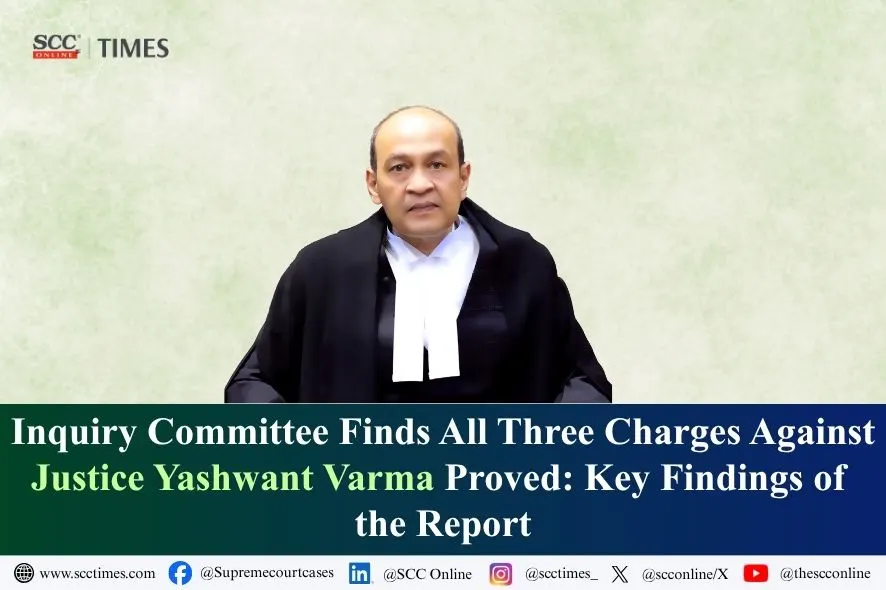
On 12 August 2026, the report of the Inquiry Committee constituted under the Judges (Inquiry) Act, 1968 in relation to Justice Yashwant Varma was laid before the Lok Sabha, along with the oral and documentary evidence recorded during the inquiry.
The Inquiry Committee found all three Articles of Charge against Justice Yashwant Varma proved, concluding that substantial unexplained currency notes were present within his official residential premises, material evidence was not preserved, and the explanations furnished by him were evasive and unsatisfactory.
Background
The report arises out of a fire incident that occurred on the intervening night of 14-15 March 2025 at the official residence of Justice Yashwant Varma at 30, Tughlaq Crescent, New Delhi, when he was a Judge of the Delhi High Court. During firefighting operations, Delhi Fire Services and Delhi Police personnel reported finding burnt, half-burnt and wet Indian currency notes inside a storeroom situated within the premises.
The incident subsequently led to an in-house inquiry, notices for removal in Parliament, and the constitution of a statutory Inquiry Committee under the Judges (Inquiry) Act, 1968.
The Inquiry Committee comprised:
-
Justice Aravind Kumar, Judge, Supreme Court of India (Presiding Officer);
-
Justice Shree Chandrashekhar, Chief Justice of the Bombay High Court; and
-
Senior Advocate B.V. Acharya, Karnataka High Court.
The Committee was constituted under Section 3(2) of the Judges (Inquiry) Act, 1968 after the Speaker of the Lok Sabha admitted a motion seeking the removal of Justice Yashwant Varma under the constitutional framework contained in Articles 124(4), 124(5) and 218 of the Constitution of India.
Also Read: Justice Varma Inquiry Report Submitted to Lok Sabha Speaker; Parliament to Deliberate Next
The Committee framed three Articles of Charge against Justice Varma:
-
Article I: Discovery and possession of unexplained Indian currency notes within the official residential premises.
-
Article II: Failure to preserve material evidence and causing interference with evidence after the fire incident.
-
Article III: Furnishing evasive and misleading explanations regarding the incident and the currency found at the premises.
Key Findings of the Committee:
-
The Committee concluded that substantial quantities of ₹500 denomination currency notes, in burnt, half-burnt, wet and scattered condition, were present inside the storeroom situated within the Judge’s official residence.
-
According to the report:
-
Multiple officials from Delhi Fire Services and Delhi Police independently stated that they saw large quantities of ₹500 notes.
-
Witnesses described bundles, heaps and stacks of notes spread across the room.
-
Videos and photographs recorded at the scene were treated as corroborative material.
-
The Committee held that the presence of currency notes was established even though the exact amount could not be quantified.
-
-
The Committee noted that no currency was seized, no panchanama or inventory was prepared, no sample notes were preserved, and no counting or physical verification was conducted. Accordingly, it declined to determine the exact amount involved.
-
However, it held that the evidence clearly established the presence of substantial quantities of currency and that the inability to quantify the amount did not negate that finding.
-
A key defence advanced was that the storeroom was detached from the main living quarters and accessible to staff and others.
-
The Committee accepted that the room was separate and used for storage but held that it remained part of the official residence under the Judge’s effective control, notwithstanding shared access.
-
The report also referred to the Judge’s own statement that a locked liquor cabinet was kept in the storeroom, concluding that this weakened the argument that the room was entirely outside his control.
-
Justice Varma had suggested that the incident might be the result of a conspiracy and that the currency may have been planted.
-
The Committee held that:
-
No individual was identified as having planted the currency.
-
No evidence was produced showing how the currency entered the premises.
-
No entry by any outsider was established.
-
No material was produced to substantiate allegations of conspiracy.
-
-
The Committee therefore concluded that the theory remained “an assertion, not an explanation”.
-
During cross-examination, suggestions were put that police or fire officials themselves removed the currency and the Committee found:
-
No evidence supported the allegation.
-
Witnesses firmly denied suggestions that they had removed cash.
-
No independent evidence was produced linking first responders to removal of the currency.
-
-
One of the central conclusions of the report is that material evidence was not secured, noting:
-
Currency allegedly seen by several officials was not preserved.
-
The storeroom was not sealed.
-
Inventory was not prepared.
-
The evidentiary condition of the site was altered before lawful inspection.
-
-
The Committee described these lapses as highly significant given that the incident occurred at the official residence of a sitting High Court Judge.
-
After the fire, individuals were observed near the storeroom and later engaged in cleaning activities, while assistance offered by another witness was declined.
-
The Committee concluded that the later disappearance of the currency remained unexplained.
-
The Committee held that, once substantial currency notes were found within the official residential premises, a satisfactory explanation regarding their source, ownership and subsequent disappearance was expected. It concluded that no such explanation was furnished and drew an adverse inference against the Judge.
-
The report records that:
-
The presenting side examined nine witnesses.
-
Witnesses were extensively cross-examined.
-
The Judge was given opportunities to submit a defence witness list and affidavits.
-
No defence witness was ultimately examined.
-
-
The Committee observed that no family member, staff member, security personnel, or other relevant individual relied upon by the Judge was produced as a defence witness to support the factual assertions made.
-
According to the report, the Judge communicated on 9 April 2026 that he was withdrawing from the proceedings and later instructed his advocates not to appear further.
-
The Committee therefore continued the statutory inquiry, holding that unilateral withdrawal after completion of the presenting side’s evidence could not bring the proceedings under the Judges (Inquiry) Act, 1968 to an end.
Findings on the Charges
The charges were framed under Section 3(3) of the Judges (Inquiry) Act, 1968 and communicated to Justice Varma through Form I under the Judges (Inquiry) Rules, 1969.
-
Article I: Unexplained Currency in Official Premises
The Committee held that substantial currency was found within the official residence and that the Judge failed to satisfactorily explain its presence, source, or ownership, thereby rendering the charge PROVED.
-
Article II: Failure to Preserve Evidence
The Committee concluded that material evidence was not preserved, the condition of the storeroom was altered, the subsequent disappearance of the currency remained unexplained, and persons attached to the Judge’s establishment were involved in post-fire activities affecting the scene, thereby rendering the charge PROVED.
-
Article III: Evasive and Misleading Explanations
The Committee found that the Judge’s explanations shifted over time, evolving from an initial denial to unsubstantiated theories of conspiracy, planting, fake currency, and removal by officials, and concluded that the explanations were “evasive, incomplete and misleading in effect”; accordingly, the charge was PROVED.
The Inquiry Committee ultimately held all charges proved, finding that substantial unexplained currency was discovered within the official residence and that Justice Yashwant Varma failed to satisfactorily explain its presence.
[Justice Yashwant Varma Inquiry Report, dated 12-8-2026]