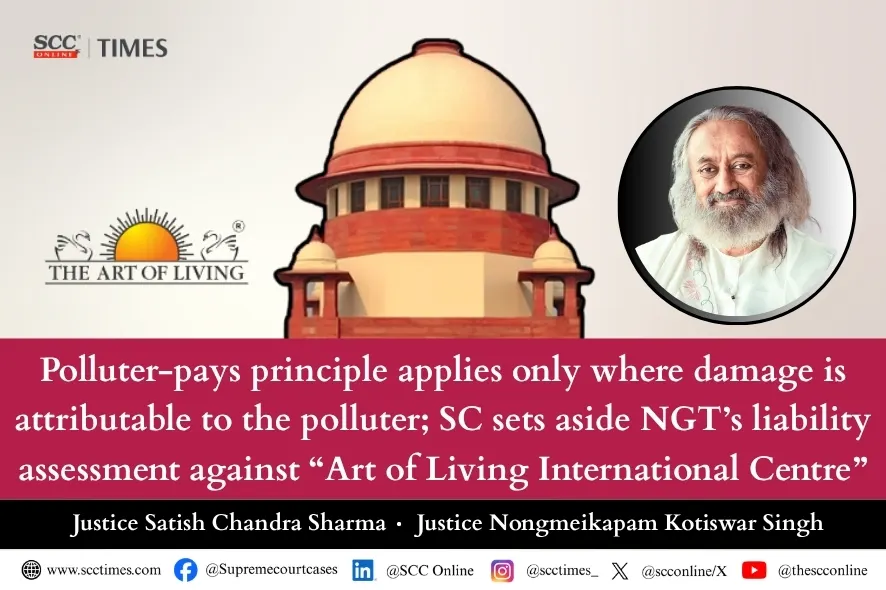
Supreme Court: In an appeal challenging the National Green Tribunal’s (NGT) dated 7 December 2017 in Manoj Misra v. DDA, 2017 SCC OnLine NGT 966, wherein the appellant, the organiser of the 2016 World Culture Festival, “Vyakti Vikas Kendra, India” or as per NGT “Art of Living International Centre”, was held liable for environmental damage allegedly caused to the Yamuna floodplain, the Division Bench of Satish Chandra Sharma* and Nongmeikapam Kotiswar Singh, JJ., found that the floodplain was already in a damaged condition before the site was handed over to the appellant and that the evidence relied on by the NGT did not establish that the appellant caused additional damage. The Court further held that
-
The mere existence of environmental degradation is insufficient. A causal connection between the conduct of the alleged polluter and the environmental damage must be established.
-
Once a person is established to be the polluter, the polluter pays principle can impose absolute liability for the environmental degradation caused by that person. But the principle cannot be applied unless the degradation is attributable to the alleged polluter.
-
The NGT cannot mechanically invoke the statutory no-fault provision where the case does not arise from an “accident” within the meaning contemplated by Section
17(3) ,National Green Tribunal Act, 2010 (NGT Act). -
Restoration and rehabilitation are legally distinct. Restoration seeks to return an affected area to its original state; rehabilitation seeks optimum ecological functionality.
-
Section 15 does not permit expansion of the dispute into a general rehabilitation project. Where proceedings concern damage allegedly caused by a particular private party, compensation/restoration must remain connected to the damage attributable to that party.
-
An interim finding cannot ordinarily become a final adjudication merely because it was not challenged immediately. Particularly where the order itself was stated to be interim and without prejudice, the NGT must reconsider the issue after allowing the parties a meaningful opportunity to contest the factual findings.
-
The State’s obligation to rehabilitate public resources flows from the public trust doctrine and intergenerational equity; private liability arises where environmental damage is actually attributable to the private party.
Accordingly, the Court set aside the impugned NGT judgment, directed to refund ₹5 crore deposit to the appellant, and left the Delhi Development Authority’s (DDA) existing responsibility for rehabilitation of the Yamuna floodplain undisturbed.
Factual Matrix
The appeal arose out of proceedings concerning the World Culture Festival (WCF) organised by Vyakti Vikas Kendra, India on the Yamuna floodplain in Delhi from 11—13 March 2016.
The event site comprised approximately 25 hectares upstream of the DND Flyway on the active floodplain of the Yamuna. The appellant had obtained the requisite permissions from the authorities concerned, including the DDA. The DDA granted permission for the event on 15 December 2015. A total area of 25 hectares was handed over to the appellant in December 2015 and remained with it until 16 April 2016.
Significantly, even before the proceedings concerning the event commenced, the appellant had written to DDA on 14 December 2015, stating that substantial construction material and debris was lying at the site and seeking permission to remove it. DDA subsequently permitted the appellant to remove the debris on 21 December 2015.
Respondent 1 approached the NGT alleging that the proposed event violated the NGT’s earlier judgment in Manoj Misra v. Union of India, 2015 SCC OnLine NGT 840, dated 13 January 2015 (hereinafter referred as “Yamuna Matter”) concerning the Yamuna floodplain. It was alleged that the event involved extensive construction activity on the floodplain and had caused serious ecological damage.
On 19 February 2016, the NGT constituted a High-Powered Committee comprising Professor Babu, Professor A.K. Gosain, Professor Brij Gopal and the Secretary of the Ministry of Water Resources or his nominee. The Committee submitted an interim report on 22 February 2016.
On 9 March 2016, only 2 days before the scheduled event, the NGT in Manoj Misra v. DDA, 2016 SCC OnLine NGT 114, passed an interim order and permitted the event to proceed but imposed environmental compensation of ₹5 crore upon the appellant and required an undertaking regarding the cost of restoration if damage was ultimately established.
The NGT recorded that the floodplain had been “drastically tampered with” and referred to the destruction of natural vegetation, water bodies and wetlands, along with the construction of ramps, roads, pontoon bridges and other temporary or semi-permanent structures.
The appellant complied with the order and furnished the undertaking without prejudice to its rights and contentions. By order dated 4 April 2016, the NGT expressly clarified that its 9 March order was only an interim order and that the rights and contentions of the parties remained open.
Ultimately, the NGT in Manoj Misra v. DDA, 2017 SCC OnLine NGT 966, dated 7 December 2017, held that the appellant was responsible for damage to the Yamuna floodplain and wetlands. It applied the principle of no-fault liability, holding that the appellant had failed to discharge the burden of demonstrating that it had taken all necessary precautions and that no environmental damage had resulted from its activities.
The NGT directed restoration/restitution of the portion allotted to the appellant and required DDA to undertake the restoration works under the guidance of the expert committee. It also directed the development of a biodiversity park and permitted the ₹5 crore deposited by the appellant to be used towards restoration.
Issues for Determination
The Court noted that the legality of the permission granted by DDA was not the issue before it. The real question was whether the appellant had caused environmental damage to the floodplain and, if so, whether it was responsible for restoration or rehabilitation. The Court considered the following questions:
-
Whether the appellant had caused environmental damage to the Yamuna floodplain during the preparation for or conduct of the World Culture Festival?
-
Whether the NGT correctly attributed the pre-existing damage of the floodplain to the appellant.
-
Whether the NGT was justified in treating its interim order dated 9 March 2016 as effectively conclusive on the appellant’s culpability?
-
Whether “restoration” and “rehabilitation” are interchangeable concepts for the purposes of Section
15 ,NGT Act ? -
Whether the NGT correctly invoked the principle of no-fault liability under Section
17(3) ,NGT Act in the circumstances of the case? -
Whether the appellant could be burdened with the cost of rehabilitation and development of the Yamuna floodplain, including the proposed biodiversity park?
Appellant’s Contentions
The appellant principally contended that the site was already in a sordid and damaged condition when it was allotted. It relied on earlier reports in the Yamuna matter, including material showing that the floodplain had suffered extensive degradation even before the appellant received possession. The appellant also relied on its correspondence with DDA regarding construction debris already lying at the site and argued that the expert committee’s later reports were inconsistent with its earlier findings.
It challenged the methodology adopted by the committee, particularly the reliance on a Google satellite image and visual inspections without a scientific benchmark or baseline against which the alleged damage could be measured.
The appellant further argued that restoration and rehabilitation were distinct concepts, that the committee had exceeded its mandate, and that its undertaking given pursuant to the interim order had been furnished without prejudice to its rights.
Respondents’ Contentions
Respondent 1 maintained that the NGT had correctly found that the event was held on the active floodplain in violation of the Tribunal’s earlier directions. It was argued that the expert reports, photographs and the NGT’s interim findings established extensive damage and that the appellant could not escape liability merely because it had obtained permissions.
DDA contended that the permissions granted to the appellant contained adequate safeguards against environmental damage. It also submitted that, pursuant to the Supreme Court’s earlier order dated 20 April 2023, restoration of the allotted area had been undertaken at a cost of approximately ₹8.03 crore, and that the expenditure should ultimately be borne by the appellant under the polluter pays principle.
Analysis
The Court considered the all the expert committee reports. It noted that report dated 22 February 2016 was based principally on a visual inspection and described the condition of the floodplain at that time. It did not establish that the floodplain had been in a better condition immediately before the appellant commenced its preparatory work. The Court held that this distinction was crucial because the issue before the NGT was not merely whether the floodplain was damaged, but whether the appellant had caused the damage. The Court described the report as “inadequate to justify such a finding”.
Following the event, the committee was directed to assess environmental damage and the cost of restoration. The report dated 28 July 2016 described the pre-event floodplain as containing wetlands, natural vegetation, water bodies and agricultural patches, relying substantially on photographs and a Google satellite image dated 5 September 2015. The Court noted that earlier material concerning the same floodplain had described it as being in a damaged and dilapidated condition even before the appellant obtained possession. Consequently, it found the 5 September 2015 satellite image unreliable because it stood in “stark contrast” with the surrounding contemporaneous evidence.
In subsequent report dated 28 November 2016, the committee acknowledged that it was not possible to assess the ecological status of the riparian ecosystem at the site before the event or determine the ecological state to which restoration should be undertaken. It nevertheless proposed a broader programme of ecological rehabilitation, including restoration of ecological functions. The Court considered this a significant departure from the original mandate and observed that the committee had effectively moved from an inability to identify the original ecological condition to recommending rehabilitation of the floodplain.
A separate committee consisting mainly of government officials inspected the site and submitted a report dated 28 July 2017 which stated that the event site was covered with grass, portions were under water, there was no debris, no significant wetland or water body was found within the allotted area, there was no significant difference between the pre-event and post-event Google Earth images, any difference could be attributed to the monsoon, no soil compaction was found and the land had also been used for agriculture.
The Court noted that the NGT rejected this report on the ground that the committee had exceeded its mandate by commenting on damage rather than merely proposing an action plan. The Court disagreed with NGT’s approach and held that, as a neutral fact-finding body, the NGT ought to have considered all relevant material bearing upon liability.
The Court noted that earlier reports had already established that the floodplain was damaged before it was handed over to the appellant. Therefore, the NGT was required to determine whether the appellant’s preparatory activities caused additional damage. It stated that “the whole basis of the lis before the Tribunal was the causation of damage by the appellant and not mere existence of damage on the floodplain”. Thus, the Court held that the NGT had failed to answer that question adequately.
The Court relied on Yamuna matter and noted that 2014 expert report had described the floodplain as damaged, and the NGT’s order dated 14 July 2015 had recorded the failure to implement its earlier directions for rehabilitation. It further noted that the appellant’s letter of 14 December 2015 concerning construction debris was written before the NGT proceedings concerning the event and DDA itself permitted removal of the material. Therefore, the Court asserted that it could be observed with certainty that the site was already in a damaged condition before being handed over to the appellant.
The Court strongly criticised the NGT for allowing its interim order dated 9 March 2016 to determine the course of the entire subsequent proceeding. It emphasised that “the findings in an interim order are interim for a reason”. Such findings are ordinarily not based upon a full appreciation of the evidence.
The Court emphasised that NGT’s observation that the appellant itself failed to challenge the interim order before this Court, is unsustainable. Since the NGT itself had clarified that the order was passed without prejudice to the rights and contentions of the parties, the findings should have been reconsidered when the full evidence became available.
The Court asserted that the interim order had a cascading effect on the remaining proceedings. The subsequent inquiry proceeded on the assumption that extensive damage had already been conclusively attributed to the appellant, leaving the NGT concerned primarily with quantifying damage and determining rehabilitation measures.
The Court opined that NGT fell in “error in equating the distinct concepts of rehabilitation and restoration”. It noted that restoration means bringing the affected area back to its original state and rehabilitation seeks to make the area fully functional and capable of providing optimum ecological services. It explained that restoration focuses upon the original condition, whereas rehabilitation focuses upon optimum ecological functionality.
The Court stated that the distinction between the 2 was decisive because the NGT proceedings were concerned with alleged environmental damage attributable to the appellant and the consequent compensation/restoration under Section
Consequently, the Court held that the NGT could not convert the proceeding into a general exercise for rehabilitating and redeveloping the Yamuna floodplain. The Court held that “rehabilitation of the floodplain was never the issue before the committee or the Tribunal”.
Further, the Court further stated that Section 15 empowered the NGT to order restitution/restoration of the environment and compensation in appropriate circumstances. However, that power did not permit the NGT to impose upon a private party the cost of a broader rehabilitation project where the original condition of the affected site could not even be established. Thus, the Court opined that the NGT “missed the fine distinction between rehabilitation and restitution/restoration” and exceeded the scope of its jurisdiction under Section 15 by directing rehabilitation of the floodplain.
The Court noted the NGT’s direction for the recovery of costs of proposed biodiversity park from the pocket of the appellant. It observed that no biodiversity park had existed at the site before the event. Its development was a consequence of the earlier Yamuna matter and was “a standalone responsibility of the public authorities/DDA concerned”. Therefore, the NGT could not require the appellant to finance development of something which “it never destroyed”.
The Court did not reject the polluter pays principle. On the contrary, it expressly recognised that the principle has acquired a permanent place in Indian environmental jurisprudence and that “the polluter must pay and must be held as absolutely liable for environmental degradation caused by it”.
However, the Court made an important qualification that the person must first be shown to be the polluter. There must be a causal link between the alleged actor’s conduct and the environmental degradation. Without proof of causation, the principle cannot simply be invoked to impose liability. Further, it asserted that the NGT had incorrectly relied on Section 17(3), because that provision specifically directs application of no-fault liability “in case of an accident”.
The Court noted that the present matter was not an accident of the kind contemplated by that provision. Further, the causal link had not been established by any standard as the material on record did not establish that the appellant caused the alleged degradation. There was substantial evidence that the site was already in a dilapidated condition before possession was handed over.
Therefore, the Court disagreed with the NGT’s approach that the appellant had failed to prove that it had not caused the damage. The Court held that the NGT had effectively prevented the appellant from reopening the findings made in the interim order, while overlooking material that supported the appellant’s case.
Although the appellant was exonerated, the Court did not approve of the manner in which DDA had granted permission for the event. It held that permitting the event on an active floodplain was not only avoidable but also inconsistent with the precautionary principle and doctrine of public trust. DDA, as the authority responsible for the ecological maintenance and rehabilitation of the Yamuna floodplain, was required to take preventive measures against further deterioration. The Court found that DDA had failed to act consistently with its duties towards the public at large. Since the legality of DDA’s permission was not before the Court, it did not disturb DDA’s continuing responsibility for rehabilitation of the Yamuna floodplain.
Decision and Directions
The Court directed that:
-
The NGT’s judgment dated 7 December 2017 be set aside.
-
All consequential and interim actions taken against the appellant pursuant to that judgment stand set aside.
-
The appellant was entitled to a refund of ₹5 crore deposited with DDA pursuant to the NGT’s order dated 9 March 2016.
-
DDA must refund the ₹5 crore within 4 weeks from the date of this judgment.
-
DDA should continue to carry out rehabilitation work on the Yamuna floodplains in accordance with the existing plan and the directions issued by the NGT from time to time.
The Court expressly clarified that it had not altered the responsibilities entrusted to DDA concerning management or rehabilitation of the Yamuna floodplains.
Also Read: India’s Mining Revolution: Balancing National Security with Environmental Democracy
[Vyakti Vikas Kendra India v. Manoj Misra, 2026 SCC OnLine SC 1694, decided on 22-8-2026]
*Judgment Authored by Justice Satish Chandra Sharma
Advocates who appeared in this case :
For the Appellant: Mr. Nikhil M. Sakhardande, Sr. Adv. Ms. Rohini Musa, AOR Ms. Shubhra Swami, Adv. Mr. Nipun Katyal, Adv. Mr. Manan Sharma, Adv. Mr. Dhananjay Kumar, Adv.
For the Respondents: Mr. Sanjay Parik, Sr. Adv. Mr. Rahul, Adv. Ms. Srishti Agnihotri, Adv. Ms. Tara, Adv. Ms. K. V. Bharathi Upadhyaya, AOR Mr. Kailash Vasdev, Sr. Adv. Mr. Nitin Mishra, AOR Ms. Mitali Gupta, Adv. Ms. Neoma Vasdev, Adv. Mr. Umrao Singh Rawat, Adv. Ms. Anushka Mamgain, Adv. Ms. Shivani Sethi, Adv. Mr. Mukesh Kumar Maroria, AOR Mrs. Aishwarya Bhati, A.S.G. Mr. Annirudh Sharma Ii, Adv. Mr. Merusagar Samantaray, Adv. Ms. Suhasini Sen, Adv. Mrs. Chitrangda Rastaravara, Adv. Mr. S.N. Terdal (AOR), Adv. Mr. Aishwarya Bhati, A.S.G. Mr. Gurmeet Singh Makker, AOR Ms. Suhashini Sen, Adv. Mr. Merusagar Samantaray, Adv. Mr. Ishaan Sharma, Adv. Mr. Rohan Gupta, Adv. Mr. T S Sabrish, Adv. Ms. Aishwarya Bhati, A.S.G. Mr. Sudarshan Lamba, AOR Ms. Suhasini Sen, Adv. Mr. Merusagar Samantrey, Adv. Mr. Sabarish Subramanium, Adv. Mr. Ishaan Sharma, Adv. Mr. Kamlendra Mishra, AOR Mr. Rajeev Kumar Dubey, Adv. Mr. Ashiwan Mishra, Adv. Ms. Vaidruti Mishra, Adv. Ms. Aditi Mishra, Adv. Mr. Vinod Kumar, Adv. Mr. Suraj, Adv. Mr. Manoj K Mishra, Adv. Mr. Sanjay Parik, Sr. Adv. Mr. Rahul Choudhary, Adv. Ms. Srishti Agnihotri, Adv. Ms. Tara Elizabeth Kurien, Adv. Ms. K. V. Bharathi Upadhyaya, AOR Ms. Itisha Awasthi, Adv. Mr. D.P. Singh, Adv. Ms. Anchal Kanthed, Adv.