2026 SCC Vol. 6 Part 4: Key Supreme Court Cases on Competition Law, IBC, Criminal Law, & more
Explore the latest Supreme Court Cases in 2026 SCC Vol. 6 Part 4 on Competition Act penalty, resolution plan, dearness allowance, and more.
The Court noted that the presence of the appellant at the time of occurrence at the scene of crime has not been proved beyond reasonable doubt and no active role has been assigned to him and the chain of the evidence is not consistent only with the hypothesis of the guilt of the accused.
Supreme Court set aside the conviction of a man who spent 22 years in prison, holding that the prosecution case rested on an unreliable solitary eyewitness account. The Court also emphasised that Constitutional Courts must adopt a proactive approach in condoning delays in criminal appeals filed by convicts.
From a fake AI-generated precedent that voided an insolvency order to a stray bull attack that reshaped animal-welfare law, July 2026 was one of the Supreme Court’s most consequential months. Explore 30+ rulings spanning constitutional law, criminal justice, technology, and human rights, plus the appointments, transfers, and numbers behind the month’s docket.
The Court noted that the respondent was dragged unnecessarily to the High Court by a review prompted by the office of the Chief Minister. The State ought to have accepted the High Court’s interference with a “patently illegal and blatantly tainted” sanction order.
Delhi High Court ruled that a caste-based insult under Section 3(1)(x), SC/ST Act must occur in a place within public view. Finding this essential ingredient absent, it set aside the charge and remanded the case for consideration under the IPC.
The GITAM Moot & Advocacy Committee is proud to announce the 7th edition of the Dr. MVVS Murthi Moot Court Competition which will be held from 7th to 10th of October,
The Court observed that although bail is the rule and jail the exception, and every accused is entitled to the presumption of innocence, the present case stood on a different footing as the earlier orders rejecting the respondent’s bail on merits had attained finality and the trial had already commenced.
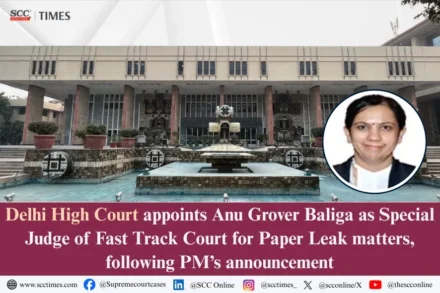
The newly constituted court at Rouse Avenue Courts will exclusively hear offences under the Public Examinations (Prevention of Unfair Means) Act, 2024 and connected offences.
Supreme Court granted bail the appellant, who was alleged to be an attesting witness to a forged Power of Attorney and subsequent sale deeds, after over 11 months of incarceration.
Delhi High Court observes that NSE is a recognised stock exchange performing vital public functions, not an ordinary commercial venture. But whether its MD & CEO, by virtue of that office, qualifies as a “public servant” under Section 2(c)(viii) of the Prevention of Corruption Act is a mixed question of fact and law that must be determined on evidence at trial.
Umar Khalid has been in judicial custody since 2020 and was allowed two e-mulakats a week for six years without violating any prison rule, before the jail reduced it to one in May 2026.
Delhi High Court directed the Deputy Commissioner of Police to inquire into the circumstances in which the investigating officer sought permission to search and arrest an accused despite the subsistence of interim protection from arrest in an anticipatory bail matter.
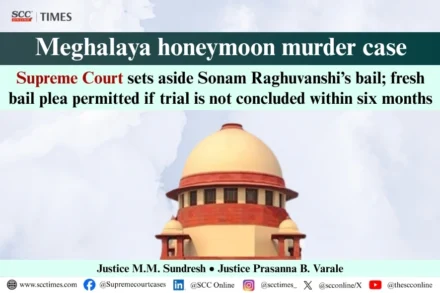
After the High Court upheld the grant of bail to Sonam Raghuvanshi on 29 June 2026, the State of Meghalaya approached the Supreme Court on 1 July 2026 challenging the order. The matter was first heard on 3 July 2026 and has been listed for further hearing on 9 July 2026.
The Court held that while prosecuting offences arising out of the alleged sale or use of Chinese manjha, a Magistrate must record reasons demonstrating application of mind before taking cognizance and issuing summons.
The Court held that absence of external injuries or pending forensic reports cannot, by themselves, justify grant of bail if the trial court had overlooked material circumstances bearing upon the gravity of the offence and the vulnerability of the victim.
The Court was called upon to decide the recurring questions concerning the interpretation of Sections 466-A, 467 and 471, Delhi Municipal Corporation Act, 1957, particularly regarding the limitation applicable to prosecutions for unauthorised construction under Section 332 of the Act.
The Court, however, noted that considering the seminal importance and significance of the issues raised in it, it required a little more research and appreciation of law to decide these issues, which are relevant not only for these proceedings, but also in any other criminal proceedings.
The present case is an unfortunate occasion where despite repeatedly knocking the doors of the Courts below, there had been an inordinate delay of nearly two decades in the investigation of a criminal complaint.
The Supreme Court set aside bail granted to 3 accused in a hospital murder case, holding that the High Court failed to consider their specific roles and serious criminal antecedents. The Court reiterated that custody period and delay in trial cannot alone justify bail in heinous offences involving armed mob violence.