


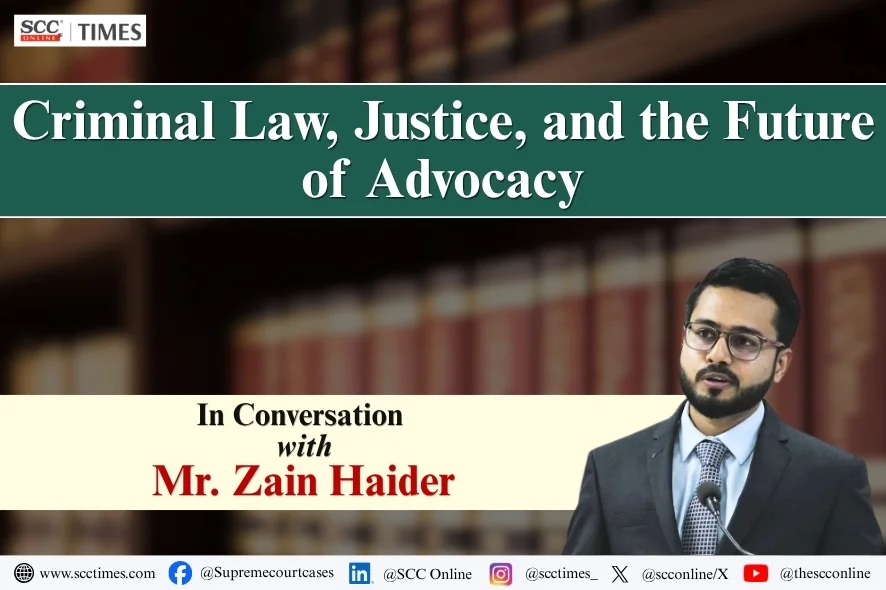
1. To begin with, kindly introduce yourself to our audience. What experiences have shaped the contours of your present practice?
I am Zain Haider. The tenet of “Only a life lived for others is a life worthwhile” has guided me since childhood. Coming from a small town in Uttar Pradesh and having witnessed the disparity in access to justice for marginalised communities prompted me to study law and represent the unrepresented sections of society.
I practice primarily before the Supreme Court of India. I graduated in law from Aligarh Muslim University (AMU) and, before commencing independent practice, worked as a Law Researcher to Senior High Court Judges, where I gained valuable insight into judicial decision-making and courtcraft. I regularly appear in criminal, service, commercial, environmental, and other matters of national importance including minimum wages for prisoners, the legal guarantee of minimum support price (MSP) for farmers, maternity benefits for pregnant and lactating women, the right to education, reservation for Scheduled Castes among converted Christians and Muslims, and the Yamuna Cleaning case and Pegasus case. Recently, I was empanelled as Counsel for the Supreme Court Legal Services Committee.
2. How do you reflect on your Clerkship (Law Researcher) experience? How did close exposure to the judicial decision-making process in criminal matters influence the way in which you conceptualise, prepare, and present criminal cases?
“Do some good courses that can sustain your livelihood; people pursue law when they have nothing else to do.” This was the expression of one of my relatives when I first expressed my interest in pursuing law. Being the first in my family to pursue law, with no guidance and support, the Clerkship gave me an environment both to learn the courtcraft by witnessing court proceedings and assisting the Judge on unsettled questions of law. The Clerkship also provided me with the opportunity for networking, which is much required in the legal profession.
Fortunately, I was attached to a Judge who was a great criminal lawyer, having an extraordinary command over the subject. He was directly elevated from the Bar. In his long-standing career as a lawyer, he worked on both the private side as well as on the government side, such as a Special Public Prosecutor for the Central Bureau of Investigation (CBI). When he became a Judge, he got a criminal roster, so I got good exposure to criminal law, as every day more than 80 matters were getting listed and, since I was the only Law Researcher of his Lordship, I was involved in all the cases of the Chamber.
I worked extensively on cases involving special laws such as Prevention of Money-Laundering Act, 2002 (PMLA), Unlawful Activities (Prevention) Act, 1967 (UAPA), Prevention of Corruption Act, 1988 (PCA), and Narcotic Drugs and Psychotropic Substances Act, 1985 (NDPS). In such cases, getting bail is the toughest thing because of the reverse burden of proof and the twin conditions test. I got the opportunity to witness and record the arguments made by the best criminal law practitioners of the country in high-stakes matters and thereafter assist the Judge in deciding unsettled questions of law. This experience allowed me to know the nitty-gritties of criminal law and the courtcraft, such as how to address the Bench and how to draft a pleading, as most Judges come having read all the files. Therefore, pleadings are equally as important as oral arguments, as a pleading helps form a prima facie view, which is crucial. Ultimately, the work of a lawyer is to assist the court. I believe preparing a good draft definitely helps a Judge, as it makes the task of the court easier.
3. Apart from criminal law practice, you also handle arbitration, service matters, commercial matters, and are also involved in several cases of national importance as you mentioned in your introduction. Based on your experience, should young lawyers specialise early in one field, or explore diverse areas of law before choosing a niche?
I believe the early years of legal practice should be a period of exploration rather than premature specialisation. Exposure to diverse areas of law enables young lawyers to build a strong legal foundation, discover their genuine interests and strengths, and make an informed choice about their area of expertise. While specialisation is essential, it is most meaningful when it is shaped by practical experience rather than preconceived notions.
Therefore, my advice to fellow young lawyers and recent law graduates is to remain intellectually curious and embrace a wide range of matters in the initial years of practice. Broad legal exposure not only develops versatile advocacy skills but also enables lawyers to choose their niche with greater clarity, confidence, and conviction.
4. On the basis of the varied range of criminal matters that you take up, do you think artificial intelligence (AI) will replace criminal lawyers in the future?
I do not believe that AI will reduce the need for criminal lawyers. Rather, it is likely to transform the way criminal lawyers work and the skills that they are expected to possess. Across the criminal justice system, technology is already being integrated through initiatives such as eSakshya for digital evidence management, the Inter-Operable Criminal Justice System (ICJS), AI-assisted transcription, virtual court appearance platforms, and advanced legal research tools. These developments are making legal processes faster, more efficient, and more data-driven.
However, the core functions of a criminal lawyer cannot be easily replaced by AI. Effective advocacy requires legal judgment, strategic decision-making, persuasive oral arguments, cross-examination of witnesses, negotiation, and the ability to build trust with clients. Criminal litigation often involves complex human situations, ethical considerations, and emotional intelligence that remain beyond the capabilities of AI.
Therefore, AI is unlikely to replace criminal lawyers, but it will reshape legal practice. The successful criminal lawyer of the future will combine traditional advocacy skills with technological proficiency, using AI as a tool to enhance efficiency while continuing to perform the uniquely human aspects of legal representation.
5. There is growing interest in the use of AI-assisted tools for drafting petitions and conducting legal research in criminal matters. How do you assess the potential of such tools? What minimum ethical safeguards would you regard as indispensable if they are to be used responsibly?
I believe AI should primarily be used as a research assistant rather than a drafting tool. While it can quickly identify relevant precedents, summarise judgments, and improve research efficiency, drafting petitions is a lawyer’s craft that demands legal reasoning, strategic judgment, and persuasive advocacy skills developed only through years of practice. AI can assist the process, but the responsibility for drafting petitions must always remain with the advocate.
6. What do you regard as the most acute systemic challenges presently confronting the Indian criminal justice system today? Where, in your view, is the need for reform most pressing?
In my view, the Indian criminal justice system is confronted with four interconnected systemic challenges: prolonged delays in investigations and trials, excessive reliance on pre-trial detention, inadequate quality of criminal investigations, and limited access to timely and effective justice for both victims and accused persons.
7. How does Indian criminal law balance the rights of the accused with the legitimate interests of victims and of the community more broadly? Are there particular doctrines or practices which you would identify as either unduly weighing the balance in one direction or failing to give sufficient protection to the other?
Indian criminal law is founded on the principle that it must protect both the rights of the accused and the legitimate interests of victims and society. The rights of the accused, such as the presumption of innocence, the right to a fair trial, and due process, are indispensable in a constitutional democracy because they safeguard individual liberty against arbitrary State action. At the same time, victims are entitled to dignity, participation, protection, and timely justice.
In my view, the larger problem is not that the law disproportionately favours one side over the other, but that systemic shortcomings such as delayed investigations, prolonged trials, excessive pre-trial detention, poor quality of investigation, and inadequate victim support often undermine the rights of both. The focus of reform should therefore be on improving the efficiency, fairness, and accountability of the criminal justice system, rather than diluting the rights of either the accused or the victims.
8. For students and young lawyers contemplating a career in litigation, what qualities do you consider most critical?
Patience, consistency, discipline, and intellectual curiosity are indispensable qualities for anyone aspiring to succeed in litigation. I would also encourage every law student and young lawyer to read Justice Felix Frankfurter’s “Letter of Advice to a Young Person Interested in Going into the Law”, where he emphasises that a lawyer must be a cultivated and well-read person, capable of clear thinking and effective communication. In my view, those qualities remain just as essential today as they were when Justice Frankfurter wrote them.
1. Advocate, Supreme Court of India.
2. EBC-SCC Online Foreign Student Ambassador, Queen Mary University of London.





