








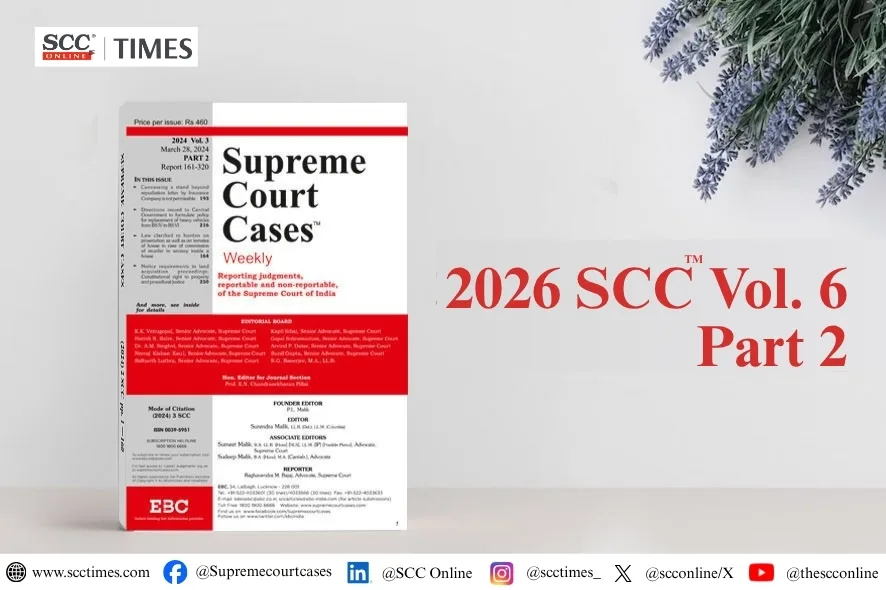
This volume of the Supreme Court Cases (SCC), Part 2 of Volume 6, embodies landmark cases decided by the Supreme Court on issues like right to dignity and the ideal of fraternity, death due to COVID-19 vaccination, inference of title and identity of property, and more.
Civil Procedure Code, 1908 — S. 105(1), S. 104 r/w Or. 43, S. 94 and Or. 2 R. 2 — Interlocutory order — Challenge to, in appeal against final decree: Even if rejection of an interlocutory application on maintainability under Or. 2 R. 2 has not been appealed against, it can still be challenged while appealing final decree, as such rejection does not attain finality nor bar its reagitation at appellate stage, [Channappa v. Parvatewwa, (2026) 6 SCC 271]
Conservation of Foreign Exchange and Prevention of Smuggling Activities Act, 1974 (COFEPOSA) — Ss. 3(1), 8(c) & (e) — Preventive detention — Legal assistance before the Advisory Board: Preventive detenus under COFEPOSA cannot seek legal assistance as a matter of right, [Priyanka Sarkariya v. Union of India, (2026) 6 SCC 336]
Constitution of India — Arts. 21, 32, 14, 19(1)(a) & (2), Arts. 51-A & 51-A(e) and Preamble: Right to dignity and the ideal of fraternity visà- vis right to freedom of speech and expression and creative freedom of a film maker, clarified. Positive and conciliatory approach of the party producing the film concerned with the alleged offending title and duty of Court and manner of disposal, explained, [Atul Mishra v. Union of India, (2026) 6 SCC 294]
Criminal Procedure Code, 1973 — S. 438 r/w Ss. 82 and 83 — Anticipatory bail: Validity of order granting bail, when accused remained absconding and never cooperated with the investigation, determined, [Balmukund Singh Gautam v. State of M.P., (2026) 6 SCC 216]
Criminal Procedure Code, 1973 — Ss. 218 to 223 and 482: Separate trial, held, permissible where the offences form part of the same transaction or the conditions in Ss. 219 to 223 are satisfied, but even then it held a matter of judicial discretion. Decision to hold a joint or separate trial, held, must ordinarily be taken at the outset of the proceedings and for cogent reasons. Two paramount considerations in such decision making, held, whether a joint trial would cause prejudice to the accused, and whether it would occasion delay or wastage of judicial time, [Mamman Khan v. State of Haryana, (2026) 6 SCC 192]
Human and Civil Rights — Humanitarian and Natural Disasters, Epidemics and Pandemics — Generally — Onset of unwarranted situations having grave consequences: Union Government directed to establish a no-fault compensation framework for individuals who suffered serious Adverse Events Following Immunization (AEFI) or death due to COVID-19 vaccination, [Rachana Gangu v. Union of India, (2026) 6 SCC 317]
Penal Code, 1860 — S. 306 r/w S. 107 — Abetment of suicide: Determining factors for requisite mens rea on part of accused, explained, [Abhinav Mohan Delkar v. State of Maharashtra, (2026) 6 SCC 233]
Penal Code, 1860 — S. 306 r/w Ss. 107 and 34 — Scope and applicability: Absence of prima facie case since there was a gap of more than one month between the alleged instigation and the commission of suicide and delayed FIR, as factors, [Prakash v. State of Maharashtra, (2026) 6 SCC 251]
Specific Relief Act, 1963 — S. 34 — Title and identity of property: Inference of title and identity of property, without proper adjudication, not permissible, [Ravi Kala v. Casablanca Estate, (2026) 6 SCC 208]





0 replies