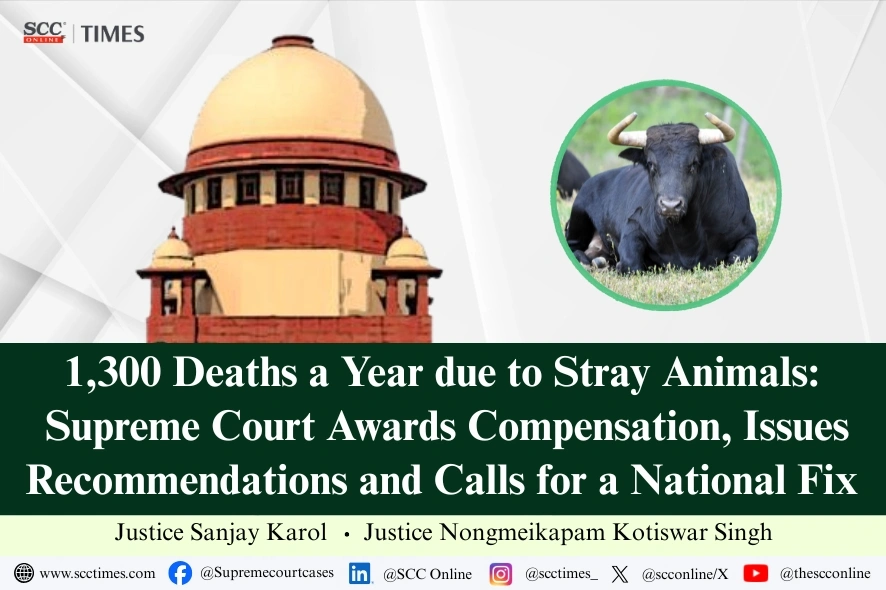
Supreme Court: While considering an appeal against the Punjab and Haryana High Court’s decision relegating the claimants to a civil suit in a compensation claim arising from a fatal stray bull attack, a Division Bench comprising of Sanjay Karol* and Nongmeikapam Kotiswar Singh, JJ., held that after the efflux of nearly 2 decades, directing the claimants to pursue a civil remedy would leave them “remediless”, rendering such a course unjust, unfair and inequitable.
Observing that bovine-related accidents are “not few and far between”, the Court awarded a lump sum compensation of ₹15 lakhs to the appellant, while issuing a series of recommendations to the Union and State Governments for the implementation of cattle laws, development of a compensation mechanism for bovine-related accidents, mandatory tagging of animals, and strengthening of animal shelter management to safeguard both human lives and animal welfare. Citing government data, the Court noted that animal attacks killed 1,130 persons across India in 2018, 1,425 in 2019, and 1,305 in 2020.
Background
The appeal was preferred by Nisha, widow of the deceased Vijay Kumar, against the judgment of the Division Bench of the Punjab and Haryana High Court, which had set aside the order of the learned Single Judge awarding compensation of ₹29.32 lakhs along with interest. The deceased had sought compensation of ₹1 crore from the Deputy Commissioner. The original compensation of ₹29.32 lakh awarded by the Single Judge carried 6% interest per annum from 1 September 2012.
The Division Bench held that the writ petition was not maintainable under Article 226 of the Constitution as the case involved disputed questions of fact and granted liberty to the appellant to pursue an appropriate remedy before the competent civil court.
The case arose from an incident that occurred on 21 September 2007, when Vijay Kumar was attacked by a stray bull while walking on a public road, resulting in a serious head injury that rendered him unconscious. The incident was reported to the police, and a daily diary report (DDR) was duly recorded. Although Vijay Kumar sought compensation from the authorities concerned during his lifetime, his claim did not receive any response. Following his demise, his widow approached the High Court by way of a writ petition seeking compensation on account of the alleged failure of the authorities to control stray cattle. The learned Single Judge allowed the petition and awarded compensation by applying the principles governing assessment of compensation under the Motor Vehicles Act, 1988. Aggrieved by the reversal of that decision by the Division Bench, the appellant approached the Supreme Court.
Analysis
The Court held that although the reasoning of the Division Bench appeared appealing at first blush, a closer examination of the facts warranted a different conclusion. The Court observed that the writ petition had remained pending since 2010 and was decided by the Single Judge only in 2019, while the Division Bench rendered its judgment in 2025. In such circumstances, relegating the claimants to a civil suit after the efflux of nearly 2 decades would leave them “remediless”, which would be unjust, unfair and inequitable. On this short ground alone, the impugned judgment warranted interference and the matter deserved adjudication on merits.
On examining the record, the Court found that the occurrence of the incident had never been disputed. The deceased had approached the Deputy Commissioner seeking compensation, but the claim was rejected only on the ground that no fund was available for payment of compensation. The incident had also been reported to the police and a DDR had been recorded, while a legal notice issued by the deceased remained unanswered. The Court, therefore, held that no disputed questions of fact arose so as to non-suit the appellant in writ jurisdiction.
The Court further observed that bovine-related accidents had become common place and raised concerns extending beyond the facts of the present case. Referring to Articles 48 and 51-A(g) of the Constitution, the Prevention of Cruelty to Animals Act, 1960, the Cattle Trespass Act, 1871, and various State legislations, the Court emphasised the constitutional and statutory obligation of the State and citizens alike to ensure the welfare of animals while simultaneously safeguarding human life. The Court cited the seven-judge Bench decision in State of Gujarat v. Mirzapur Moti Kureshi Kassab Jamat, (2005) 8 SCC 534, which held that the fundamental duty to “have compassion for living creatures” under Article 51-A(g) reinforces the Directive Principles under Articles 48 and 48-A. The Court also referred to Animal Welfare Board of India v. A. Nagaraja, (2014) 7 SCC 547, which recognised that every species has an inherent right to a dignified life, and to the Constitution Bench ruling in Animal Welfare Board of India v. Union of India, (2023) 9 SCC 322, which clarified that while animals must be protected from unnecessary pain and suffering, this obligation is not absolute. Tracing the issue further back, the Court cited the Constitution Bench decision in Mohd. Hanif Quareshi v. State of Bihar, 1958 SCC OnLine SC 176, on the economic and welfare concerns posed by unproductive or abandoned cattle.
The Court, hence, underlined the need for effective mechanisms to prevent stray cattle from roaming on public roads, including proper animal shelters, tagging of animals, and accountability of owners and Local Authorities.
As regards compensation, the Court held that the method adopted by the Single Judge of applying the principles under the Motor Vehicles Act, 1988 could not be accepted as a matter of rule in every case involving bovine-related accidents. While noting that the Punjab Municipal Bye-laws framed in 2020 and amended in 2023 now prescribe fixed compensation for such incidents, the Court observed that those provisions were inapplicable to the present case, which arose in 2007. Under these Bye-laws, compensation was fixed at ₹5 lakh in case of death and ₹2 lakh for permanent incapacitation. Considering the prolonged pendency of the matter and the severe injuries suffered by the deceased before his death, the Court deemed it appropriate to award a lump sum compensation of ₹15 lakhs to the appellant, directing that the amount be remitted within 4 weeks. The Court clarified that the order had been passed in the attending facts and circumstances of the case and shall not be treated as a precedent.
Decision
Before parting, the Court issued a series of recommendations to the Union and State Governments:
-
States should ensure complete and immediate implementation of their cattle laws in letter and spirit.
-
Necessary amendments or rules should be made to develop a mechanism for payment of compensation in bovine-related pedestrian and vehicular accidents.
-
Tagging of all animals should be mandated to facilitate tracking, veterinary check-ups and vaccinations.
-
Owners letting go of animals should be held responsible for their safe transfer to authorised shelters with due updation of tagging records.
-
A nodal officer should be deputed in every Corporation/Department to oversee tagging, digitisation of records and smooth functioning of animal shelters.
-
A copy of the judgment be sent to all Chief Secretaries, UT Administrators and Member-Secretaries of the State Legal Services Authorities for appropriate action.
Accordingly, the appeal was allowed and the judgment of the Division Bench was set aside.
Also Read: Stray Cattle on Roads causing accidents| Chh HC directs NHAI to file affidavit | SCC Times
[Nisha v. Municipal Council Sangrur, 2026 SCC OnLine SC 1464, decided on 31-7-2026]
*Judgment Authored by: Justice Sanjay Karol