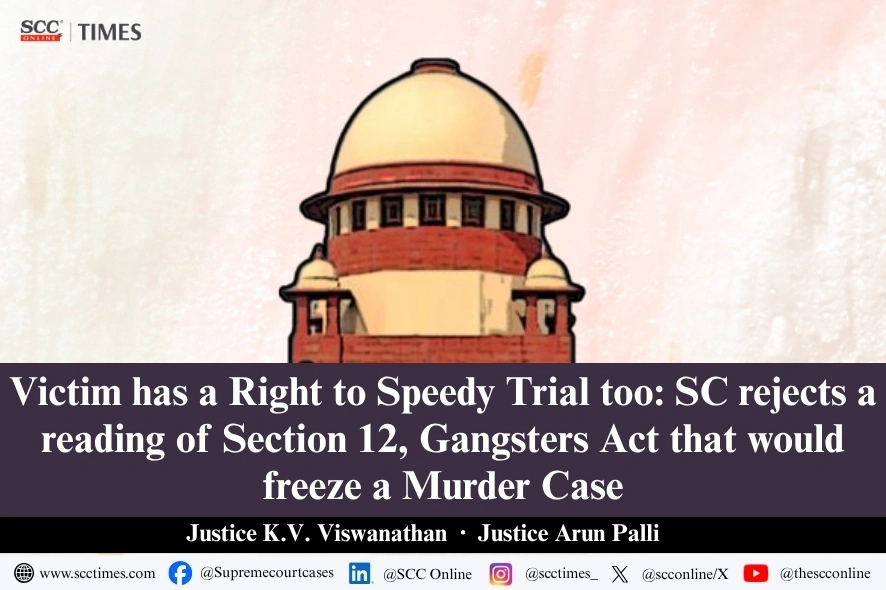
Supreme Court: In a case concerning the interpretation of Section 12, Uttar Pradesh Gangsters and Anti-Social Activities (Prevention) Act, 1986 (Gangsters Act) and its effect on a pending sessions trial, a Division Bench of K.V. Viswanathan* and Arun Palli, JJ., held that Section 12 does not contemplate keeping other criminal proceedings in abeyance until conclusion of the proceedings under the Gangsters Act. The Court clarified that the provision is intended only to resolve a clash of dates, in which event proceedings under the Gangsters Act are to be given preference. Emphasising the mandate of Section 346, Nagarik Suraksha Sanhita, 2023 (BNSS) for expeditious conclusion of trials and the victim’s right to speedy trial under Article 21, the Court held that Section 12 cannot be construed to permit indefinite deferment of other criminal proceedings. Finding that there was no clash of dates in the present case, as the sessions trial had substantially progressed while the Gangsters Act proceedings had not even commenced, the Court set aside the Allahabad High Court’s order directing the trial to be kept in abeyance. The appeal was accordingly allowed.
Background
The present appeal arises out of an order dated 25 August 2025 passed by the Allahabad High Court in Criminal Revision No. 1669 of 2025, whereby the High Court set aside the order of the Sessions Court dated 3 March 2025 and directed that the trial in Session Trial No. 934 of 2023 be kept in abeyance in view of the proceedings under Gangsters Act.
The appellant, brother of the deceased Raghvendra Singh, lodged FIR No. 0342 of 2023 on 30 September 2023 at Police Station Talbehat, District Lalitpur, alleging that 9 accused persons, including Respondent 1, had assaulted and brutally beaten the deceased with lathis, stones and metal rods, resulting in his death. Following investigation, charge-sheets were filed against 7 accused persons under Sections 147, 323, 504, 506, 302 and 427, Penal Code, 1860 (IPC). Cognizance was taken on 27 November 2023 and the case was thereafter committed to the Sessions Court, where it was registered as Session Trial No. 934 of 2023.
During the pendency of the sessions trial, a Gang Chart was prepared on the allegation that the accused had committed the offence as members of a gang. Consequently, FIR No. 0001 of 2024 was registered on 1 January 2024 under Section 2(b)(i), Gangsters Act. The High Court had earlier directed, while considering the bail application of one of the accused, that the sessions trial be conducted on a day-to-day basis and concluded within 1 year.
On 18 January 2025, the accused sought abeyance of the sessions trial, contending that the proceedings under the Gangsters Act ought to take precedence in view of Section 12, Gangsters Act. The Sessions Court, relying upon the decision of this Court in Dharmendra Kirthal v. State of U.P., (2013) 8 SCC 368, rejected the application on 3 March 2025, holding that Section 12 did not warrant postponement of the IPC trial, particularly when the trial had substantially progressed. However, in revision, the Allahabad High Court accepted the accused’s contention, set aside the Sessions Court’s order and directed that Session Trial No. 934 of 2023 be kept in abeyance while expediting the Gangsters Act proceedings.
During the pendency of the present appeal, this Court, on 13 April 2026, stayed the High Court’s order and directed the trial court to proceed with the trial and conclude it within 2 months. The Sessions Court has since concluded the trial and convicted all the accused under Section 302 IPC, among other offences, and a compliance report has been received. The present appeal was thereafter heard by this Court.
Analysis
The Court held that Section 12, Gangsters Act does not contemplate keeping other criminal proceedings in abeyance until conclusion of the proceedings under the Gangsters Act. Its object is limited: where there is a clash of dates, proceedings under the Gangsters Act are to be given preference. The provision is thus intended to resolve a conflict of proceedings, and not to operate as a statutory freeze on all other trials.
Reading Section 12 harmoniously with Section 346 BNSS, corresponding to Section 309 CrPC, the Court emphasised the legislative mandate for expeditious trial. Proceedings are required to continue from day to day until the witnesses in attendance have been examined, save where adjournment beyond the following day is necessary for reasons to be recorded. The interpretation sought by the accused, if accepted, would defeat this mandate and permit indefinite deferment of other trials merely because proceedings under the Gangsters Act were pending.
The Court also relied on a Single Judge decision of the Allahabad High Court in Mobin Iftikhar Zaidi v. State of U.P., 2011 SCC OnLine All 4160, which similarly held that Section 12 was intended to ensure the Gangsters Act trial is not delayed by clashing dates, not to require other trials to be stayed pending its conclusion.The Court further underscored that the right to speedy trial under Article 21 is not confined to the accused but extends to the victim as well. In support of the victim’s right to speedy trial, the Court relied on Rattiram v. State of M.P., (2012) 4 SCC 516, which held that speedy trial is not the exclusive entitlement of the accused, and that delay can cause acute suffering to the victim, who may in some cases suffer even more than the accused. Prolonged delay may result in deterioration of evidence, witnesses becoming unavailable and fading of human memory, thereby causing serious prejudice to the victim and society at large. An interpretation of Section 12 which facilitates such delay cannot be countenanced.
Decision
Applying the above principles, the Court found that the trial court had rightly rejected the accused’s application seeking abeyance of Session Trial No. 934 of 2023. Charges had already been framed on 26 February 2024 and, by 8 January 2025, the prosecution had completed its evidence, with statements under Section 313 of the accused scheduled to be recorded. The application for keeping the trial in abeyance was filed only thereafter, whereas the trial under the Gangsters Act had not even commenced and the charge-sheet had only recently been submitted. There was, therefore, no clash of dates so as to attract Section 12, Gangsters Act.
The High Court, despite correctly noticing that Section 12 was intended only to address a clash of dates, erred in directing that the other trial be kept in abeyance. The Supreme Court accordingly set aside the High Court’s order dated 25 August 2025. It was noted that, pursuant to the interim order dated 13 April 2026, Session Trial No. 934 of 2023 had already concluded and the accused stood convicted.
The appeal was accordingly allowed.
[Keshvendra Singh v. Shankar Singh, 2026 SCC OnLine SC 1588, decided on 17-8-2026]
*Judgment authored by: Justice K. V. Viswanathan
Advocates who appeared in this case:
For the Appellant: Aviral Kashyap, Advocate
For the Respondent: Ashish Pandey, Advocate
For State: Arup Banerjee, Advocate