


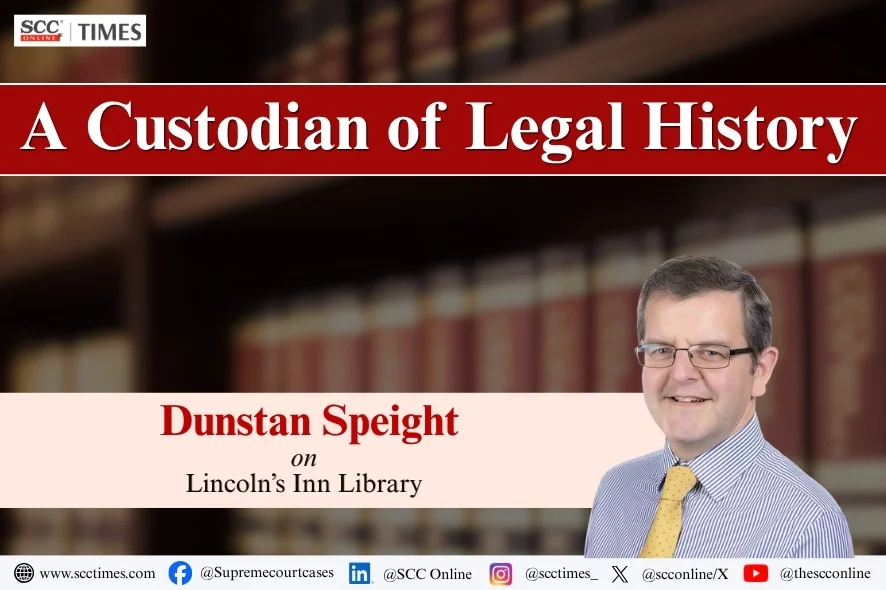
With a professional career dedicated to law librarianship, Dunstan Speight has worked across the libraries of the Inns of Court, the Law Society, and leading law firms. In his current role, he is responsible for Lincoln’s Inn’s library services, archives, and historic collections. His work brings together legal research, knowledge management, and the preservation of the legal profession’s rich heritage. Through the Library’s extensive print and digital resources, he supports barristers and Bar students in their research and professional development, while also safeguarding one of the country’s important collections of legal books, manuscripts, and archival records.
1. Kindly briefly introduce yourself and outline your role as librarian at Lincoln’s Inn.
I am Dunstan Speight, Librarian of Lincoln’s Inn, one of the four Inns of Court. I have been the librarian here for the past ten years. Prior to that, I worked for sixteen years in law firm libraries and, further back, at the Law Society and the Middle Temple. I manage a team of eight librarians and archivists and am also responsible for the Inn’s chattels — its paintings and other works of art. Finally, I am responsible for the budget and staffing requirements for the Inn’s Chapel and musicians.
2. How has your journey at Lincoln’s Inn evolved since you first joined? What have been some defining moments in your tenure?
It takes quite a time to build up a sufficient knowledge of the library, its collections and the Inn’s history to feel that one is contributing something useful. Even after ten years here, I still feel that I have only scratched the surface of this job. The Inn has been in existence since at least 1417 and the library since at least 1505. There is a tantalising, ambiguous reference to 1475 which, if it does refer to a library at the Inn, would make this the earliest law library in the country and the oldest library in London to have been in continuous existence.
The easiest aspect of my job in many ways is its primary purpose of providing a library service for the practising barristers and the Bar students. This is broadly equivalent of what I was doing in law firms. Here, as there, the challenge is in managing the budget to obtain the best array of resources.
One of my first priorities was building up the range of training courses which we offer — again, something familiar from law firms. I am a firm believer in training being one of the core skills of all law librarians and all our research librarians now carry out training courses.
One unfamiliar task which faced me on joining the Inn was the project to build a new library office and extend the library store. Happily, my predecessor had done all the hard work in making the business case for this project and securing the finance. Although, planning permission had been secured, and the project was overseen by our Estates department, but the three years of trying to maintain a library service in the middle of a building site was not without its challenges. The end result was well worth the inconvenience.
The Library and Archives team also face the challenge of maintaining historic collections in an old building. Our climate-controlled strong rooms were a particular concern. They had a propensity to fail in hot, humid weather, exactly when they were needed most. We are just approaching the end of a major project to replace the air conditioning in both the Library and Archives strong rooms.
Responsibility for the art collection has also had its sticky moments, with several paintings damaged by leaks. The compensation for the horror of discovering such incidents is the fascination of seeing the extraordinary skills of conservators in undoing the damage. Fortunately, in both the rare books world and the art world, one is not alone in facing these challenges and colleagues are generous in providing advice and assistance.
The Covid Pandemic was as defining a moment for the library as it was for every other organisation. When the government restrictions were imposed, I thought that it would be a “make or break” incident for the library. Happily, it was a “make”. Thanks to our online services, assistance from legal publishers Thomson Reuters and LexisNexis and, crucially, from the library staff who were keen to do whatever was possible under the restrictions, we managed to continue providing a library service throughout the pandemic and boost our profile at the same time.
3. Lincoln’s Inn has a rich and longstanding history — how would you describe its significance within the English legal tradition? Are there aspects of its history that are often overlooked?
There are four Inns of Court, all of which have contributed to the development of English law, the safeguarding of rights and freedoms and the Rule of Law. Each Inn can boast major figures among its membership who have contributed to these features of English life which most people take for granted.
Perhaps the strongest link between Lincoln’s Inn and the development of law was in the field of Equity. From 1737, the Court of Chancery sat in the Old Hall of Lincoln’s Inn and, partly as a result, the association between the Inn and Chancery practice has been particularly strong. Although Equity and the Common Law were merged in the mid 19th century law reforms, Equity played a hugely important role in mitigating the severity of the Common Law in cases where its strict application would have resulted in manifest injustice and the range of equitable remedies still available enables the courts to provide more nuanced solutions in cases where monetary damages would not solve the problem.
4. The Inn has been associated with many distinguished legal figures. Could you highlight some notable members who have gone on to shape law, politics, or public life? What do you think the Inn contributed to their success?
One of the great figures in the history of Lincoln’s Inn was William Murray, later Lord Mansfield. Mansfield had a long career, including 32 years as Lord Chief Justice of the King’s Bench, during which he gave judgment in many leading cases which are still cited today. He was particularly sensitive to the needs of merchants and traders and the cumulative effect of his judgments was to create a body of English Commercial Law which still commands respect worldwide. At the turn of the 18th and 19th century, the Inn included William Garrow and Thomas Erskine among its members. Garrow was a key figure in redressing the bias against defendants in criminal trials through his forensic examination of prosecution witnesses. He is credited with coining the phrase “presumed innocent until proven guilty”. Thomas Erskine rapidly gained a reputation at the Bar for his effective advocacy which was employed for the defence of many of the radicals prosecuted in the 1790s. Claiming (probably disingenuously) that such clients could damage his career prospects, Erskine was the first to enunciate the “cab rank” rule that barristers have a moral and professional obligation to accept cases regardless of who the accused is. Mansfield, Garrow and Erskine are all represented in the Inn’s collection of portraits. They are often airily dismissed today as “old, white men” by people unaware of what the country owes them.
There is a very strong link between the Bar and politics. Some of the country’s best-known Prime Ministers have been members of the Inn. Some joined but did not practice at the Bar, others including Margaret Thatcher and Tony Blair did practice as barristers for a short time before entering politics. With eminent lawyers and politicians, it is impossible to pinpoint how the Inn shaped their lives and careers but they are both careers which rely on the successful deployment of arguments and, in its educational and social events, the Inn provides countless opportunities for its members to develop these skills formally and informally. There is also a strong tradition at the Bar of people being able to discuss and argue in a civilised manner, a quality which seems more desirable today than ever before.
5. In your view, what makes Lincoln’s Inn Library unique compared to other legal research libraries in the UK? Are there particular collections or services that stand out?
The vicissitudes of history mean that all historic libraries have unique collections — depending on what they have collected, what they have been given, and whether they have been able to retain their collections. Lincoln’s Inn Library has been the fortunate recipient of many important gifts and bequests over the centuries. 350 years ago, Matthew Hale bequeathed his collection of manuscripts to the Inn. Hale was not just one of the finest legal minds of his generation but a man of wide interests. His manuscripts reflect this, with works of literature, science and history, as well as law. It is to Hale that we owe our oldest manuscript — a copy of Petrus Comestor’s Historia Scholastica from c. 1200. The early 19th century, the age of bibliomania, saw the Inn collecting books on a wide range of subjects and receiving further major gifts, such as nearly 2000 books from the library of Charles Purton Cooper many of which are rare editions of civil and roman law. It is to Purton Cooper that we owe most of our incunabula (books published before 1501).
If the Inn had little control over the gifts it received, it has amassed important collections as a result of active purchasing. Once the library restricted its collection to Law in the late 19th century, it built up major collections of parliamentary papers and law from Commonwealth jurisdictions. These remain important areas of active collecting today. We share responsibility for collecting Commonwealth materials with Inner Temple Library.
6. How does the library balance the preservation of its historical collections with the need to remain relevant in an increasingly digital legal landscape?
This is an interesting question and key to managing a library like Lincoln’s Inn in the 21st century. Many people coming into the library for the first time look around at the many thousand volumes on the shelves and say “isn’t this all online now?” implying that there is no need for printed books. There are many reasons for continuing to maintain a print collection. Many of our older titles are still not available online and, although it is commonly assumed that once works are converted to digital media they will always be available, digital media can still degrade or become redundant due to software changes. The cyberattack in October 2023 which paralysed the British Library’s operations for many months is also a salutary warning of the dangers of relying too much on online resources and systems. Online subscriptions are also reliant on publishers continuing to provide an online service at a price one is prepared to pay. If you subscribe to a set of law reports in print which you cancel, you do at least retain everything which you have bought. If you cancel an online licence, you lose all access to the material.
This is not to suggest that we are living in a Luddite world at the Inn. We see online resources as supplementing print collections rather than replacing them. We have subscriptions to the main legal databases and a number of databases related to our special collections. In addition to providing access to these for readers, we also provide training courses in how to use them effectively. The library has also embraced the world of legal AI. We currently provide access to the main legal AI research services in the library and have hosted a number of events with legal publishers and barristers who have been using AI to provide members with a better understanding of how legal AI is being used, the advantages of the different AI tools and how the AI services are being developed.
Finally, we have been digitising some of the Inn’s manuscripts and archives and making these available on the Inn’s website. Much of this work has been time-consuming and expensive, as many sources have required conservation work before they could be digitised but we now have some key sources available online. These include the Inn’s Black Books — the records of the Inn’s governing body, which extend back to 1422 in an unbroken sequence. This programme of digitisation not only makes the Inn’s history more accessible to scholars and the wider world, but, as these sources are studied by more people, we should benefit from their research and discover more about our own history.
7. What does the legacy of Lincoln’s Inn mean to you personally, particularly in your role as custodian of its library resources?
When I began working here ten years ago, I was struck by how well supported the library was by its members. The investment in the new library office and store was a very visible expression of this but the Inn’s members have a tremendous pride in the library and its treasures. My job, as I see it, is simply to make sure that this is never lost, and this informs many of my activities. It is important to demonstrate the continuing relevance of the library to students and practitioners, via training courses and engagement with legal AI.
It is equally important to give members and visitors the opportunity to see some of the library’s treasures. As Neil MacGregor demonstrated in his “A History of the World in 100 Objects”, physical artefacts are a very powerful means of engaging people’s interest in the past, and I cannot think of anyone who has not looked at our earliest manuscripts and printed books without being impressed by these links with the remote past.
In 2018 we commissioned a new display cabinet, designed to hold some of our larger books and manuscripts, and this has given us the opportunity to have a succession of exhibitions. In addition, I also present sessions where members can see rare books and manuscripts. Although the preservation of these materials is of the highest importance, there is not much point keeping them if no one ever sees them.
8. What advice would you offer to future lawyers who are about to join an Inn of Court and begin their professional journey?
If you are attracted to the idea of a career at the Bar of England and Wales, start researching as soon as possible. Look at the careers’ guidance on the websites of the four Inn, take advantage of opportunities such as student tours of the Inns, mini-pupillages, etc.
If you approach this career with your eyes open in terms of the hard work which it will demand, there are many people who will help and support you. The Inn’s website contains a wealth of useful advice on how to become a barrister at https://www.lincolnsinn.org.uk/becoming-barrister/. Our Outreach Team are also happy to answer any questions via email at outreach@lincolnsinn.org.uk.
All the Inns of Court also host events where barristers talk about their experiences studying for the Bar and the Education teams provide information about scholarships, qualifying sessions and much more. For the Lincoln’s Inn sessions, look for “Innsight Day” on the Events section of the website.
The Inn also offers over £2 million each year through various scholarships, awards and prizes. Guidance is again available on the website.
Once you have joined the Inn, support is available in many forms. In addition to formal education and training events, there are many opportunities to socialise with your peers and other members. One of the many admirable features of the Bar is the willingness of established practitioners to give up free time to educational and member events.
Finally, remember that the Bar is an extremely competitive profession. Those who are most likely to succeed are those who most want to succeed and have the determination to make it happen.
1. Librarian of the Honourable Society of Lincoln’s Inn, London.
2. EBC- SCC Online Student Ambassador, Queen Mary, University of London.





