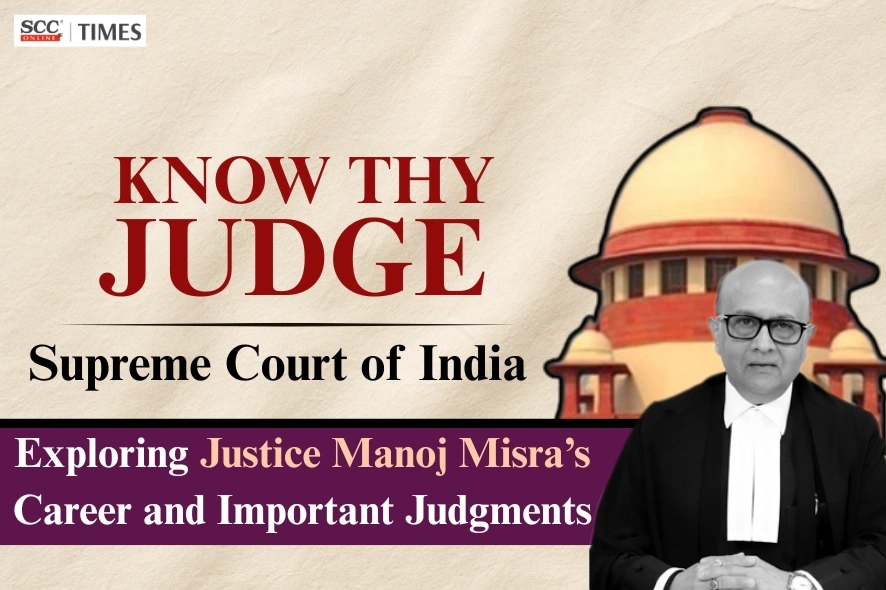
Born on 2 June 1965, Justice Manoj Misra graduated with a law degree from the University of Allahabad in 1988. He was enrolled with the Bar Council on 12 December 1988 and dealt in matters related to Civil, Revenue, Criminal and Constitutional sides at High Court of Judicature at Allahabad.1
Judgeship
After 23 years of practice, Justice Misra was appointed as an Additional Judge of the High Court of Judicature at Allahabad on 21 November 2011. Two years later, on 6 August 2013, he was appointed as a Permanent Judge of the High Court of Judicature at Allahabad.2 Justice Manoj Misra was elevated as a Judge of the Supreme Court on 6 February 2023.3 He is due to retire on 1 June 2030.
Important Judgments by Justice Manoj Misra
Supreme Court
*Did You Know? Since his elevation to the Supreme Court in 2023, Justice Manoj Misra has been a part of over 500 decisions including 40+ Constitution/Larger Bench decisions and has authored over 70 judgments4.
In S. Balagopal (Dr) v. State of T.N.5 concerning alleged unauthorised surgical intervention on a minor, a Division Bench of Manoj Misra* and Pamidighantam Sri Narasimha, JJ., allowed the appeal and quashed proceedings against the operating surgeon. The Court held that the surgeon had obtained valid consent for surgery, and that Orchidectomy, performed as an alternative to Orchidopexy in cases of undescended testicle, was medically justified. The Court emphasised that mere interpolation of the alternative procedure in the consent form, without evidence of malice, does not constitute a criminal offence, and that continuation of criminal proceedings in such circumstances would amount to abuse of process of law.
In Sivakumar v. State6, arising out of a fatal incident triggered by a boundary dispute between close relatives, a Division Bench of Manoj Misra* and Pamidighantam Sri Narasimha, JJ., partly allowed the appeals and examined the scope of offences under Sections 294(b), 304 Part II, and the applicability of Section 34 IPC. The Court held that mere use of abusive language during a heated altercation does not constitute “obscenity” under Section 294(b) IPC, and set aside the conviction on that count.
In Sant Rohidas Leather Industries & Charmakar Development Corpn. Ltd. v. Vijaya Bank7, challenging order of the National Consumer Disputes Redressal Commission (NCDRC), dated 13 March 2023, whereby the consumer complaint of the appellant was dismissed on the ground that the complainant-appellant was not a consumer as per Section 2(1)(d) of the Consumer Protection Act, 1986 (Consumer Protection Act), a Division Bench of Pamidighantam Sri Narasimha and Manoj Misra,* JJ., upheld the impugned order, holding that although the reasoning adopted by the NCDRC regarding the commercial purpose of the deposit was not entirely correct, the dismissal of the complaint was nevertheless justified because the dispute involved serious allegations of fraud and disputed facts unsuitable for summary consumer proceedings.
In Sri Om Sales v. Abhay Kumar Alias Abhay Patel8, where the Patna High Court had quashed criminal proceedings under Section 138 of the Negotiable Instruments Act, 1881 at the pre-trial stage, the bench of Manoj Misra* and Ujjal Bhuyan, JJ set aside the said order after observing that the High Court exceeded its jurisdiction by conducting a roving enquiry into disputed questions of fact at the pre-trial stage.
While considering Poonam Wadhwa v. Ajay Wadhwa9, challenging Punjab and Haryana High Court’s decision to allow a revision petition filed by the father thereby setting aside the order on grant of custody of the minor son to the mother; the Division Bench of Manoj Misra and Ujjal Bhuyan, JJ., explained that the parties who are working parents, it is expected that they cannot always be physically with their children, however, this cannot be a ground to place the child’s custody with the parent who may be temporarily working from home because, “It is a matter of common knowledge that to meet individual as well as family aspirations married couples have to work to build a proper home and most importantly to secure better education for their ward which is getting costlier day by day”. The Court, therefore, declined to subscribe to the view that if one parent is working from home and the other is not, then it has to be inferred that child’s interest would be better served if he is placed in the custody of the parent who works from home.
In Poly Medicure Ltd. v. Brillio Technologies (P) Ltd.10, was an appeal filed by the appellant assailing the order dated 15-6-2020, whereby the order passed by State Consumer Disputes Redressal Commission, Delhi, (‘State Commission’) was affirmed, wherein it was held that the appellant was not a ‘consumer’ as per Section 2(1)(d) of the Consumer Protection Act, 1986 (‘Consumer Protection Act’) was affirmed. The Division Bench of J.B. Pardiwala and Manoj Misra, J.*, stated that the appellant is an established company, which bought the product license to automate its processes. In such circumstances, the object of the purchase was not to generate self-employment but to organize its operations to maximise its profits and reduce costs. It was held that company purchasing automation software to maximise profits and reduce costs not a ‘consumer’.
In Rajendra Bihari Lal v. State of U.P.11, arising out of six FIRs filed under various provisions of the Penal Code, 1860 (IPC) and the Uttar Pradesh Prohibition of Unlawful Conversion of Religion Act, 2021 (“the U.P. Conversion Act”), the Division Bench of J.B Pardiwala* and Manoj Misra, JJ., took note of the scheme of the UP Conversion Act and observed that the provisions of the U.P. Conversion Act pertaining to the pre and post-conversion declaration seems to introduce a very onerous procedure to be followed by an individual seeking to adopt a faith other than the one he professes. The involvement and interference of the State authorities in the conversion procedure is also conspicuous, with the District Magistrate having been legally obliged to direct a police enquiry in each case of intended religious conversion. Further, the Court observed that statutory requirement of making public the personal details of each person who has converted to a different religion may require a deeper examination to ascertain if such a requirement fits well with the privacy regime pervading the constitution.
In Kailas v. State of Maharashtra12, challenging Bombay High Court’s decision to direct re-trial of a NDPS case and remanding the appellant to judicial custody, who was originally convicted by the Trial Court after recovery of contraband; the Division Bench of Manoj Misra* and Ujjal Bhuyan, JJ., opined that mere non-production of the seized contraband during trial may not be fatal if there is reliable evidence in respect of its seizure, drawing of samples therefrom, and FSL report relating to the sample drawn from the seized material. The Court further set aside the High Court’s order for re-trial and instead restored the case of the file of the High Court for fresh decision in accordance with law as neither the High Court nor the Trial Court has enlisted the entire evidence available on record; therefore, it was difficult for the Court to take a decision with precision as to whether the prosecution has been successful in bringing home the charge against the accused and appellant or not.
While considering BGM & M-RPL-JMCT (JV) v. Eastern Coalfields Ltd.13, revolving around existence of an arbitration agreement between the parties; the Division Bench of P.S. Narasimha and Manoj Misra*, JJ., upheld Calcutta High Court’s impugned judgment wherein it had held that, when there is use of “may” in a supposed arbitration clause, there is no clear intention of the parties to refer the dispute between them to arbitration.
In Alka Agrawal v. State of Maharashtra14, there was an appeal arising from Bombay High Court’s judgment dated 14 August 2025, wherein the controversy revolved whether private loan transactions can constitute “deposits” under the Maharashtra Protection of Interest of Depositors (in Financial Establishments) Act, 1999 (MPID Act) and whether the statutory mechanism under the MPID Act could be invoked despite earlier unsuccessful proceedings under the Penal Code, 1860 (IPC). The Division Bench of Manoj Misra and N.V. Anjaria*, JJ., set aside the impugned order, holding that the amount advanced by the appellants to Respondents 2 to 6 constituted “deposit” within the meaning of Section 2(c), MPID Act.
In Dhirubhai Bhailalbhai Chauhan v. State of Gujarat,15 a set of two criminal appeals against the Gujarat High Court’s decision in State of Gujarat v. Dhirubhai Bhailalbhai Chauhan, 2016 SCC OnLine Guj 8909, whereby the acquittal of the present accused persons in the 2002 Gujarat riots was partly reversed and convicted them for offences punishable under Sections 143, 147, 153(A), 295, 436 and 332 of the Penal Code, 1860 (IPC), the Division Bench of PS Narasimha and Manoj Misra*, JJ. allowed the appeal and set aside the impugned decision. The Court considered that in the absence of any inculpatory role ascribed to the accused persons, their arrest on the spot where riots outbroke, was not conclusive that they were a part of the unlawful assembly, particularly when neither instrument of destruction nor any inflammatory material was seized from them. Besides that, the police resorted to firing causing people to run helter skelter. In that melee, even an innocent person may be mistaken for a miscreant. Hence, the mere presence of the accused persons at the spot, or their arrest therefrom, was not sufficient to prove that they were a part of the unlawful assembly comprising of more than a thousand people.
In Lifeforce Cryobank Sciences Inc. v. Cryoviva Biotech (P) Ltd.,16 an arbitration petition, the division bench of Dr. D.Y. Chandrachud, CJI and Manoj Misra*, J. said that since at the stage of consideration of a prayer under Section 11(6) of the Arbitration and Conciliation Act, 1996 (‘Act, 1996’) , the Court has to confine itself to the examination of the existence of an arbitration agreement, it would not be appropriate for it to delve deep into the issue as it could well be considered by the arbitrator on the basis of evidence led by the parties. More so, when existence of arbitration agreement in the license agreement and share subscription agreement is not in dispute. Therefore, the Court referred the matter to the Delhi International Arbitration Centre for the appointment of a sole arbitrator to adjudicate upon the dispute between the parties.
“We have not expressed any opinion on the merits of the claim of either party including regarding the arbitrability of the dispute. All contentions and pleas are kept open for the parties to raise before the arbitral tribunal.”
In Rajive Raturi v. Union of India,17 a writ petition to make public buildings accessible for persons with disabilities, the three-Judge Bench of then CJI Dr. DY Chandrachud, J.B. Pardiwala and Manoj Misra, JJ. ruled that several guidelines prescribed in Rule 15 of Right of Persons with Disabilities Rules, 2017, appear to be recommendatory guidelines, under the garb of mandatory rules. Hence, the Court held Rule 15(1) to be ultra vires the scheme and legislative intent of the RPWD Act which creates a mechanism for mandatory compliance. Therefore, the Court directed the Union to form mandatory rules, as required by Section 40, within a period of three months from the date of the Judgment.
In Re: Alleged Rape and Murder Incident of a Trainee Doctor in R.G. Kar Medical College and Hospital, Kolkata and Related Issues,18the 3-Judge Bench of Dr DY Chandrachud, CJ, J.B Pardiwala and Manoj Misra, JJ., took note of the 5th Status Report filed by the CBI wherein it was stated that a chargesheet has been submitted against the primary accused on 7-10-2024 for alleged offences punishable under Sections 64, 66, 103(1) of the Nyaya Sanhita, 2023 (BNS) and that the ACJM, Sealdah, Kolkata has taken cognizance and committed the case to the Court of the Additional Sessions Judge, 1st Court, Sealdah.
While considering the instant appeal filed by the original complainant (appellant), against the decision of Jharkhand High Court whereby the Court had quashed the order of cognizance and all further proceedings for offences punishable under Ss. 406 and 420 of Penal Code, 1860 in Somjeet Mallick v. State of Jharkhand,19 the Division Bench of J.B Pardiwala and Manoj Misra*, JJ., held that Court must apply its mind to the materials submitted in support of the police report before taking a call whether the FIR and consequential proceedings should be quashed or not; more so, when the FIR alleges an act which is reflective of dishonest conduct of the accused. Thus, when the FIR alleges dishonest conduct on the part of the accused which, if supported by materials, would disclose commission of a cognizable offence, investigation should not be thwarted by quashing the FIR.
While deliberating over the instant appeal revolving around the interpretation of Rule 50 of National Company Law Tribunal Rules, 2016 (NCLT Rules) and Rule 22 of National Company Law Appellate Tribunal Rules, 2016 (NCLAT Rules) in SBI v. India Power Corporation Ltd.;20 the Division Bench of D.Y. Chandrachud, CJ., and Manoj Misra, JJ., clarified and held that the provisions of Rule 50 of the NCLT Rules, place both the free certified copy of NCLT’s final order as well as the certified copy which is applied for on payment of fees, on the same footing.
In Atul Kumar v. Chairman (Joint Seat Allocation Authority),21 a matter concerning the unjust denial of admission to a deserving candidate from a marginalized community at Indian Institute of Technology, Dhanbad, the three-Judge bench of Dr Dhananjaya Y Chandrachud, CJI, J B Pardiwala, and Manoj Misra, JJ. while invoking its powers under Article 142 of the Constitution, directed the authorities concerned to grant admission to the student at IIT Dhanbad against the seat which was allotted to him in the branch of Electrical Engineering, to the same batch to which he would have been admitted in pursuance of the order of allotment.
Discussing the scope of the Court’s jurisdiction and the role to be played by the referral court in the appointment of an arbitrator especially with reference to the participation of the non-signatory in the performance of the underlying contract in Ajay Madhusudan Patel v. Jyotrindra S. Patel,22 the 3-judge bench of Dr. DY Chandrachud, CJI and JB Pardiwala and Manoj Misra, JJ held that the conduct of the non-signatory party along with the other attending circumstances may lead the referral court to draw a legitimate inference that it is a veritable party to the arbitration agreement.
While considering the instant appeal revolving around specific performance of contract in Ishwar v. Bhim Singh,23 the Division Bench of J.B. Pardiwala and Manoj Misra, JJ., held that an application under Section 28 of the Specific Relief Act, 1963, either for recission of contract or for extension of time, can be entertained and decided by the Execution Court provided it is the Court which passed the decree in terms of Section 37 of the CPC.
While considering the instant appeal challenging the enhancement of compensation by Chhattisgarh High Court, in a motor accident claim and deliberating over issues of ownership of the offending vehicle in K. Nirmala v. Canara Bank,24 the Division Bench of J.B Pardiwala and Manoj Misra*, JJ., stated that ‘owner’ of a vehicle is not limited to the categories specified in Section 2(30) of the Motor Vehicles Act, 1988. If the context so requires, even a person at whose command or control the vehicle is could be treated as its owner to fix tortious liability for compensation payment.
In Kalanithi Maran v. Ajay Singh,25 a special leave petition filed against the judgment and order of the division bench of the Delhi High Court, wherein the Court remand the proceedings to the Single Judge for reconsidering the petition under Section 34 of the Arbitration and Conciliation Act 1996, observing that the validity of the award of refund and the grant of interest appears in the context of examining the correctness of the judgment rendered by the Single Judge alone, the Three Judge Bench of Dr. DY Chandrachud, CJI, J.B. Pardiwala and Manoj Misra, JJ. while agreeing with the reasoning which led the Division Bench of the Delhi High Court to remand the proceedings to the Single Judge, said that interference with an arbitral award under Section 34 must be confined to the grounds which are permissible under the statute. But equally, the Judge hearing an application under Section 34 must apply their mind to the grounds of challenge and then deduce as to whether a case for interference within the parameters of Section 34 has been made out.
In Property Owners Assn. v. State of Maharashtra,26 the Nine-Judge Constitution Bench comprising of CJI Dr. DY Chandrachud, Hrishikesh Roy, B.V. Nagarathna, Sudhanshu Dhulia, J.B. Pardiwala, Manoj Misra, Rajesh Bindal, Satish Chandra Sharma and Augustine George Masih, JJ., delivered its judgment on the issue of whether private resources form part of the ‘material resource of the community’ under Article 39(b) of the Constitution. The majority judgment delivered by CJI Dr. DY Chandrachud by ratio of 7:2 held that all the ‘private properties’ cannot form part of the ‘material resources of the community’ under Article 39(b) of the Constitution. The Court unanimously held that Article 31-C of the Constitution to the extent that it was upheld in Kesavananda Bharati v. State of Kerala, (1973) 4 SCC 225 remains in force.
The majority view held that the view expressed by Justice Krishna Iyer in State of Karnataka v. Ranganatha Reddy,27 that- material resources of the community covered all resources, natural and man-made, publicly and privately owned and relied on by Justice Chinnappa Reddy in Sanjeev Coke Mfg. Co. v. Bharat Coking Coal Ltd.,28 cannot be accepted.
In Sk. Noorul Hassan v. Nahakpam Indrajit Singh,29 an appeal against the High Court of Manipur’ order granting leave to the respondent to file a replication in answer to the new facts asserted in the written statement filed by the returned candidate, the appellant, a three-judge bench comprising of Dr D.Y. Chandrachud, C.J. and J.B. Pardiwala and Manoj Misra,* JJ., denied appellant’s appeal and affirmed the High Court’s decision permitting the election petitioner to submit a replication in response to the new information presented in the returning candidate’s written statement.
“The replication does not seek to incorporate any new material facts or a new cause of action to question the election. It only seeks to explain the averments made in the written statement. Thus, in our view, leave to file replication was justified and well within the discretionary jurisdiction of the High Court.”
In Union of India v. Santosh Kumar Tiwari,30 an appeal against the judgment and order of the Division Bench of Orissa High Court, wherein the Court upheld the Single Judge order, allowed the petition of the accused on the ground that the punishment of compulsory retirement was not one of the punishments specified in Section 11 (1) of the Central Reserve Police Force Act, a three-judge bench comprising of Dr. DY Chandrachud, CJI, JB Pardiwala and Manoj Misra*, JJ. has held that the punishment of compulsory retirement prescribed by Rule 27 of the CRPF Rules is intra vires the CRPF Act and is one of the imposable punishments.
“It cannot be gainsaid that compulsory retirement is a well-accepted method of removing dead wood from the cadre without affecting his entitlement for retirement benefits, if otherwise payable. It is another form of terminating the service without affecting retirement benefits. Ordinarily, compulsory retirement is not considered a punishment. But if the service rules permit it to be imposed by way of a punishment, subject to an enquiry, so be it.”
In Greater Noida Industrial Development Authority v. Prabhjit Singh Soni, 31 a three-judge bench comprising of Dr. DY Chandrachud, CJI, JB Pardiwala and Manoj Misra*, recognised Greater Noida Industrial Development Authority as a secured operational creditor, on the strength of security created by operation of Sections 13, 13-A and 14 of the U.P. Industrial Area Development Act, 19762 (UPIDA).
In Bhaskar Raju & Brothers v. Dharmaratnakara Rai Bahadur Arcot Narainswamy Mudaliar Chattram and Other Charities.,32 a 7-Judge bench comprising of Dr. DY Chandrachud, C.J., SK Kaul, Sanjiv Khanna, BR Gavai, Surya Kant, JB Pardiwala, and Manoj Misra, JJ., is set to hear the judgment relating to unstamped arbitration agreements.
In Sita Soren v. Union of India,33 a 7-Judge Bench comprising of Dr. DY Chandrachud, CJI*, AS Bopanna, MM Sundresh, Pamidighantam Sri Narasimha, JB Pardiwala, Sanjay Kumar and Manoj Misra, JJ. overturned the 5-Judge Bench 1998 verdict in P.V. Narasimha Rao v. State (CBI/SPE),34 wherein it was established that the Member of Parliaments (‘MP’) and Member of Legislative Assemblies (‘MLA’) enjoyed immunity if they cast vote in the House after taking bribe for it.
Following the decisions in N.N. Global Mercantile (P) Ltd. v. Indo Unique Flame Ltd. (N.N. Global I)35 and N.N. Global Mercantile (P) Ltd. v. Indo Unique Flame Ltd. (N.N. Global II),36 a 7-judges bench comprising of Dr D.Y. Chandrachud, C.J. and Sanjay Kishan Kaul, B.R. Gavai, Surya Kant, J.B. Pardiwala, Manoj Misra and Sanjiv Khanna, JJ., was called upon in Interplay between Arbitration Agreements under the Arbitration and Conciliation Act, 1996 and the Indian Stamp Act, 1899, In re (N.N. Global III)37 to resolve a pressing issue that arose in the context of three statutes i.e. the Arbitration and Conciliation Act, 1996 (Arbitration Act), the Stamp Act, 1899 (Stamp Act), and the Contract Act, 1872 (Contract Act). The Court held that
-
Agreements lacking proper stamping, or with inadequate stamping, are deemed inadmissible in evidence as per Section 35 of the Stamp Act. However, such agreements are not automatically void, void ab initio, or unenforceable.
-
Non-stamping or insufficient stamping is a rectifiable/curable flaw.
-
Challenges related to stamping do not fall within the purview of determinations under Section 8 or Section 11 of the Arbitration Act. The referral court should only assess the prima facie existence of the arbitration agreement.
-
Objections regarding the stamping of the agreement fall under the jurisdiction of the Arbitral Tribunal.
-
The rulings in N.N. Global — II(Supra) and in SMS Tea Estates38 are overturned. To that extent, the content in paras 22 and 29 of Garware Wall Ropes,39 are also overruled.
In Ankita Thakur v. H.P. Staff Selection Commission,40 a bunch of appeals challenging the judgment and order passed by Himachal Pradesh High Court regarding recruitment to the post of Junior Office Assistant, a Class III (Non-gazetted) post, a Division Bench comprising of Hrishikesh Roy and Manoj Misra,* JJ., set aside the impugned judgment and order stating that the essential qualifications advertised in accordance with the applicable Rules could not be relaxed by the Government after last date of applications, while the same was not even publicized giving applicants the due opportunity.
In Urban Improvement Trust v. Gordhan Dass,41 a matter where the landowner-purchaser of suit land (which was agricultural land) not having mutated the land in their name but being in possession and having only converted a part of the land to nonagricultural use, a Division Bench comprising of Hrishikesh Roy* and Manoj Misra,* JJ., while deciding whether the landowner entitled to procedural safeguards of notice and compensation prior to dispossession (as provided under S. 52 of the 1959 Act) and such procedural safeguards whether mandatory in nature; in view of disagreement at the Bench, matter referred to larger Bench.
In RPSF v. Bhavnaben Dinshbhai Bhabhor,42 an appeal against judgment and order passed by Gujarat High Court dismissing appeal under Section 30 of Employees Compensation Act, 1923 (‘1923 Act’) against order passed by Workmen Compensation Commissioner, the Division Bench of B.V. Nagarathna and Manoj Misra,* JJ., upheld the maintainability of claim of compensation of Railway Protection Special Force (‘RPF’) Constable disputed to be part of the Armed Forces of the Union.
In Sunil v. State (NCT of Delhi),43 appeals challenging judgment and order passed by Delhi High Court affirming Trial Court’s order of conviction and sentence of the appellants under Sections 302, 307 and 34 of the IPC against 4 of the appellants, the Division Bench of Hrishikesh Roy and Manoj Misra*, JJ., partly allowed the appeal, being convinced that the appellants may not be regarded to have common intention for offence under Section 302, but upheld conviction under Section 307 read with Section 34.
In Bloomberg Television Production India (P) Ltd. v. Zee Entertainment Enterprises Ltd.,44 a special leave to appeal against the decision of the Delhi High Court upholding the interim order of the ADJ, South Saket Courts directing the Bloomberg Television Production India Private Limited (‘Bloomberg’) to take down an article dated 21-02-2024 allegedly against the Zee Entertainment Enterprises Limited (‘Zee’), the three Judge Bench comprising of Dr. DY Chandrachud, CJI, JB Pardiwala and Manoj Misra, JJ., allowed the appeal and set aside the impugned orders.
In Union of India v. Jogeshwar Swain,45 twin appeals challenging judgment and order passed by Delhi High Court in Jogeswar Swain v. Union of India, 2013 SCC OnLine Del 754, setting aside the respondent’s dismissal and directing his entitlement to full consequential benefits except salary to the extent of 50%, and another order dated 22-11-2013 dismissing review petition of the said judgment, the Division Bench of JB Pardiwala and Manoj Misra*, JJ. upheld the High Court’s decision while explaining the importance of strict adherence with Rule 142(2) of BSF Rules, 1969.
In Ravi Mandal v. State of Uttarakhand,46 a set of two criminal appeals against the Judgment and Order of High Court of Uttarakhand, wherein the conviction and sentence under Section 302 read with Section 34 of the Penal Code, 1860 (‘IPC’) awarded to the appellants/convicts was affirmed, the Division Bench of Hrishikesh Roy and Manoj Misra,* JJ., allowed the convicts appeals and set aside their conviction.
The Court was of the considered view that the case in hand was a quintessential case where to solve a blind murder, occurring in a forest in the darkness of night, bits and pieces of evidence were collected which warranted a strict scrutiny before the basing of a conviction thereupon. The Court said that the Court below failed to properly evaluate and test the evidence by applying the correct legal principles.
In Rajkumar Hariram Gameti v. State of Gujarat,47 a criminal appeal against Gujarat High Court’s decision, whereby the convict’s appeal against the Trial Court’s decision, holding the convict guilty of the offences punishable under Sections 8(c), 21(c) read with Section 29 of the Narcotic Drugs and Psychotropic Substances Act, 1985 (‘the NDPS Act’), was dismissed, the Division Bench comprising of JB Pardiwala and Manoj Misra, JJ., allowed the appeal and quashed the impugned orders.
The Court said that the prevailing position of law had changed, and any confessional statement made by an accused to an officer invested with the powers under Section 53 of the NDPS Act, is barred because such officers are ‘police officers’ within the meaning of Section 25 of the Evidence Act. A statement made by an accused and recorded under Section 67 of the NDPS Act cannot be used as a confessional statement in the trial of an offence under the NDPS Act.
In Cox and Kings Ltd. v. SAP India (P) Ltd.,48 a 5-Judge Bench comprising of Dr. D.Y. Chandrachud C.J., Hrishikesh Roy, Pamidighantam Sri Narasimha, J.B. Pardiwala and Manoj Misra JJ., considered the existence of Doctrine of Group of Companies in Indian jurisprudence vis-à-vis Arbitration Act. The issue in hand is that if parties who did not sign an arbitration agreement can be made parties to arbitration proceedings.
In Mohd. Arif v. Enforcement Directorate,49 the full bench of Sanjay Kishan Kaul, Manoj Misra and Aravind Kumar JJ., granted interim bail to the petitioner while noting that the petitioner had almost served 50% of the sentence, the wife had passed away because of cancer and there was a child from the marriage.
In BLS Infrastructure Ltd. v. Rajwant Singh,50 a Division Bench comprising of Sudhanshu Dhulia and Manoj Misra,* JJ., while deciding a matter related to dismissal of complaint for non-appearance of complainant, held that the Magistrate was not justified in straight away dismissing complaints and ordering acquittal of accused on mere non-appearance of complainant where complainant’s statement had been recorded. The Court further explained the principles related to applicability of the proviso of S. 256(1) of the CrPC.
In Ravi Mandal v. State of Uttarakhand,51 a 22 year old murder case, a Division bench constituting of Hrishikesh Roy and Manoj Misra*, JJ., acquitted the two persons convicted under Ss. 302, 34 and 201 of the IPC and Ss. 4 and 25 of Arms Act, on the ground that the prosecution failed to prove beyond reasonable doubt that the deceased as last seen alive in the company of the accused near the spot at the relevant time and held that “Courts below failed to properly evaluate and test the evidence”.
In Santhakumari v. State of T.N.,52 a Division bench comprising of Hrishikesh Roy and Manoj Misra*, JJ., held that a proposed accused has a right to be heard in Revisional proceedings under S. 401 of the CrPC which is filed against the dismissal of the petition under S. 156(3) of the CrPC and remitted back the matter to the High Court so that the same can be decided afresh and in accordance with law.
While upholding the Gujarat High Court’s Order directing the accused to give voice samples to the police, a Division Bench comprising of Hrishikesh Roy and Manoj Misra*, JJ., in Pravinsinh Nrupatsinh Chauhan v. State of Gujarat,53 reiterated that a Magistrate can direct for the collection of voice samples of the accused.
“…until explicit provisions are engrafted in the Code of Criminal Procedure by Parliament, a Judicial Magistrate must be conceded the power to order a person to give a sample of his voice for the purpose of investigation of a crime. Such power has to be conferred on a Magistrate by a process of judicial interpretation and in exercise of jurisdiction vested in this Court under Article 142 of the Constitution of India.”
While setting aside the conviction of the accused and acquittal of the co-accused in a 23 year old Murder case, a 3-judge bench consisting of Sanjay Kishan Kaul, Manoj Misra* and Aravind Kumar, JJ., in Santosh v. State (NCT of Delhi),54 held that the prosecution has failed to prove the chain of incriminating circumstances as to conclusively prove the guilt of the accused persons. The Court remarked that
“…it is a case where the prosecution failed to elevate its case from the realm of “may be true” to the plane of “must be true” as is indispensably required for conviction on a criminal charge.”
In State of M.P. v. Phoolchand Rathore,55 a 3-judge bench consisting of Sanjay Kishan Kaul, Manoj Misra* and Aravind Kumar, JJ., upheld the Madhya Pradesh High Court’s order of acquittal of the death row convict for the alleged murder of his wife on the grounds that the prosecution has failed to prove the circumstances beyond reasonable doubt in terms of (a) Motive; (b) Disclosure Statement and Recovery; (c) Extra Judicial Confession; and (d) Accused taking the deceased with him and soon thereafter the deceased was found in an injured state.
In Kunnel Engineers & Contractors (P) Ltd. v. New India Assurance Co. Ltd.,56 a matter related to payment of interest on compensation where there is a contractual exception for the insurer on payment of interest, the Court observed that “When parties have agreed upon the terms of the insurance contract, the Court cannot interpret the clauses in the contract, by adverting to equity principles.” The Court opined that the liability of the insurance company does not fall under the Employees Compensation Act, 1923 and the same is governed only by the terms of the contract.
While setting aside the decree of eviction in Shanti Prasad v. Thakur Dass,57 a Division Bench comprising of Manoj Misra and Aravind Kumar, JJ., held that the appellant/tenant is entitled to the benefit of S. 20(4) of the Uttar Pradesh Urban Buildings (Regulation of Letting, Rent and Eviction) Act, 1972 and cannot be denied the same only on the ground that the plea taken by him with regard to the rate of rent was found incorrect.
Allahabad High Court
In Kishan Kumar v. State of U.P.,58 a Division Bench comprising of Manoj Misra and Virendra Kumar Srivastava, JJ., held that the date of birth in Aadhaar Card is not conclusive evidence. The Court clarified that no protection shall be given, and the investigating agency shall be free to take all steps to bring the investigation to its logical conclusion if the victim is not produced by the date fixed.
In Prabhunath Tiwari v. State of U.P.,59 Manoj Misra, J. held that the Revisional power of the High Court against the order passed under S. 29 of the Domestic Violence Act is “intact and unaffected”. The Court remarked that the supervisory power of the High Court “has not been excluded expressly or impliedly” by the Act, therefore, the Sessions Court was subject to the revisionary power of the High Court.
In Ram Pratap v. State of U.P.,60 the Division bench of Manoj Misra and Sameer Jain, JJ., held that an accused cannot be held guilty merely on account of motive and abscondence even though it may give rise to strong suspicion.
“Merely on the basis of motive and abscondence, though it may give rise to strong suspicion, the accused cannot be held guilty.”
In Bhanu Pratap Singh v. State of U.P.,61 a Division Bench comprising of Manoj Misra and Rohit Ranjan Agarwal, JJ., opined that the court cannot presume the consent of wife simply because she was present at the time of adoption. The wife’s silence or lack of protest on her part also cannot give rise to an inference that she had consented to the adoption.
While expressing its dissatisfaction over the manner in which the officers of the State are progressing on serious issues pertaining to infrastructure and functioning of courts in the State of Uttar Pradesh, a full bench of Munishwar Nath Bhandari, ACJ., Naheed Ara Moonis, Manoj Misra, Sunita Agarwal, Surya Prakash Kesarwani, Manoj Kumar Gupta and Anjani Kumar Mishra, JJ., in Zila Adhivakta Sangh Allahabad, In re62 directed the District Judges to co-ordinate with the District Magistrates to identify land that can be made available for the construction of the Courts and residential buildings for the Subordinate Courts. The Court also stressed the issue of the unavailability of adequate infrastructure to the POCSO courts in the state.
“The District Magistrates being the Custodian of the records of the districts are required to identify the lands at the local level for their allotment to the Subordinate Courts both for the Court complexes and residential accommodations for the judicial officers.”
In Ram Kishore v. State of U.P.,63 a Division Bench comprising of Manoj Misra and Syed Aftab Husain Rizvi, JJ., remarked that the provisions of S. 106 of the Evidence Act cannot be invoked to place the onus of explaining how the deceased died in presence of the murder suspect because there is insufficient proof that he was there at home with the victim at the relevant time.
While dismissing a PIL challenging the ‘Sugam Darshan’ system in Shri Kashi Vishwanath Temple, which provides priority ‘darshan’ on payment of certain amount of money, a Division bench comprising of Manoj Misra and Sameer Jain, JJ., in Gajendra Singh Yadav v. State of U.P.,64 observed that the decision of the Board of Trustees of providing for a Sugam Darshan system does not fall within the ambit of judicial review.
“…once the Board of Trustees are vested with the power to fix fees for the performance of any worship, service, rituals, ceremony or religious observance in the temple and in exercise of such power, they take a decision to provide a facility of ‘SUGAM DARSHAN’ for those who, on account of their disability, be it physical or otherwise, cannot wait in a queue and, while taking such decision, they do not exclude the common class from exercising their right of worship or perform Puja as per religious practices, in our view, the decision of the Board of Trustees does not fall within the ambit of judicial review.”
In Mukut Nath Verma v. State of U.P.,65 a habeas corpus writ petition seeking production an IPS officer claiming that he has been missing since November 2020, a Division bench comprising of Manoj Misra and Sameer Jain, JJ., while expressing serious concern over the fact that an IPS officer who was implicated in a case of extortion and suicide abetment has gone missing for months, directed the Investigation agency dealing with the investigation of the cases pending against Mani Lal Patidar to file an affidavit in reply to the petition.
While deciding Missing of an LLM Student at Swami Shukdevanand Law College, In re,66 an application moved by the Shahjahanpur law student, alleging bias on the part of SIT who is investigation a rape and extortion case against the former Union Minister and BJP leader, Swami Chinmayanand, a Division Bench comprising of Manoj Misra and Deepak Verma, JJ., rejected the application and opined that it would not mean that the investigation is tainted or was biased, merely because press conferences were held by the investigation team. The Court held that the investigating agency has duly investigated all aspects and after thorough investigation has submitted a police report under S. 173(2) CrPC in both the cases.
In Govind Enterprises v. State of U.P.,67 a Division Bench comprising of Manoj Misra and Suresh Kumar Gupta, JJ., upheld a First Information Report (FIR) against GST evaders under the CrPC as the prima facie, the necessary ingredients of an offence of cheating, by submitting false information and documents, are clearly spelt out. The Court refused to stay the arrest for GST evasion.
*Judge who has penned the judgment.
1. Justice Manoj Misra, High Court of Judicature at Allahabad.
2. Hon’ble Mr. Justice Manoj Misra, Supreme Court of India
3. Orders of appointment of Shri Justice Manoj Misra, Judge, Allahabad High Court as a Judge of the Supreme Court of India, Department of Justice
4. scconline.com “coram only’ feature
48. Arbitration Petition 38 of 2020, order dated 23-03-2023
49. Special Leave Petition (Criminal) 5709 of 2022, order dated 13-02-2023
56. 2023 SCC OnLine SC 674
63. Criminal Appeal No. 1443 of 2018, order dated 18-07-2022
66. Criminal Misc. Writ Petition No. 21181 of 2019, order dated 30-04-2020