


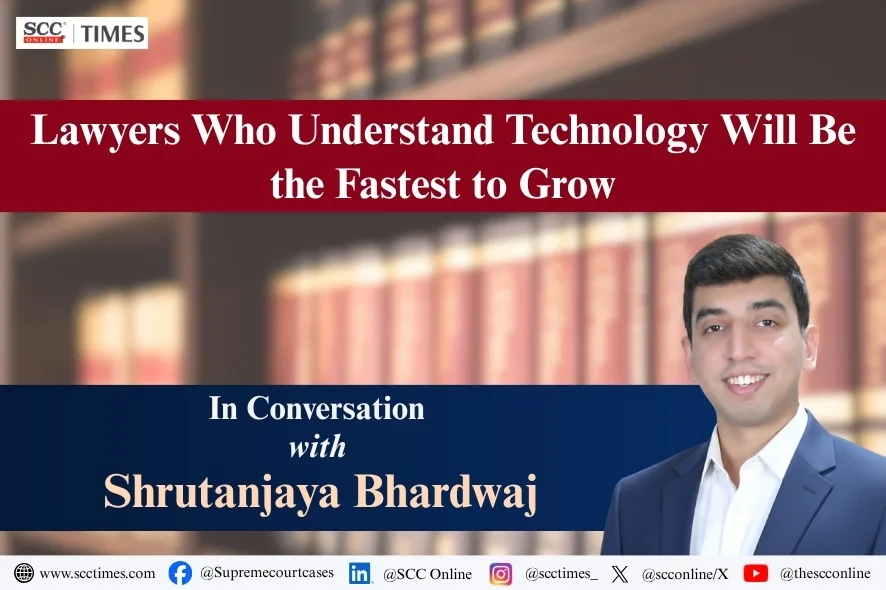
1. Kindly introduce yourself to our readers.
I am an Advocate-on-Record at the Supreme Court of India. My educational qualifications include a BA LLB (Hons.) degree from National Law University Delhi (2017) and an LLM degree from the University of Michigan, Ann Arbor (2019). I also hold a UGC-NET qualification. Besides law practice, I have taught courses at some of India’s leading law schools, including elective courses on the “freedom of speech” and foundational courses on “interpretation of statutes and jurisprudence”.
2. You come from a family deeply rooted in the law: Your grandfather practised at Sonepat District Courts, your father is a Senior Advocate at the Supreme Court, and your sister an Advocate-on-Record (AOR). Did you ever have second thoughts in choosing a career in law, or was it always a natural path to you?
It was a natural path and I never had second thoughts. The law is a subject I thoroughly enjoy, despite the pressure that comes with the rich lineage you mentioned. Besides, advocates are well-placed to help the underprivileged, which makes litigation thoroughly rewarding.
3. In February 2026, you topped the AOR examination. Can you tell us a little more about how you structured your study? Which paper did you find challenging, and how did you prepare for it?
The achievement means a lot to me — it was a tough set of exams. My sister and friends had already taken the exam earlier and were kind enough to help me with my preparation. I received two crucial pieces of advice from them: first, finishing the paper is more important than writing perfect answers; and second, one’s preparation must begin by watching the lectures conducted by the Supreme Court Bar Association (SCBA) and the Supreme Court Advocates-on-Record Association (SCAORA) and uploaded on their respective YouTube channels. I found the “Leading Cases” paper as the most challenging one due to the breadth of its syllabus, i.e. 80—90 voluminous judgments of the Supreme Court. The saving grace was that I had already read most of these judgments at some earlier point in time, owing to my association with Gopal Sankaranarayanan, Senior Advocate and Haripriya Padmanabhan, Senior Advocate at their (rather busy!) chambers for four years.
4. You began your career in 2017 at the Chambers of Senior Advocates Gopal Sankaranarayanan and Haripriya Padmanabhan. What did those early years teach you that no law school could have?
Law school only teaches us legal principles. These are important but constitute a small fraction of what litigation requires. So many cases turn on facts and facts alone without anyone citing a single legal provision or judgment. The best litigators are those who are great at recognising patterns and revealing them to the court in simple language.
5. Supreme Court practice can be demanding and, at times, quite insular. For a young advocate outside Delhi, or without family connections in the legal world, how realistic is it to build a practice at the Supreme Court?
It is realistic and possible. Family connections give you a great push, but as I have learnt from the experiences of my peers, lineage is not everything. The disadvantage that comes from a lack of lineage can be overcome by joining a good chamber. Many seniors in the profession have a reputation of providing extensive support to their juniors, and I have seen many first-gen peers perform at par with — sometimes even outperform — those with lineage.
6. Supreme Court practice is at an interesting crossroads. There are debates around court reform and AI entering legal research. What does that mean for how you are building Pravah Law, and what lies ahead for the firm?
Pravah Law is fully up-to-speed with legal and technological advancements. We regularly rely on modern tools for legal research and automation of clerical tasks, which makes us quicker and more efficient. E.g., we use DraftoSLP — an app of my own making — for assembling, paginating and bookmarking special leave petition (SLP) paperbooks in virtually no time. This has completely eliminated the need for any of us to spend time or energy in formatting, file arrangement, pagination, annexure labelling, delay calculation, volume-splitting, etc. and vastly minimised the “defects” that the Supreme Court’s Registry would ordinarily mark in the paperbook before listing it in court. It is my firm belief that lawyers who understand technology, try to develop the necessary skills, and deploy modern tools in their practice will be the fastest to grow in the coming years.
7. You have had teaching engagements at National Law University, Delhi (NLUD), National Law School of India University (NLSIU), and Campus Law Centre (CLC) Delhi. Based on your interaction with students, how do you evaluate the learning ecosystems at India’s top National Law Universities (NLUs)? Where do you think they are making their mark, and where do gaps in legal education still persist?
Graduates from these colleges are, of course, incredibly bright. They are making their mark in terms of corporate firm placements — big names, great packages, the works. However, these institutions are getting more unaffordable and inaccessible by the year. I wish they would reduce their fees and throw themselves open to the average Indian. I also hope for a greater scope for practitioners to come in and offer elective courses and guest lectures.
8. If you could go back and give yourself one piece of advice on the day you enrolled as an advocate in 2017, what would it be?
Invest in comfortable shoes and, when you have earnt enough, a big iPad.
1. Advocate-on-Record, Supreme Court of India and the founder of Pravah Law, a litigation firm based in New Delhi.
2. EBC-SCC OnLine Student Ambassador, National Law University, Delhi.
I found Shrutanjaya’s interview deeply impressive. His understanding of technology in law is remarkable, and honestly, there is so much for all of us to learn from him. The fact that he is building something so useful for the entire profession is truly laudable. We really owe him for taking such an initiative. my warmest congratulations.