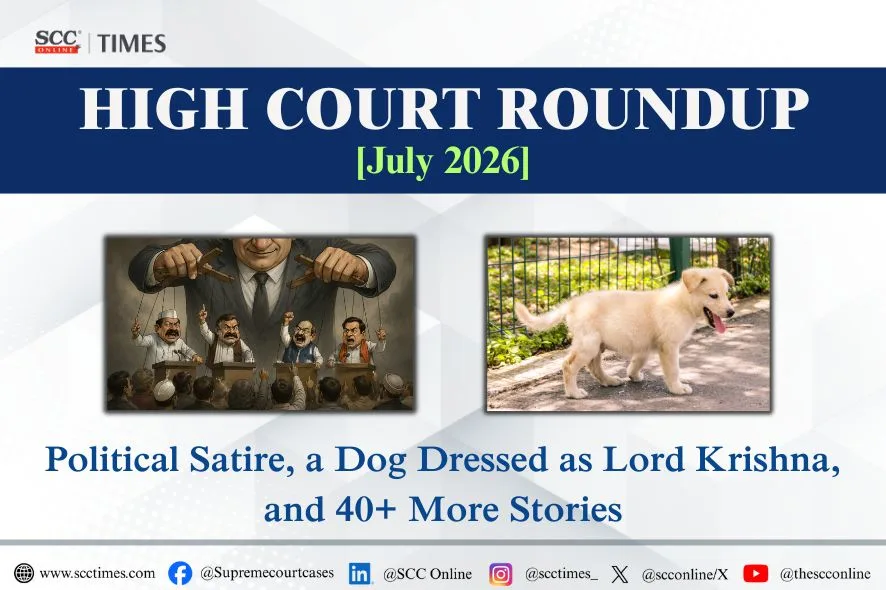
July 2026 saw several important rulings across India’s High Courts. Courts dealt with issues including AI-generated content and personality rights, copyright protection in the age of artificial intelligence, medical rights, child welfare, bail in serious offences, workplace rights, GST proceedings, trademark disputes, and constitutional freedoms. From the Delhi High Court’s observations on AI deepfakes in Raghav Chadha’s defamation suit to the ANI—OpenAI copyright dispute and other landmark decisions, here is a quick summary of the month’s most significant High Court rulings.
STORIES OF THE MONTH
Sonam Wangchuk Shifted to Safdarjung Hospital Amid Hunger Strike: Here is What Delhi High Court Directed in its Medical Monitoring Order
In Rakesh Kumar Saini v. Union of India 2026 SCC OnLine Del 5200, a public interest litigation (PIL) expressing concern over the deteriorating health of Shri Sonam Wangchuk, who had allegedly been observing a fast at Jantar Mantar, New Delhi, for approximately 17—18 days at the time of the order, seeking Court’s intervention to ensure that adequate medical attention was provided to him, the Division Bench while emphasising that “life of every citizen is precious and all medical efforts ought to be made by the Government authorities to save the same”, directed regular clinical monitoring and timely medical treatment. Read about Delhi HC’s Medical Monitoring Order HERE
Public Figures Must Tolerate Political Satire, But Not Vulgar AI Deepfakes That Cross the Line into Defamation; Raghav Chadha’s Defamation Suit partly allowed
In Raghav Chadha v. Ashok Kumar 2026 SCC OnLine Del 4838, an application was filed by Raghav Chadha, a Member of Parliament in the Rajya Sabha representing Punjab, seeking protection against the circulation of artificial intelligence (AI)-generated deepfake videos, morphed images, synthetic media and other manipulated content allegedly created to tarnish his public image. While acknowledging the serious threat posed by AI-enabled misinformation and its potential to undermine an individual’s dignity and reputation, the Delhi High Court held that “public figures assuming such positions of power must accept being at the receiving end of the satirical humour as a necessary and inevitable aspect of their profession, though unpleasant”. However, the Court clarified that AI-generated content that is profane, vulgar, malicious, or seriously impairs an individual’s dignity may justify judicial intervention. Read Raghav Chadha’s defamation case HERE
ARBITRATION LAW
Manipur HC Sets Aside Arbitral Award by Consent, Appoints Former Chief Justice as New Arbitrator for Thoubal Project Dispute
In Progressive Construction Ltd. v. State of Manipur, 2026 SCC OnLine Mani 347, the Single Judge Bench set aside an arbitral award and recommence the arbitration through a fresh, de novo proceeding before a mutually acceptable sole arbitrator by the parties. The Court directed the proceedings would resume from the stage which has been already completed by the previous arbitrator. Read about Thoubal Project Dispute HERE
ANTI-CORRUPTION
Whether NSE MD Is a ‘Public Servant’ Under Prevention of Corruption Act?
In Chitra Ramkrishna v. Union of India, 2026 SCC OnLine Del 5031, the Delhi High Court dismissed a writ petition challenging the constitutional validity of provisions of the Prevention of Corruption Act, 1988, sanction orders and cognizance order in the alleged NSE co-location scam. The Court held that the definition of “public servant” under the Act is intentionally broad and not vague or arbitrary. Observing that recognised stock exchanges perform vital public functions, the Court held that the petitioner, as NSE’s Managing Director and CEO, was connected with the public duties discharged by the Exchange. Read about ‘Public Servant’ Under Prevention of Corruption Act HERE
CIVIL LAW
New Suit, New Mediation: Mandatory Section 12A Compliance Under the Commercial Courts Act Reaffirmed
In Ramji Lal Agarwal v. Sourav Agarwal1, the Calcutta High Court rejected a commercial suit seeking enforcement of a negative covenant in a family agreement as the plaintiff failed to comply with the mandatory pre-institution mediation requirement under Section 12-A, Commercial Courts Act, 2015 (CC Act). The Court highlighted that the statutory pre-institution mediation is an indispensable condition precedent for instituting an independent commercial suit. Read about Mandatory Section 12A Compliance case HERE
CONSTITUTIONAL LAW
Delhi HC Dismisses Passport DOB Correction Writ for Lack of Jurisdiction
In Chintan Agrawal v. Union of India, 2026 SCC OnLine Del 5028, a writ petition seeking correction of the petitioner’s date of birth in his passport and removal of the Emigration Check Required (ECR) status, a Single Judge Bench dismissed the petition as not maintainable for want of territorial jurisdiction. The Court held that the mere location of the Ministry of External Affairs in Delhi does not, by itself, confer territorial jurisdiction under Article 226(2) of the Constitution when the entire cause of action has arisen outside Delhi. Read more about Passport DOB Correction Jurisdiction HERE
Parents or State Cannot Compel Adult Woman to Return Home or Marry; Right to Choose Residence, Education Protected Under Article 21
In Safia Sultana v. State of Maharashtra, 2026 SCC OnLine Bom 5211, while hearing a writ petition filed by a 21-year-old woman seeking protection against coercion from her parents and the State, the Division Bench observed that the petitioner, being an adult, is legally competent to decide her residence, marriage, and education. The Court noted that she had voluntarily left her parental home as she was unwilling to marry against her wishes and expressed her desire to pursue higher education. The Court held that neither her parents nor the State could compel her to return home and further emphasised that such matters of personal choice are protected under Article 21 of the Constitution. Read more about right to choose residence HERE
PIL on Somnath Temple archaeological survey dismissed, Rs 2 lakh cost imposed
In Vilas Tukaram Kharat v. Union of India 2026 SCC OnLine Guj 4447, the Gujarat High Court dismissed the petition with exemplary costs of ₹2 lakhs holding that the petitioner had abused the process of the Court by filing a PIL based on misleading, incomplete and distorted facts. Read about Somnath Temple case HERE
Common Areas Must Be Obstruction-Free, and Children Have a Fundamental Right to Play: Trial Court order set aside, Association directed to act within 3 Months
In Sangeetha Agrawal v. Esteem Gardenia Apartment Owners Assn., 2026 SCC OnLine Kar 7971, the Karnataka High Court held that common areas of the apartment must remain obstruction-free, affecting safe movement. The Court held that it is a fundamental right of the children to play and prohibiting them takes away their overall health. The restrictions on children’s recreation require reasonable justification. Read about Fundamental Right to Play case HERE
CONTEMPT OF COURT
Moment of Anger, Years of Proceedings: Kerala HC Closes 7-Year-Old Criminal Contempt Case Against Congress MP Kumbakudi Sudhakaran After Apology
In Janardhana Shenoy K. v. Kumbakudi Sudhakaran 2026 SCC OnLine Ker 6381, the Kerala High Court held that a genuine, unconditional and unqualified apology, coupled with an admission of contempt and an assurance of future restraint, warranted acceptance under Rule 14(a), Contempt of Courts (High Court of Kerala) Rules, 1988. The Court accepted the apology tendered by him, discharged him, and closed the contempt proceedings. Read about Kumbakudi Sudhakaran contempt case HERE
CRIMINAL LAW
A Sour Relationship Isn’t a False Promise: Rape Charge Over Tinder Match Quashed
In Ankush Sehgal v. State of Uttarakhand, 2026 SCC OnLine Utt 1837, the Uttaranchal High Court held that a consensual physical relationship between adults who met through the dating app Tinder does not constitute rape merely because the relationship subsequently did not culminate in marriage. Read about rape case over Tinder match HERE
Husband who called police himself after killing pregnant wife gets life sentence commuted to 7 years: Held, verbal taunt amounted to grave and sudden provocation
In Shiva v. State of M.P., 2026 SCC OnLine MP 18550, a criminal appeal was filed by a husband convicted of murdering his pregnant wife by stone pelting, the Madhya Pradesh High Court partly allowed the appeal, holding that it was not a premeditated murder because if the convict intended to murder his wife, then he would not have informed the police and other people, like the complainant. Thus, it was a case of grave and sudden provocation caused by the wife’s statement that she could keep 1000 husbands like him. Accordingly, the Court convicted him under Section 304-II, Penal Code, 1860 (IPC). Read about grave and sudden provocation case HERE
Investigating officer cannot do two jobs at once: Separate police wings for investigation and law & order, establishment of investigation labs and increase in cadre strength directed
In a petition titled Prem Prakash Bidyasar v. State of Rajasthan 2026 SCC OnLine Raj 4400, the Rajasthan High Court, while considering recommendations for separate police wings for investigation and law-and-order maintenance, directed the State to increase police and investigator cadre strength and establish well-equipped investigation labs. The Court held that inadequate investigation infrastructure causes delays and violates the constitutional right to fair investigation and speedy trial, making it the State’s obligation to provide proper facilities and trained personnel. Read about investigation law & order case HERE
Also read: Can Police Arrest You Anytime? Your Rights Explained | SCC Times
25 Years, No Conclusion: Warned Against “Taarikh pe Taarikh” Becoming the Hallmark of Criminal Justice, Grants Anticipatory Bail in 2001 Kidnapping Case
In an anticipatory bail application titled Ajay Kumar v. State of U.P., 2026 SCC OnLine All 22408, filed by 2 accused persons in a 2001 kidnapping case, the Allahabad High Court allowed the application, holding that it would be expedient in the interest of justice that the liberty of the accused be protected. The Court expressed that it was deeply disturbing that the present criminal case revealed a disquieting state of affairs, wherein an FIR registered in 2001 remained pending for over 2 decades without reaching its logical conclusion, thereby reducing the criminal trial to a mere formality. Read about Taarikh pe Taarikh case HERE
Also read: Delhi HC: Knowledge of Order Essential Under S. 188 IPC | SCC Time
Fractured Hand, No Treatment, and a Demand for Protection Money: CCTV ordered to be preserved and independent medical examination to be held in Tihar Assault Allegations
In Ashish v. State (NCT of Delhi), 2026 SCC OnLine Del 5184, the Delhi High Court, hearing an appeal seeking immediate medical examination after allegations of custodial assault inside Tihar Jail, observed that the allegations, if true, were “extremely disconcerting”. The Court directed preservation of CCTV footage, independent medical examination of the appellant and two other injured inmates, and reports from the Head Warden, Jail Medical Officer and Jail Superintendent to ascertain the facts regarding alleged assault, denial of medical treatment and demand for illegal protection money. Read about CCTV preservation case HERE
Mansoor Asghar Peerbhoy’s Bail Under UAPA rejected
In Mansoor Asghar Peerbhoy v. State (NCT of Delhi), 2026 SCC OnLine Del 4984, the Delhi High Court dismissed an appeal under Section 21 of the National Investigation Agency Act, 2008 challenging rejection of the appellant’s third bail application in the 2008 Delhi Bomb blasts case. The Court held that while considering bail, it must balance the appellant’s right to life with the safety of citizens, considering the gravity of the alleged offences and the role attributed to him. Despite noting 17 years of pre-trial custody, the Court held that the advanced stage of trial, seriousness of charges and prima facie material did not justify grant of bail. Read more about Mansoor Asghar Peerbhoy’s Bail HERE
Also read: Athar Khan denied bail in Delhi riots case| SCC Times
“Constitutional tolerance must override hypersensitivity”: FIR quashed against bank manager for dressing her dog as Lord Krishna
The Punjab & Haryana High Court, in Ranjanni Gaur v. State of Punjab, 2026 SCC OnLine P&H 19377, held that “constitutional tolerance must override hypersensitivity which leads innocent acts to be construed as desecration.” Read about dog dressed as Lord Krishna case HERE
Also read: Criminal Law July 2026 Roundup: Key Rulings | SCC Times
CYBER LAW
A Purchaser’s ₹1,000 UPI Payment Froze a Trader’s Entire Bank Account: Unfreezing Ordered
In Sri Sai Wines v. Union of India, Writ Petition No. 969 of 2026, the Andhra Pradesh High Court directed the respondent Bank to unfreeze the petitioner’s account, holding that freezing the petitioner’s account without verifying the credentials of the petitioner and without noticing his involvement in any criminal case was unsustainable, contrary to law and illegal. Read about UPI payment case HERE
Crypto Exchange Fraud Is Not a Public Law Issue Just Because Many Investors Are Affected: Told BitBNS Users Their Crypto Dispute Must Be Settled in Civil Court
In Amit Ranjan v. Union of India, 2026 SCC OnLine Del 4994, the Delhi High Court held that disputes arising out of an alleged cyber incident, withdrawal restrictions, and fund mismanagement by a private cryptocurrency exchange are in the nature of private commercial disputes and do not warrant the exercise of writ jurisdiction. Read about Crypto Exchange case HERE
Also read: MP High Court: Directs Unfreezing of the Bank Account Frozen on Cyber Fraud Suspicion | SCC Times
DEMOGRAPHICS AND DEMOGRAPHY
Child Conceived During Separation, But Ex-Husband’s Name Went on the Birth Certificate: Correction to Biological Father Ordered
In N v. Municipal Corpn., Brihanmumbai, 2026 SCC OnLine Bom 6674, the Bombay High Court held that when there is adequate material available on record, Section 15, Registration of Births and Deaths Act, 1969 (1969 Act) can be invoked for correction of the birth certificate. The Court observed that the biological mother and the biological father had both conceded the parentage of the child and the DNA test report established the biological relationship with a probability of paternity measured at 99.99 per cent. Accordingly, the Court allowed the petition and directed the authorities concerned to issue a fresh birth certificate by deleting the name of the person earlier recorded as father and adding the name of the biological father. Read about Birth Certificate case HERE
EDUCATION LAW
Repeating Class Does Not Violate Right to Education: Detention of EWS student in Class V, upheld
In Master Sorabh Rathor Through His Guardian Savitri v. North Delhi Public School 2026 SCC OnLine Del 5279, the Delhi High Court interpreted Section 16 of the Right of Children to Free and Compulsory Education Act, 2009 and held that requiring a child to repeat a class, despite repeated opportunities, additional classes and re-examinations due to inability to comprehend basic concepts, would not violate the RTE Act. The Court observed that such measures facilitate better learning outcomes and must be viewed in light of the legislative intent of ensuring academic progression, particularly for vulnerable children. Read about Class V EWS student case HERE
KG Admission Cannot be Declared Void After a Decade Due to Parents’ Incorrect Declaration: DOB Correction allowed in CBSE Records Based on Public Documents
In Aarav Giri v. St. Columbas School, 2026 SCC OnLine Del 5182, the Delhi High Court allowed the writ petition and held that authentic public documents, including the Birth Certificate, Aadhaar Card, and Passport, which carry a presumption of correctness, can form the basis for correction of educational records when their genuineness is undisputed. Thus, a student’s educational records may be corrected on the basis of reliable statutory public documents, even where the school and CBSE records are consistent with each other, as a court’s power to order correction is not restricted by the limitations applicable to the CBSE under its bye-laws. Read about DOB correction case HERE
Directions compelling minority schools to provide free education to journalists’ children quashed
In Brothers of St. Gabriel Educational Society v. State of Telangana, 2026 SCC OnLine TS 7117, the Telangana High Court held that the Right of Children to Free and Compulsory Education Act, 2009 cannot be enforced against minority educational institutions protected under Article 30(1) of the Constitution. The Court further held that educational authorities cannot impose such obligations through administrative instructions issued without statutory authority or without giving the affected institutions an opportunity of hearing and accordingly set aside the impugned proceedings. Read about free education to journalists’ children case HERE
Challenge to a Policy Doesn’t Justify Interim Suspension of Operative Rules; AFT’s Refusal to Permit NEET PG Appearance Under Superseded Rules, affirmed
In Major Jayati Chandra v. Union of India, 2026 SCC OnLine Del 4826, the Delhi High Court upheld the Armed Forces Tribunal’s refusal to grant interim relief to Short Service Commission (SSC) Medical Officers challenging the Training and Professional Progression Rules, 2025, which reduced the NEET PG eligibility period from 10 years to 7 years of physical service. The Court held that merely challenging the validity of the Rules did not justify interim relief that would effectively suspend their operation pending final adjudication before the AFT. Read about AFT’s Refusal to Permit NEET PG Appearance case HERE
FAMILY LAW
Wife who obtained custody asserting financial capacity cannot burden husband alone with minor’s maintenance
In a revision petition titled Roji Bano v. State of U.P., 2026 SCC OnLine All 22081, filed by a wife seeking maintenance, the Allahabad High Court dismissed the petition, holding that in the absence of any cogent material showing a substantial increase in the actual and reasonable expenses of the minor daughter, any material enhancement in the income of the husband, or any subsequent deterioration in the financial condition of the wife, no sufficient ground was made out either to grant interim maintenance to the wife in her individual capacity or to enhance the maintenance already awarded to the minor daughter. Thus, the Court denied maintenance to the wife and refused to enhance the minor daughter’s maintenance. Read about minor maintenance case HERE
Can marriage or divorce be performed via a notarised agreement under Hindu Law?
In Ram Kripal Singh v. State of Madhya Pradesh, 2026 SCC OnLine MP 22161, the Madhya Pradesh High Court dismissed the appeal, holding that the appellant was not entitled to benefits arising from the deceased as there was no valid marriage between them. The Court held that the deceased’s notarised agreement with her first husband did not amount to a valid divorce and, since her first marriage was never legally dissolved, any subsequent relationship could not be presumed to be a valid marriage under Sections 5 and 11 of the Hindu Marriage Act, 1955. Read about marriage via notarised agreement case HERE
Maternal aunt’s emotional bond cannot override biological father’s right as natural guardian; Custody granted to father
In Nikhil v. State of Maharashtra, 2026 SCC OnLine Bom 4849, the Bombay High Court held that the maternal aunt’s emotional bond cannot override biological father’s right as natural guardian and that the father was entitled to custody in the absence of any material demonstrating his inability to care for the child or any detriment to the child’s welfare. Read about natural guardian case HERE
Reputational Discomfort Can’t Outweigh Child’s Right to Know Their Biological Parentage, Dignity, and Future; Order Upheld Directing DNA Testing
In Ravi Kumar v. Geeta Devi, 2026 SCC OnLine Del 4944, the Delhi High Court dismissed the petition and upheld the DNA-test direction in maintenance disputes, holding that where a serious and bona fide paternity dispute arises, and prima facie material exists, a scientific examination cannot be foreclosed merely because the relationship between the adults may not amount to a valid marriage in law. The Court further held that the alleged father’s concern for his and his first wife’s reputation cannot override the children’s right to know their biological parentage, secure their identity, and protect their future. Social discomfort of adults must yield where necessary to the constitutional and legal interests of innocent children. Read about Right to Know Their Biological Parentage case HERE
FREEDOM OF PRESS
Freedom of the Press Must Be Protected, But ‘Cannot become a shield for irresponsible journalism, intimidation’; Media regulation called for
In Abid Ali v. State (NCT of Delhi), 2026 SCC OnLine Del 5173, the Delhi High Court granted bail, holding that continued incarceration of the applicants was unwarranted in view of the doubtful identification, deficiencies in the investigation, and the fact that the trial had not yet commenced. Recognising the growing phenomenon of unregulated digital journalism, where anyone with a mobile phone and microphone can present themselves as a reporter without professional accountability, the Court urged the legislature to consider an appropriate regulatory framework balancing press freedom with professional accountability. Read about Freedom of the Press case HERE
GST
Multiple Tax Years Cannot be Clubbed in One GST Show-Cause Notice: ₹10.97 Crore GST Notice Against SBI Covering Six Financial Years Quashed
In SBI v. Union of India2, the Calcutta High Court allowed the writ petition and set aside the composite show-cause notice with a penalty of ₹10.97 crores issued by the respondent-GST Authorities. The Court held that the show-cause notice was impermissible and beyond jurisdiction under Section 74, Central Goods and Services Tax Act, 2017 (CGST Act). The Court emphasised that taxing statutes must be strictly construed, and limitation cannot be extended beyond statutory prescription. Read about GST Show-Cause Notice case HERE
HEALTH & MEDICAL LAW
Termination of pregnancy cases are urgent. MP HC allows 10-week pregnant minor rape victim’s plea
In Prosecutrix X v. State of M.P., 2026 SCC OnLine MP 19624, while hearing a writ petition filed seeking medical termination of a 17-year-old rape victim’s 10-week-old pregnancy, the Single Judge Bench allowed the termination with certain directions. The Court also noted that, in several cases, despite having the authority to initiate the termination process, the authorities were shifting their burden to one another, and thereafter the matters travelled up to this Court, and the procedure was carried out after the Court’s permission. For a minor victim with a pregnancy of less than 24 weeks, there was no need to seek court permission for termination if the victim or her guardian had given written consent. Read more Termination of pregnancy cases for minor rape victims HERE
“Practitioner without knowledge is a quack”: Allahabad HC denies relief to homeopathic doctor whose clinic was sealed for practicing allopathy
In Santosh Kumar Sharma v. State of U.P., 2026 SCC OnLine All 21982, a writ petition filed by a homeopathic doctor against the sealing of his clinic, the Division Bench rejected the petition, holding that the doctor was not entitled to practice modern medicine (allopathy) on the strength of his electro homeopathy certificate. Additionally, his clinic/hospital also failed to meet the standards prescribed by various government orders and the National Commission for Indian System of Medicine Act, 2020 (NCISM Act). Read about homeopathic doctor’s case HERE
No absolute bar on organ donation by minors: 17-year-old permitted to donate part of liver to father on exceptional medical grounds
In a petition titled Pratik Shaw Minor v. Union of India, 2026 SCC OnLine Del 4834, wherein a mother sought seeking permission to donate a portion of her son’s liver to his father, who was suffering from advanced chronic liver disease with cirrhosis, portal hypertension, ascites, and hepatocellular carcinoma, the Delhi High Court permitted the 17-year-old minor to donate a part of his liver to his father, observing that while the law generally prohibits living organ donation by minors, such donations may be allowed in exceptional medical circumstances where the statutory requirements are fully satisfied. Read about organ donation case HERE
HUMAN AND CIVIL RIGHTS
Religious properties not beyond State’s eminent domain; Places of Worship Act bars only conversion
In Syed Rashad Ali v. State of U.P. 2026 SCC OnLine All 20661, the Allahabad High Court held that the petitioners, being tenants, had no right to challenge acquisition proceedings concerning the owners’ property or to seek protection of Waqf properties and that the Places of Worship (Special Provisions) Act, 1991 (Act of 1991), does not curtail the State’s power to acquire places of worship for a public purpose in accordance with law. The Court clarified that the Act of 1991 preserves only the religious character of places of worship as it existed on 15 August 1947 and does not curtail the State’s power of eminent domain. Observing that the petitioners had no enforceable right to seek the reliefs claimed, the Court, dismissed the writ petition. Read about religious properties case HERE
Also read: Tenant Rights in India: Legal Protections Every Renter Should Know | SCC Times
Valid Certificate of Vending Not a Licence to Sell Tobacco Near Schools: Street Vendor’s Livelihood Protected but MCD Directed to Find Alternate Vending Spot
In Noor Alam v. MCD, 2026 SCC OnLine Del 4995, the Delhi High Court held that a valid CoV protects a street vendor’s right to carry on vending activity, but the same does not mean that a street vendor would be permitted to sell pan masala, gutka and other similar products close to the school, where young children would be studying. Thus, the Court while protecting the petitioner’s entitlement to vend, issued conditional directions. Read about Street Vendor’s Livelihood case HERE
ZEE asked to make ZEE5 accessible for persons with disabilities
In Rahul Bajaj v. Zee Entertainment Enterprises Ltd., 2026 SCC OnLine Del 4931, the Delhi High Court directed expeditious steps to ensure that the platform complies with the prescribed accessibility standards. Pending adjudication of the writ petition, the Court requested ZEE to take immediate steps towards compliance with the BIS Standard and directed the authorities concerned to act expeditiously, with the objective of ensuring that ZEE5’s streaming services are accessible to and can be enjoyed by everyone, including persons with disabilities. Read about ZEE5 case HERE
INTELLECTUAL PROPERTY
Copyright
Threefold Test for AI Training: Why ANI Failed to Stop OpenAI’s Use of Its News Content
In ANI Media (P) Ltd. v. OpenAI OPCO LLC3, the Delhi High Court held, prima facie, that OpenAI’s storage of ANI’s literary works for training the LLMs underlying ChatGPT fell within the scope of Section 52(1)(a), Copyright Act, 1957 (Copyright Act) and did not amount to infringement. The Court held that such use qualified as “private or personal use, including research” and satisfied the requirements of fair dealing, as it was limited to training, did not result in market substitution, and furthered public interest in technological innovation and dissemination of knowledge. Read about OpenAI case HERE
Cognizant gets relief to continue using its logo in Atyati dispute as independent creation defeats claim of copying
In Atyati Technologies (P) Ltd. v. Cognizant Technology Solutions US Corpn, 2026 SCC OnLine Bom 5210, while considering an interim application in a commercial intellectual property suit alleging copyright infringement and passing-off in respect of a logo device mark, a Single Judge Bench held that the defendants had prima facie established independent creation of the impugned logo and that the plaintiff had failed to demonstrate reasonable opportunity of access, copying, goodwill in the standalone logo, or likelihood of confusion. Consequently, the Court dismissed the interim application and allowed Cognizant to continue using its logo. Read more about Atyati-Cognizant dispute HERE
Personality Rights
Ravi Kishan’s Personality Rights Protected; AI-Generated Deepfakes and Unauthorised Online Exploitation Restrained
In Ravindra Shukla v. Ashok Kumar (John Doe) 2026 SCC OnLine Del 4973, the Delhi High Court granted an ex parte ad interim injunction in his favour. The Court restrained the unauthorised use and commercial exploitation of Ravi Kishan’s name, image, likeness, voice, and other personality attributes. Recognising the increasing misuse of celebrity identities through artificial intelligence and digital platforms, the Court also directed the removal of objectionable online content, including AI-generated and deepfake material, holding that such acts were prima facie unlawful and likely to cause irreparable harm to Ravi Kishan’s reputation, dignity, and privacy. Read Ravi Kishan’s Personality Rights case HERE
Trade mark
Use of “ZEPTO FINANCE” restrained; says deceptively similar marks prima facie infringe ZEPTO trade marks and cause public confusion
In ZEPTO Ltd. v. Sailendra Kashyap, 2026 SCC OnLine Del 5441, the Delhi High Court held that the plaintiffs had made out a prima facie case for grant of interim protection. The Court observed that the plaintiffs’ “ZEPTO” marks had acquired substantial goodwill and reputation through extensive use, commercial expansion, digital presence and promotional activities, while the defendants’ adoption of deceptively similar marks including “ZEPTO FINANCE” in relation to financial services was prima facie intended to encash upon the plaintiffs’ reputation and create a false association with the plaintiffs. Read “ZEPTO” case HERE
Also Read: Manipur High Court protects adults’ Right to choose spouse | SCC Times
Prior declaration as “well-known trade mark” not mandatory to invoke Section 11(2); cancels “ZORA” trade mark for similarity with “ZARA”
In Industria De Diseno Textil v. Registrar of Trade Marks, 2026 SCC OnLine Del 5181, the Delhi High Court held that Section 11(2) does not require a trade mark to be formally declared “well-known” before its proprietor can oppose registration of a similar or identical mark. Holding that “ZORA” was deceptively similar to “ZARA”, the Court found that the Registrar had wrongly dissected the rival marks instead of comparing them as a whole and failed to consider whether “ZARA” qualified for protection as a well-known trade mark. The Court accordingly allowed the appeal. Read about “ZARA” case HERE
JUDICIARY
Ensuring judicial safety is the prime duty of State
In reference Suo Motu Judicial officers of the State of M.P. v. State of M.P., 2026 SCC OnLine MP 20200, while hearing a PIL registered regarding security facilities of District Judges, the Division Bench of took note of the recent alleged threats being given to Justice Tabassum Khan, Additional Judge, Seonimalva, Narmadapuram, due to an order passed by her. Noting that many Judges did not have official accommodations, which impacted their security, the Court directed the Additional Chief Secretary (Home) to file an affidavit mentioning the steps likely to be taken by the State and a detailed plan for this issue. Read more about Safety of Judges and judicial accommodation HERE
LABOUR AND EMPLOYMENT LAW
Retired employee cannot invoke consumer jurisdiction for gratuity claim; Consumer Commission lacks jurisdiction
In Tirur Service Coop. Bank Ltd. No. 10094 v. Moideen M., 2026 SCC OnLine Ker 6280, the Kerala High Court held that a retired employee cannot invoke consumer jurisdiction for a gratuity claim as he cannot be treated as a “consumer” under Section 2(7), Consumer Protection Act, 2019 (CP Act) and that the District Commission lacked jurisdiction to entertain such a complaint. Read about gratuity case HERE
LIMITATION
Bureaucratic Inaction Cannot Excuse Limitation Delay: Condonation plea dismissed
In Zila Parisad, Deoghar v. Sukhdeo Rao, 2026 SCC OnLine Jhar 822, the Jharkhand High Court dismissed the appeal sought for the condonation of delay on the grounds that the appellants failed to provide specific, cogent, and satisfactory reasons for claiming the relaxation specified under Section 5, Limitation Act, 1963. Read about Bureaucratic Inaction case HERE
MV Act
Compensation Enhanced by ₹1.97 lakh on fatal Accident of a Young Woman: Future Prospects and Consortium Granted
In Chandrika v. Axa Business Services (P) Ltd., 2026 SCC OnLine Kar 8131, the Karnataka High Court modified the compensation award, enhancing it to ₹16,77,000 for the family of a 20-year-old woman who died in a motor vehicle accident. The Court corrected the computational errors committed by the Tribunal and ensured that the claimants received fair compensation consistent with the principles laid down by the Supreme Court in Sarla Verma v. DTC, (2009) 6 SCC 121. Read about Young Woman’s accident case HERE
Also read: Karnataka HC Enhances Compensation awarded to Coolie in Motor Accident Claim | SCC Times
NI ACT
IBC Moratorium Not a Safe Harbour Against Section 138 NI Act Prosecution; Directors Can’t Escape Cheque Dishonour Liability
The Punjab & Haryana High Court dismissed the petition in Ajay Gupta v. Can Bank Factors Ltd., 2026 SCC OnLine P&H 22396, holding that subsequent insolvency proceedings cannot efface or obliterate criminal liability already crystallised upon dishonour of cheques, and that prosecution of the persons in-charge remains maintainable despite the moratorium or liquidation. Read about IBC Moratorium case HERE
Also read: Section 138 NI Act: Cheque-Bounce Notice, Procedure, Landmark Rulings| SCC Times
POSCO
“Chest” and “Breast” distinction immaterial in POCSO Cases; Grabbing child’s chest with sexual intent amounts to sexual assault
In Aboobacker v. State of Kerala, 2026 SCC OnLine Ker 6951, the Kerala High Court held that the act of grabbing the chest of a child with sexual intent constitutes sexual assault under Section 7, POCSO Act, rejecting a narrow interpretation based on the distinction between the terms “chest” and “breast”. However, the Court observed that a conviction for aggravated sexual assault under Section 9(l) read with Section 10, POCSO Act requires proof of repeated sexual assault and cannot be sustained merely based on an unsubstantiated allegation of an earlier incident. Read about Chest and Breast distinction case HERE
Incoherence in a 3-Year Old’s Narrative Does Not Diminish Its Credibility; Bail Granted to POCSO Accused School Caretaker, cancelled
In State v. Lalit Kumar, 2026 SCC OnLine Del 4827, wherein the State and the victim’s mother (complainant) sought cancellation of bail granted to an accused charged with aggravated penetrative sexual assault on a 3-year-old child under the Protection of Children from Sexual Offences Act, 2012 (POCSO Act), the Delhi High Court cancelled the bail holding that where the victim is a child of tender age and the investigation in a POCSO case is at a crucial stage, the Court must assign due weight to the child’s consistent disclosure, identification of the accused, surrounding circumstances, and the object of the POCSO Act. Read about 3-Year Old’s Narrative case HERE
Betrayed Her Trust, Destroyed Her Life, Degraded Her Very Soul: Life Sentence of man convicted of impregnating 12-year-old daughter, upheld
In an appeal titled Bandu Vishwanath Matte v. State of Maharashtra, 2026 SCC OnLine Bom 6366, challenging the sentence for sexually assault of a minor daughter by her father, the Bombay High Court held that the victim, who was a minor at the time of the incident, was subjected to forceful sexual assault by her father and the DNA report established the facts; thus, no reason found to interfere with the impugned judgment or the sentence. Read about 12-year-old pregnant daughter case HERE
PROPERTY LAW
Sale deed prior in time prevails under Section 48 TPA: Appeal challenging declaration of title dismissed
In Swaraj Pal Singh v. Arun Kumar, 2026 SCC OnLine P&H 19655, the Punjab & Haryana High Court held that a prior registered sale deed prevails over subsequent transfers and that a suit seeking declaration of title based on an earlier sale deed is not barred by limitation merely because it also challenges a subsequent sale deed. Read about Section 48 TPA case HERE
Senior Citizens Act Cannot Be Invoked to Adjudicate Property Disputes Beyond Section 23
In Satish Chandra Gupta v. State of U.P., 2026 SCC OnLine All 20665, the Allahabad High Court held that the Senior Citizens Act cannot be invoked to adjudicate disputed questions of title or the validity of property documents. The Court observed that the jurisdiction of the authorities and Tribunal under the Act is limited to matters falling within Section 23, Senior Citizens Act, and that property disputes outside its scope must be decided by competent civil courts, and accordingly dismissed the present petition. Read about senior citizen property dispute case HERE
PUBLIC ORDER
“Traitor” Posters Outside Harbhajan Singh’s Residence Did Not Establish a Threat to Life, Security Cover declined
In Harbhajan Singh v. State of Punjab, 2026 SCC OnLine P&H 20113, the Punjab and Haryana High Court disposed of a writ petition challenging the withdrawal of Punjab Police security cover, holding that the decision was based on an earlier threat assessment by the Security Review Committee and not on the petitioner’s decision to leave the ruling political party. The Court observed that peaceful protests and posters branding him a “traitor” did not, by themselves, establish a threat to his life and liberty, particularly when he already had “Y+” category CRPF security and the State had undertaken to provide local security whenever required. Read about Harbhajan Singh security cover case HERE
RAILWAY LAW
Technical Approval for Concrete Sleeper Plants Cannot Be Judicially Presumed; Deemed Approval Unknown to Railway Policy
In Calcutta Springs v. Union of India, 2026 SCC OnLine All 22860, the Allahabad High Court dismissed the petition, holding that there is no concept of deemed approval under the Railway policy governing CSPs. The Court observed that approval of a CSP requires satisfaction of technical parameters at multiple stages, which cannot be substituted by judicial determination, and that the benefit of the revised guidelines extending time for commissioning railway sidings is confined to already approved or operational CSPs. Read about Concrete Sleeper Plants case HERE
RECRUITMENT
Gender cannot be a ground to deny promotion where Recruitment Rules make no distinction
In Bela Dutta v. State of Tripura, 2026 SCC OnLine Tri 247, the Tripura High Court allowed the writ petition and held that, in the absence of any gender-based distinction in the recruitment rules, a woman employee could not be denied promotion on the ground of gender. The Court further held that the rejection of the petitioner’s candidature was contrary to the recruitment rules and the principles of natural justice. The Court quashed the communication dated 1 May 2025, rejecting the petitioner’s claim and directed the authorities to reconsider her case for promotion to the post of Deputy Superintendent (Home) Jail within 3 months. Read about promotion case HERE
Also read: Fired Without Being Heard? What Indian Law Says | SCC Times
Delhi High Court Upholds DHJS Exam 2026 Eligibility Criteria; Rejects Age Relaxation Claim Due to Non-Conduct of Examination in 2025
In Ajay Kumar Sharma v. High Court of Delhi, 2026 SCC OnLine Del 5030, a writ petition challenging the validity of the eligibility criteria prescribed for the Delhi Higher Judicial Service (DHJS) Examination, 2026. particularly the upper age-limit introduced after the amendment to the Delhi Higher Judicial Service Rules, 1970 (DHJS Rules), the Division Bench of V. Kameswar Rao and Manmeet Pritam Singh Arora, JJ., dismissed the writ petition holding that the recruitment Notification dated 1 July 2026 and the eligibility criteria prescribed therein were valid. Read more about DHJS Examination criteria HERE
RTI
National Stock Exchange of India is a “public authority” under RTI Act
While deciding pure question of law arising an appeal, National Stock Exchange of India Ltd. v. Central Information Commission, 2026 SCC OnLine Del 4857, whether the National Stock Exchange of India (NSEI) is a “public authority” within the meaning of Section 2(h) of the Right to Information Act, 2005 (RTI Act) in a case titled National Stock Exchange of India Ltd. v. Central Information Commission, the Delhi High Court upheld the Single Judge’s judgment, holding that NSEI is amenable to the RTI Act. Read about NSE case HERE
SC/ST ACT
“Public View” Is Not Optional: SC/ST Act Charge Over Remarks Made Inside an Office Set Aside
In Christine Swaroop Raj v. State, 2026 SCC OnLine Del 5274, the Delhi High Court held that the requirement that the alleged caste-based insult or intimidation must occur “in any place within public view” is an essential statutory ingredient of the offence. The Court found that the complaint itself alleged that the remarks were made inside the petitioners’ offices without any averment that any member of the public or independent person was present. Holding that the foundational requirement of “public view” was not prima facie disclosed, the Court set aside the order framing charges under Section 3(1)(x), 1989 Act and remanded the matter to the trial court for fresh consideration of framing of charges, if any, under the provisions of the IPC. Read about SC/ST case HERE
SERVICE LAW
Not a matter of State charity, but an unassailable constitutional right; Tenure-based Senior Residents/Tutors cannot be denied Maternity Benefits
In Sonakshi Gupta v. State (UT of J&K)4, the Jammu & Kashmir and Ladakh High Court held that maternity benefits for Senior Residents/Tutors could not be denied merely because appointments were tenure-based. The Court quashed the impugned communication and directed payment of full pay and allowances during maternity leave as well as the corresponding extended period of residency. Read more HERE
Blood and Urine Tests Not Mandatory in Departmental Proceedings to Prove Police Officer’s Drunkenness; Medical Certificate and Magistrate’s Observations Sufficient
In an appeal titled Tamil Nadu Police v. V. Arumuram 2026 SCC OnLine Mad 6703, wherein police personnel was found in a drunken state while deposing before a Judicial Magistrate, the Madras High Court underscored that the absence of blood and urine tests does not invalidate disciplinary proceedings. The Court observed that the incident occurred inside the court hall in the presence of the Magistrate, who immediately directed medical examination, and highlighted that the drunkenness certificate issued by the Medical Officer, together with the Magistrate’s observations, was sufficient to establish misconduct. Read about Departmental Proceedings case HERE
SOCIAL AUDIT
“Evolution and implementation of Social Audit need of hour”: Advocate directed to visit and spend time at old age home instead of paying cost
In P.S. Mandeliya v. State of M.P., 2026 SCC OnLine MP 21826, the Madhya Pradesh High Court directed the applicant’s counsel to visit an Old Age Home with food supplies and spend an hour with the residents instead of paying the cost. The Court remarked that this was a test case to give the concept of “Social Audit” a chance to gain ground. Read about social audit case HERE
SPORTS LAW
Interference with Indian Dressage Team selection for 20th Asian Games, declined; Limited scope of judicial review in sports selections reiterated
In Sudipti Hajela v. Equestrian Federation of India, 2026 SCC OnLine Del 4828, concerning the selection of the Indian Dressage Team for the 20th Asian Games, the Delhi High Court declined to interfere with the selection list issued by the Ad hoc Committee of the Equestrian Federation of India (EFI), holding that the Selection Committee evaluated the competing horse-rider combinations in accordance with Selection Criteria Version 4.0. The Court reiterated that judicial review in sports selection is limited to examining the decision-making process and does not permit the writ court to substitute its assessment for that of an expert body. Read about Indian Dressage Team selection case HERE
1. IA NO. GA-COM/1/2026
2. WPA 433 of 2026
3. CS(COMM) 1028 of 2024
4. WP(C) No. 3509 of 2025