Disclaimer: This has been reported after the availability of the order of the Court and not on media reports so as to give an accurate report to our readers.
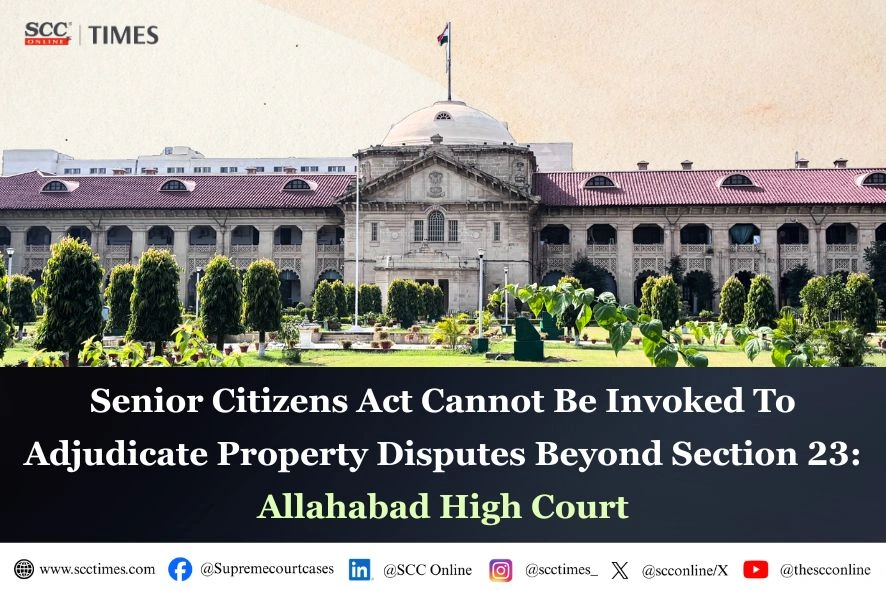
Allahabad High Court: The present petition was filed by the petitioner, a senior citizen seeking protection of his property under the Maintenance and Welfare of Parents and Senior Citizens Act, 2007 (Senior Citizens Act), police protection against interference with his possession, and a declaration that an allegedly forged will and subsequent sale deeds were void. The Division Bench of J.J. Munir and Indrajeet Shukla*, JJ. held that the Senior Citizens Act cannot be invoked to adjudicate disputed questions of title or the validity of property documents. The Court observed that the jurisdiction of the authorities and Tribunal under the Act is limited to matters falling within Section 23, Senior Citizens Act, and that property disputes outside its scope must be decided by competent civil courts, and accordingly dismissed the present petition.
Background
The petitioner claimed ownership and possession of a residential property at Rath, Hamirpur, and alleged that a will executed in favour of the private respondents by owner was forged. Based on the said will, the beneficiaries executed 2 sale deeds in favour of third parties. The petitioner contended that despite submitting representations to the district authorities seeking protection of his property under Section 22, Senior Citizens Act , no action was taken, enabling the alleged illegal transfers to take place. He also sought directions restraining the private respondents from interfering with his possession and requested the Court to declare the will and subsequent sale deeds void.
The private respondents opposed the petition, submitting that civil proceedings regarding the disputed property were already pending and that the dispute involved questions of title, which could not be decided by the authorities constituted under the Senior Citizens Act.
Court’s Analysis and Decision
The Court noted that Section 22, Senior Citizens Act obligates the State Government to frame a comprehensive action plan for the protection of the life and property of senior citizens. However, the provision does not confer adjudicatory powers upon the District Magistrate or other authorities to decide ownership disputes or declare transfer documents invalid.
The Court stated that for invoking the powers treating conveyance/document of transfer of title to be non est and void, certain prerequisites are to be satisfied, such as:
1. the transfer has been made by a senior citizen by way of gift or otherwise;
2. the transfer was subject to a condition that the transferee would provide basic amenities and basic physical needs to the transferor; and
3. the transferee failed or refused to fulfil that condition.
The Court noted that the petitioner had not pleaded that the transfer deed/conveyance was executed in consideration of the transferee providing basic amenities or care to the transferor, nor that the transferee had failed to provide such amenities. Instead, the challenge was directed against the validity of the will and the subsequent sale deeds, raising disputed questions of title that required adjudication through regular civil proceedings. However, such a course is not permissible under the statutory scheme of the Senior Citizens Act.
The Court stated that the Senior Citizens Act was enacted to provide maintenance and welfare to senior citizens and to secure their life and property through preventive measures. The legislation was not intended to replace ordinary civil remedies or create a parallel adjudicatory mechanism for resolving property disputes involving senior citizens. Further, not every property dispute concerning a senior citizen or the validity of a conveyance/transfer deed can be adjudicated under the Senior Citizens Act.
The Court further stated that the protection of a senior citizen’s property must be understood in the context of the Senior Citizen Act’s object and scheme. Accordingly, ordinary civil remedies relating to property rights cannot be replaced by proceedings under the said Act unless the dispute falls within the limited scope of Section 23, Senior Citizens Act.
The Court stated that the maxim expressio unius est exclusio alterius, which means the express mention of one thing implies the exclusion of another, applies to Section 23, Senior Citizens Act. Therefore, since the Act specifically confers jurisdiction on the Tribunal only in respect of disputes covered by Section 23, all other property disputes stand excluded from its jurisdiction. The Court lastly stated that the overriding effect of the Senior Citizens Act is confined to matters that are expressly entrusted to the Tribunal and the authorities under the said Act. Disputes falling outside their statutory jurisdiction must continue to be adjudicated by the competent civil courts and other traditional forums in accordance with law.
Thus, the Court stated that it would not exercise its writ jurisdiction to confer upon the Tribunal a power that the statute does not grant, namely, the power to determine the validity of title or conveyance deed, and accordingly dismissed the present petition.
[Satish Chandra Gupta v. State of U.P., 2026 SCC OnLine All 20665, decided on 2-7-2026]
*Judgment authored by: Justice Indrajeet Shukla
Advocates who appeared in this case:
For the Petitioner(s): Alok Kumar Dwivedi and Dharmendra Kumar.
For the Respondent(s): Standing Counsel Akhilesh Kumar Tripathi, Abhishek Srivastava, C.S.C.; Indra Pal Singh Rajpoot; and Rajesh Mishra.