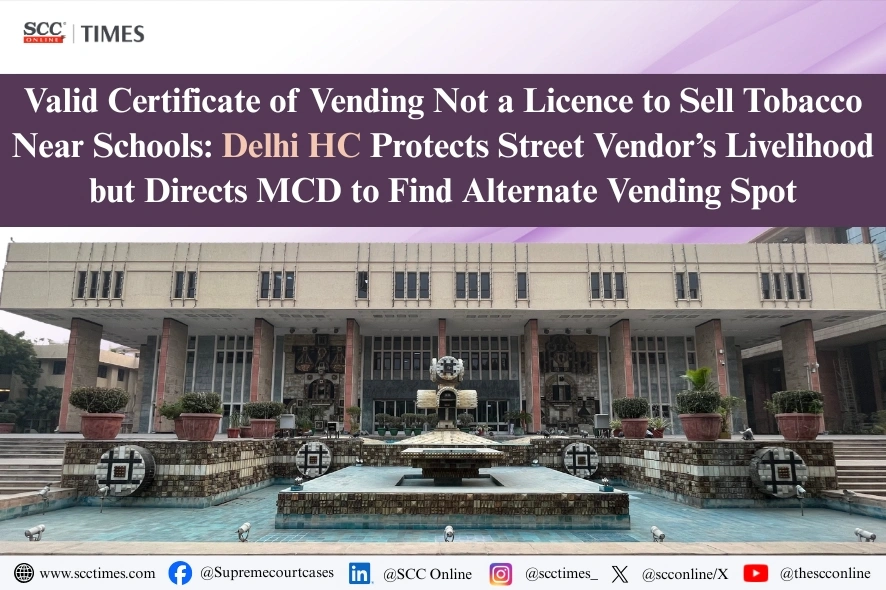
Delhi High Court: In a petition filed under Article 226 of the Constitution of India by petitioner, a street vendor, seeking protection of his right to vend peacefully near the VIP Gate of Nizamuddin Railway Station, South Delhi, which was obstructed by the Municipal Corporation of Delhi (MCD) and the Delhi Police despite possessing provisional Certificate of Vending (CoV), the Division Bench of Prathiba M. Singh* and Justice Vikas Mahajan, JJ., held that valid CoV protects a street vendor’s right to carry on vending activity, but the same does not mean that a street vendor would be permitted to sell pan masala, gutka and other similar products close to the school, where young children would be studying. Thus, the Court while protecting the petitioner’s entitlement to vend, issued conditional directions.
Background
The petitioner asserted that he had been vending at the site for several years. He held a provisional CoV under the category “Food/Snack with gas cylinder/fire.” According to him, he complied with the conditions attached to the CoV, yet was being unnecessarily harassed and prevented from carrying on his livelihood.
The MCD opposed the petition on the ground that the petitioner was selling tobacco-related products, including pan masala, gutka and cigarettes, in the vicinity of a primary school, Mata Sushila Malhotra DAV Primary School. The MCD also alleged that cleanliness and hygiene were not being maintained at the vending site. It relied on photographs, including geo-tagged photographs, to support these submissions. The photographs placed by the MCD showed the vend stocked with products such as pan masala, gutka and cigarettes. They also reflected litter and lack of cleanliness around the site.
Issues for Determination
-
Whether the petitioner, despite holding a valid provisional CoV, could continue vending from the existing location near a primary school when the evidence showed sale of tobacco-related products, lack of cleanliness and the possibility of obstruction to the school’s access?
-
How the petitioner’s right to livelihood and vending under the CoV could be balanced with the safety, health, hygiene and unhindered movement of children, parents and faculty at the school?
Analysis
At the outset, the Court referred to its earlier decision in Ram Prasad v. MCD, 2026 SCC OnLine Del 2254, wherein it was held that the sale of gutka, pan masala and similar products outside a primary school was “completely impermissible”. It had also directed the MCD to ensure that the ingress and egress of the school were not obstructed by vendors, carts or vends.
The Court held that there could be “no doubt” that the petitioner could not be permitted to sell pan masala, gutka or similar products close to Mata Sushila Malhotra DAV Primary School, where young children studied. The Court also found that the petitioner was obliged to maintain cleanliness and hygiene, which the photographs indicated had not been done.
Directions
At the same time, the Court recognised that the petitioner possessed a valid CoV. Thus, the Court while protecting the petitioner’s entitlement to vend, but made that entitlement conditional and issued following directions:
-
MCD to identify an appropriate vending space for the petitioner so that the ingress and egress of Mata Sushila Malhotra DAV Primary School would not be obstructed. This exercise was to be undertaken by the concerned Assistant Commissioner, MCD, within 3 days of the order.
-
Prohibited the petitioner from selling pan masala, gutka, cigarettes or any other tobacco products outside the school.
-
Permitted the petitioner to use only a small gas cylinder that did not occupy excessive space.
-
Petitioner was required to confine his activity to the allotted space and was restrained from extending into pedestrian areas or obstructing the movement of pedestrians.
-
Petitioner was obligated to maintain cleanliness and hygiene around the vend and to ensure the presence of a dustbin.
-
Petitioner could not create any third-party interest in the provisional CoV, sublet the vend, or hand over possession to another person.
-
No permanent or temporary construction could be erected at the vending site.
The Court clarified that these directions were expressly made subject to any plan that the Town Vending Committee-II might formulate under Section 21, Street Vendors (Protection of Livelihood and Regulation of Street Vending) Act, 2014. It further clarified that the petitioner could not claim any vested right on the basis of the order.
Decision
The Court stated that once an alternate and appropriate vending location was identified, the petitioner was required to shift his vend there and comply with all the stipulated conditions. Subject to such compliance, he was not to be disturbed from peaceful vending in terms of his CoV. It disposed of the petition with above mentioned directions.
Also Read: FSSAI Licensing & Registration Amendment Regulations, 2026 — Key Changes Explained
[Noor Alam v. MCD, 2026 SCC OnLine Del 4995, decided on 1-7-2026]
*Judgment authored by Justice Prathiba M. Singh
Advocates who appeared in this case:
For the Petitioner: Mr. AK Mishra, Mr. Arpit Mishra, Ms. Alphy Thomas and Ms. Kajal Mishra, Advs.
For the Respondent/MCD: Ms. Meherunnisa Anand Jaitley Adv.
For the Respondents 2 and 3: Ms. Uma Prasune, SPC with Mr. Akash Gupta, GP and Mr. Shreyansh Gupta, Advs.
Buy Constitution of India HERE