Disclaimer: This has been reported after the availability of the order of the Court and not on media reports so as to give an accurate report to our readers.
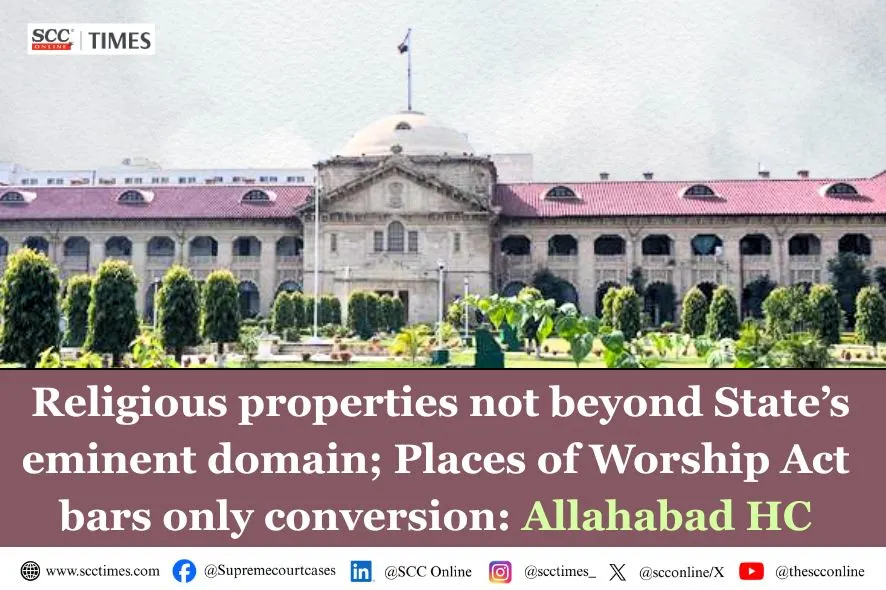
Allahabad High Court: In a writ petition filed by tenants and shopkeepers of Dalmandi Market, Varanasi, seeking protection against their alleged dispossession during the proposed road widening project and opposing the acquisition of 6 mosques situated in the area, the Division Bench of J.J. Munir and Arun Kumar, JJ., held that the petitioners, being tenants, had no right to challenge acquisition proceedings concerning the owners’ property or to seek protection of Waqf properties and that the Places of Worship (Special Provisions) Act, 1991 (Act of 1991), does not curtail the State’s power to acquire places of worship for a public purpose in accordance with law. The Court clarified that the Act of 1991 preserves only the religious character of places of worship as it existed on 15 August 1947 and does not curtail the State’s power of eminent domain. Observing that the petitioners had no enforceable right to seek the reliefs claimed, the Court, dismissed the writ petition.
Background
The controversy arose out of the Uttar Pradesh Government’s proposal to widen and beautify Dalmandi Street in Varanasi to facilitate easier movement of pilgrims and tourists visiting the Kashi Vishwanath Dham Corridor. Apprehending that the project would result in demolition of the premises from which they had been carrying on business for generations, 6 tenants and shopkeepers approached the High Court seeking protection against their alleged forcible dispossession without recourse to the procedure prescribed under the Right to Fair Compensation and Transparency in Land Acquisition, Rehabilitation and Resettlement Act, 2013 (2013 Act).
Besides seeking protection of their shops, the petitioners also sought to prevent the proposed acquisition of 6 centuries-old mosques situated along Dalmandi Street, contending that the acquisition would violate the Act of 1991, the Unified Waqf Management, Empowerment, Efficiency and Development Act, 1995 (Waqf Act), and their constitutional rights.
The State submitted that the petitioners were only tenants and not owners of the properties, that acquisition proceedings wherever necessary were being undertaken under the 2013 Act, and that the Places of Worship Act did not prohibit acquisition of religious properties for public purposes.
Analysis
The Court observed that the petitioners had conflated rights that they possessed with rights that they did not. The Court noted that the petitioners were admittedly tenants and not owners of the shops in question and that merely carrying business from the premises for generations did not elevate their tenancy into any proprietary right. The documents produced by the petitioners unequivocally established their status as tenants, limiting their rights to tenancy alone. The Court observed that the petitioners, being tenants, sought to protect their livelihood rather than any proprietary interest, and held that under the 2013 Act, the right to challenge acquisition primarily vests in the title holder, leaving tenants with little or no locus to question the acquisition.
The Court noted that upon transfer of land or acquisition by the State, the property vests in the State free from all encumbrances, and unlike a voluntary transfer where tenancy arrangements may continue, tenants ordinarily have no independent right to question the acquisition. The Court further noted that the petitioners had neither challenged any notice issued by the Nagar Nigam under the Uttar Pradesh Municipal Corporation Act, 1959, nor established that any demolition proceedings had been initiated against them by the Varanasi Development Authority under Section 27, Uttar Pradesh Urban Planning and Development Act, 1973, therefore, the reliefs sought against those authorities were misconceived.
The Court found that the petitioners had mixed their tenancy-related grievance with the issue of protecting 6 mosques located in the Dalmandi area from acquisition. The mosques are admittedly registered waqf, with their own mutawalli in each case. No doubt, members of the Muslim community may come forward in certain cases, but essentially it is the mutawalli and the Waqf Board, who have to protect such properties. The Court observed that any adjudication at the instance of the petitioners could prejudice their rights. Nevertheless, having regard to the petitioners’ emphatic reliance on the Act of 1991, the Court examined their submission that the acquisition of the mosques would offend the provisions of the Act of 1991, to the extent the claim is asserted by them as members of the Muslim community.
The Court examined the scope of definitions of “place of worship” and “conversion” under the Act of 1991, before interpreting the legislative scheme. The Court noted that when Sections 3 and 4 of the Act of 1991, is harmoniously construed, it prevents only the conversion of the religious character of a place of worship from one religion or denomination to another, while preserving its character as it existed on 15 August 1947, but the Act does not place places of worship beyond the State’s power of eminent domain or prohibit their acquisition and sue it for any public purpose, upon payment of just and fair compensation to the owner. That is what the doctrine of eminent domain, after all, means. The Act of 1991 is not meant to derogate from that right of the State.
The Court observed that Section 51, Waqf Act, as amended in 2025, expressly recognises acquisition of waqf properties for a public purpose under the 2013 Act or any other land acquisition law, subject to consultation with the Waqf Board and compliance with the Act of 1991. Relying on M. Ismail Faruqui v. Union of India, (1994) 6 SCC 360, the Court reiterated that the Act of 1991, prohibits the conversion of place of worship of one religious denomination into another. It does not derogate from the State’s authority to acquire any place of religious worship for a secular and public purpose, like development of a road or augmentation of infrastructure or any similar activity.
Decision
Holding that the petitioners, being tenants, had no enforceable right either to challenge the proposed acquisition of the 6 mosques or to seek any of the reliefs claimed, the Court dismissed the petition. The Court clarified that its observations on the acquisition of the mosques would not prejudice the rights of the State, the Waqf Board or the respective mutawallis to pursue appropriate proceedings in accordance with law, if occasion so arises.
[Syed Rashad Ali v. State of U.P., 2026 SCC OnLine All 20661, decided on 2-7-2026]
Advocates who appeared in this case:
For the petitioner: Quazi Mohammad Akaram
For the respondent: Mahesh Chandra Chaturvedi, Additional Advocate General, Suresh Singh, Additional Chief Standing Counsel, Vineet Sankalp, Ravi Prakash Pandey, Advocate