The relevance of the topic of this textbook is beyond doubt. In the current conditions of rapid development of information technologies and growing cyber threats, the problems of international legal regulation of cybersecurity acquire special theoretical and practical significance.
From a theoretical point of view, a comprehensive study of the international legal aspects of cybersecurity allows for a deeper exploration of fundamental issues of international law in the digital age, such as the applicability of existing norms of international law to cyberspace, the peculiarities of forming new principles and norms in this area, and the specifications of international cooperation in countering cyber threats. Scientific analysis of these issues contributes to the development of the general doctrine of international law in the context of global digitalisation.
From a practical point of view, the relevance of the topic is due to the urgent need to train qualified specialists capable of effectively solving the tasks of ensuring international cybersecurity. Recent large-scale cyberattacks and incidents have sharply highlighted the need to form an integrated system of international legal regulation of cybersecurity and the need to create effective mechanisms for international cooperation in this area.
The timeliness of developing a textbook on international cybersecurity law is further confirmed by the intensification of international efforts to develop common approaches to ensuring security in cyberspace, including within the framework of the United Nation (UN), regional organisations, and bilateral relations between States. In these conditions, the training of specialists with deep knowledge in the field of international legal regulation of cybersecurity becomes a critically important task for ensuring the national interests of states in cyberspace.
In this context, a comprehensive analysis of the problems of international cybersecurity law in the presented textbook appears to be extremely useful and fruitful both for academic study of this field and for training practicing specialists in the field of international law and cybersecurity.
The scientific and methodological novelty of the presented work consists in the following:
1. The authors have proposed an original structure for presenting the material, based on a comprehensive approach to considering the international legal aspects of cybersecurity. This allows students to form a holistic view of the current state and prospects for the development of international law in this area.
2. The textbook attempts to systematise existing international legal norms, principles, and mechanisms for ensuring cybersecurity, as well as to reveal their relationship with other branches of international law. The authors have proposed a classification of international legal instruments in the field of cybersecurity, which is essential for understanding the structure of legal regulation in this area.
3. Special attention is paid to the analysis of current practices of States and international organisations in the field of cybersecurity, which allows students to gain an understanding of the real state of international legal regulation in this dynamically developing area.
4. The textbook contains an innovative approach to considering the application of international humanitarian law to cyber operations, which contributes to the formation of critical thinking in students regarding complex legal problems at the intersection of traditional international law and new technological realities.
5. The authors have developed a unique methodology for analysing cases in the field of international cybersecurity law, allowing students to develop practical skills in solving current legal problems in this area.
After careful familiarisation with the presented textbook, allow me to share some thoughts regarding its content and structure, taking into account current trends in the development of international cybersecurity law and the practice of training specialists in this field. The following comments are intended to serve as a basis for further improvement of the textbook and do not claim to be exhaustive or critical.
Recommendations:
1. From the point of view of forming a theoretical base, the analysis of the conceptual foundations of international cybersecurity law presented in the textbook could be supplemented with a more detailed consideration of the influence of information society theory on the development of international legal regulation in this area. The ideas of researchers such as Manuel Castells and Jürgen Habermas on the transformation of social and legal institutions under the influence of information technologies laid the foundations for the modern understanding of the role of law in the digital age and had a significant impact on the formation of international legal approaches to regulating cyberspace.
2. When considering the principles of international cybersecurity law, it would be useful to analyse in more detail the problem of adapting traditional principles of international law to the specifics of cyberspace. In particular, the question of the applicability of the principle of territorial sovereignty to virtual space and its legal consequences for regulating cross-border information flows deserves attention.
3. Analysing the international legal mechanisms for combating cybercrime, the authors rightly note the key role of the Budapest Convention on Cybercrime. At the same time, it seems appropriate to consider in more detail alternative approaches to international cooperation in this area, in particular, the initiatives of Russia and a number of other countries to develop a universal UN Convention on countering the use of information and communication technologies for criminal purposes.
4. When considering issues of international legal regulation of cyber wars, it would be useful to pay more attention to the problem of the applicability of international humanitarian law to cyber operations. A more detailed analysis of the Tallinn Manual on the International Law Applicable to Cyber Warfare and the discussions around it would allow for a deeper disclosure of the complexity and ambiguity of legal regulation in this area.
5. Analysing the role of international organisations in ensuring cybersecurity, the authors rightly note the importance of the activities of the UN and regional organisations. At the same time, it seems appropriate to consider in more detail the role of non-State actors, in particular, technical organisations such as Internet Corporation for Assigned Names and Numbers (ICANN) and Internet Engineering Task Force (IETF), in the formation of international legal norms and standards in the field of cybersecurity.
6. When considering the international legal aspects of protecting critical information infrastructure, it would be useful to investigate in more detail the problem of cross-border interaction between national computer incident response centers (CERTs) and the legal basis for exchanging information about cyber threats between States.
7. The textbook could benefit from including a section devoted to analysing the impact of new technologies, such as artificial intelligence and quantum computing, on the development of international cybersecurity law. This would allow students to form a more holistic view of the prospects for the development of this branch of law.
8. It would be useful to expand the section devoted to the international legal aspects of ensuring cybersecurity in outer space, given the growing dependence of global infrastructure on space systems and the corresponding risks of cyberattacks on these systems.
9. It is recommended to supplement the textbook with an analysis of legal problems associated with the use of cryptocurrencies and blockchain technologies in the context of international cybersecurity, including issues of countering the financing of terrorism and money laundering using these technologies.
10. The textbook could be supplemented with a section devoted to the international legal aspects of ensuring data security in the context of cross-border information transfer, including an analysis of various approaches to regulating this area in different jurisdictions (for example, General Data Protection Regulation (GDPR) in the European Union (EU), California Consumer Privacy Act (CCPA) in California, the personal data protection law in China).
In addition, the work does not pay enough attention to promising directions for the development of international cybersecurity law. In particular, the following aspects should be considered:
-
A deeper analysis of these aspects would significantly enrich the textbook and form a more comprehensive understanding among students of the prospects for the development of international cybersecurity law.
-
Despite the recommendations made, it should be noted that the presented textbook “International Cybersecurity Law” has a number of significant advantages and considerable potential for use in the educational process.
First of all, it is necessary to emphasise the comprehensive approach of the authors to considering the problems of international cybersecurity law. The textbook covers a wide range of issues — from the theoretical foundations and principles of international law in the digital age to specific mechanisms of international cooperation in the field of countering cyber threats. Such a comprehensive approach allows students to form a holistic view of this area of law and its relationship with other branches of international law.
The interdisciplinary nature of the textbook deserves special attention. The authors skillfully combine legal analysis with consideration of technological, political, and economic aspects of cybersecurity. This not only enriches the content of the textbook but also contributes to the development of students’ systems thinking skills necessary for effective work in the field of international cybersecurity.
An important advantage of the textbook is its practical orientation. The inclusion of analysis of real cases, examples from the practice of States and international organisations, as well as practical tasks in the text allows for connecting theoretical knowledge with its practical application. This significantly increases the educational value of the textbook and its usefulness for training qualified specialists.
It is also worth noting the innovative nature of many sections of the textbook, in particular, those devoted to the latest trends in the field of international cybersecurity law. The authors do not limit themselves to presenting established approaches but also offer their vision of the prospects for the development of legal regulation in this dynamically changing field.
The textbook is distinguished by its logical structure, clarity of presentation, and accessibility of language, which makes it a convenient tool for both teachers and students. At the same time, the authors managed to maintain a high scientific level of content, which allows recommending this textbook not only for basic but also for advanced courses on international cybersecurity law.
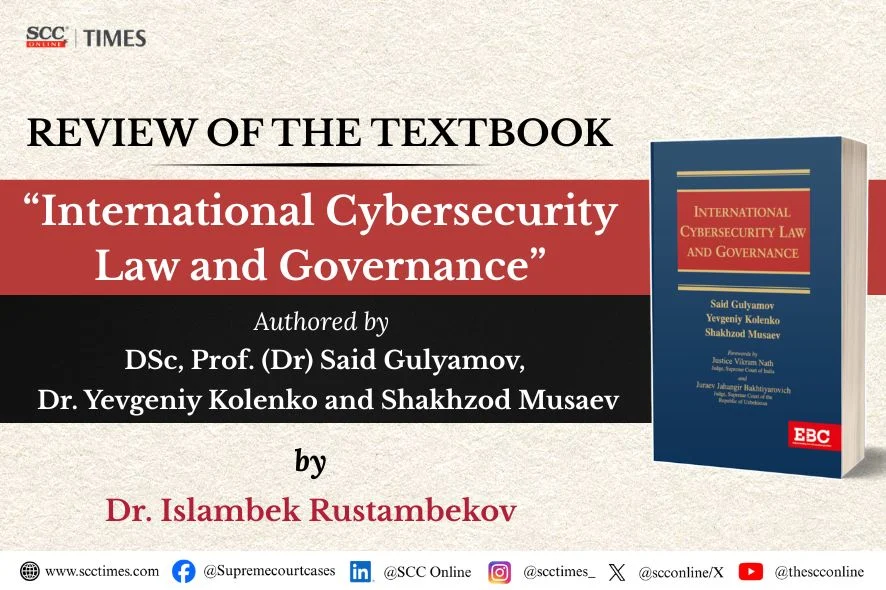
Overall, the presented textbook “International Cybersecurity Law and Governance” has significant potential to become one of the leading textbooks in its field. Its publication and implementation in the educational process can make a substantial contribution to the preparation of a new generation of specialists capable of effectively solving complex tasks of ensuring international cybersecurity in the rapidly changing digital world.
Taking into account the above, the textbook “International Cybersecurity Law and Governance”, authored by Prof. (Dr) Said Gulyamov, Dr Yevgeniy Kolenko and Shakhzod Musaev can be recommended for publication and use in the educational process in training specialists in the field of international law and cybersecurity.
*Doctor of Law (DSc), Professor, Acting Rector, Tashkent State University of Law.