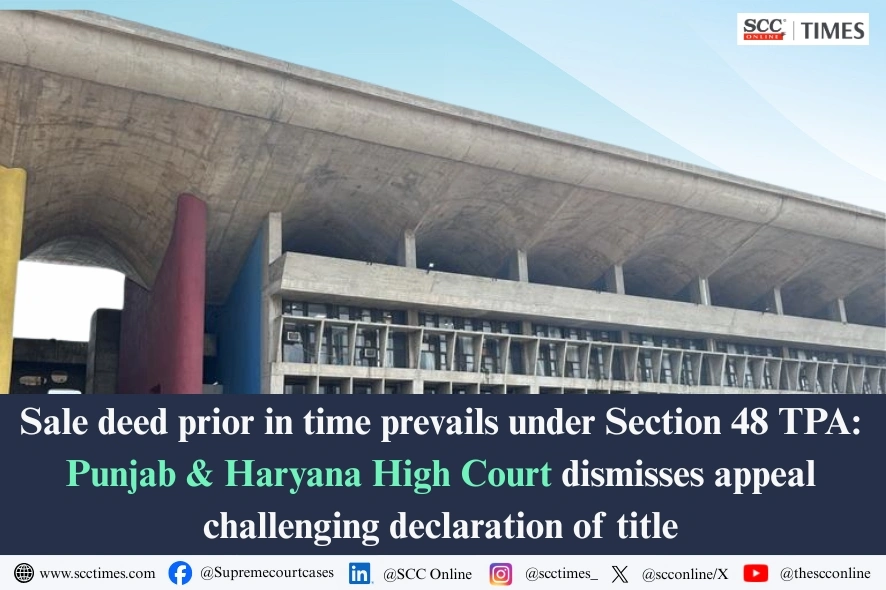
Punjab & Haryana High Court: While considering an appeal arising from a suit for declaration of title, cancellation of subsequent sale deeds, and permanent injunction, a Single Judge Bench of Pankaj Jain, J., held that a prior registered sale deed prevails over subsequent transfers and that a suit seeking declaration of title based on an earlier sale deed is not barred by limitation merely because it also challenges a subsequent sale deed.
Also read: Madhya Pradesh HC directs Enquiry against Trial Court Judge for Non-Compliance with its Orders
Background
In the present case, Respondents 1-3 were absolute owners in possession of land based on sale deed dated 29 August 1985, and Respondents 4-5 were owners of the same land as per sale deed dated 12 June 1985, both executed in their favour by Appellant 1.
The respondents filed a suit seeking a declaration that the subsequent sale deed dated 20 August 1987 executed by Appellant 1 in favour of Appellant 2, the consequential mutation, and the earlier sale deed dated 20 December 1984 executed in favour of Respondents 6 and 7 were illegal and not binding on their rights. They also sought a permanent injunction against interference with their possession.
The trial court partly decreed the suit, holding that the sale deed dated 20 December 1984, being prior in time, prevailed over the respondents’ sale deeds under Section 48 Transfer of Property Act, 1882 (TPA). It declared Respondents 4-5 owners of 6 Marlas and Respondents 1-3 owners of the remaining 9.5 Marlas, and further held that the sale deed dated 20 August 1987 in favour of Appellant 2 was void ab initio and that the suit was not barred by limitation.
The appellate court affirmed the trial court’s findings. Aggrieved, Appellants 1 and 2 approached the Court, contending that the suit was barred by limitation and that the sale deeds in favour of the respondents were sham transactions arising from a failed property exchange.
Analysis and Decision
The Court held that Appellant 1 did not dispute the execution of the registered sale deeds dated 12 June 1985 and 29 August 1985 in favour of the respondents. The appellants’ plea that the sale deeds were sham transactions executed as part of a failed property exchange was rejected, as the sale deeds were registered documents containing recitals of payment of consideration and no proceedings had ever been instituted by Appellant 1 to have them cancelled on the ground of the alleged exchange.
Regarding limitation, the Court held that although the respondents had sought a declaration that the sale deed dated 20 August 1987 was illegal and not binding, their principal relief was a declaration of title and possession based on the registered sale deeds executed in their favour. The relief of declaration of title was distinct from the relief of cancellation of an instrument, and the respondents’ claim to ownership could not be held to be barred by limitation merely because the subsequent sale deed was also challenged.
The Court further held that since the sale deed dated 20 December 1984 was prior in time, it had precedence over the subsequent sale deeds. After executing the sale deed of 20 December 1984, Appellant 1 was left with 15.5 Marlas of land, of which 6 Marlas were validly conveyed to Respondents 4 and 5 by the sale deed dated 12 June 1985. Consequently, only 9.5 Marlas remained with Appellant No.1, and the sale deed dated 29 August 1985 could operate only to that extent.
Thus, the Court stated that the Courts below rightly invoked Section 48 TPA to hold that “the transfer prior in time shall have an overriding effect over the transfer which is later in time.”
The Court held that, having already transferred his remaining interest in the property, Appellant 1 had no right, title or interest left to convey under the subsequent sale deed dated 20 August 1987 in favour of Appellant 2. Thus, the sale deed dated 20 August 1987, and the consequential mutations were rightly declared void and inoperative against the respondents’ rights.
Accordingly, the Court dismissed the appeal.
[Swaraj Pal Singh v. Arun Kumar, 2026 SCC OnLine P&H 19655, decided on 6-7-2026]
Advocates who appeared in this case:
For the Appellants: Akshay Bhan, Senior Advocate, Santosh Sharma, Varun Sandhu and Harsh Vasu Gupta, Advocates
For the Respondent: J.K. Chauhan, Abhay Pratap S. Chauhan, Advocate and Jasbir Singh Ahlawat, Vaibhav Gupta, Advocate for the applicant