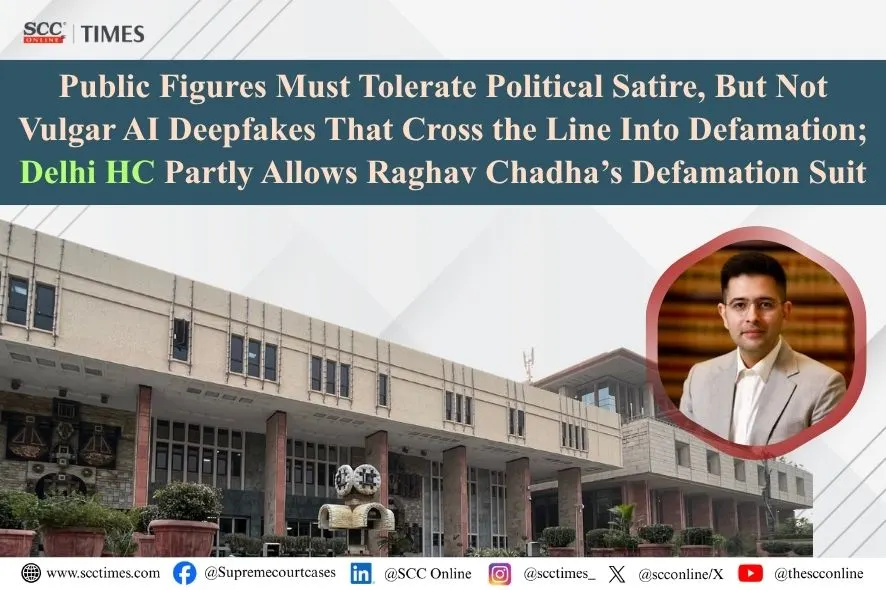
Delhi High Court: An application was filed by plaintiff, Raghav Chadha, a Member of Parliament in the Rajya Sabha representing Punjab, under Order 39 Rules 1 and 2, Civil Procedure Code, 1908 (CPC) seeking protection against the circulation of artificial intelligence (AI)-generated deepfake videos, morphed images, synthetic media and other manipulated content allegedly created to tarnish his public image. While acknowledging the serious threat posed by AI-enabled misinformation and its potential to undermine an individual’s dignity and reputation, the Single Judge Bench of Subramonium Prasad, J., held that “public figures assuming such positions of power must accept being at the receiving end of the satirical humour as a necessary and inevitable aspect of their profession, though unpleasant”. However, the Court clarified that AI-generated content that is profane, vulgar, malicious, or seriously impairs an individual’s dignity may justify judicial intervention. Accordingly, the Court on examination of documents placed on record, found Documents 2, 8, 9, 11, 25 and 40 to be explicit, profane and vulgar, thereby exceeding the limits of legitimate political satire and prima facie amounting to be defamatory and directed to remove them within 2 weeks.
Background
The plaintiff alleging that unidentified persons had created and circulated AI-generated deepfake videos, morphed images, and manipulated audio-visual content depicting him in a derogatory and defamatory manner. According to the plaintiff, these campaigns gained momentum after his political shift from the Aam Aadmi Party (AAP) to the Bharatiya Janata Party (BJP).
The plaintiff contended that the impugned content misused his face, voice, mannerisms and public identity to spread misinformation and damage his political reputation. He sought wide-ranging reliefs including permanent injunction restraining the unauthorised misappropriation and exploitation of his personality rights, removal of the offending material from intermediary platforms, disclosure of the identities of the uploaders, and directions to government authorities to block future infringing content.
However, during the hearing the plaintiff expressly stated that he would not press the claim relating to personality rights and would restrict his case to the issue of defamation.
Issue for Determination
Whether the plaintiff had established a prima facie case warranting an interim injunction on the ground of defamation?
Legal Framework
At the outset, the Court stated that “injunction is a judicial process by which a party is required to do or refrain from doing a particular act. Injunction is a nature of preventive relief to a litigant to prevent future and possible injury”. It reiterated that grant of temporary injunction is a discretionary and may be granted only when the applicant establishes:
-
a prima facie case,
-
the balance of convenience in his favour, and
-
irreparable injury incapable of being compensated by damages.
The Court relied upon the principle laid down in Bonnard v. Perryman, (1891) 2 Ch 269, as applied by the Supreme Court in Bloomberg Television Production Services India (P) Ltd. v. Zee Entertainment Enterprises Ltd., 2024 SCC OnLine SC 426, holding that pre-trial injunctions in defamation matters should be granted only in exceptional circumstances because they directly affect the constitutional guarantee of freedom of speech and expression. An ex parte injunction is justified only where the impugned publication is shown to be “malicious” or “palpably false”.
Analysis
The Court observed that the suit, in substance, did not concern protection of personality rights because the plaintiff himself chose not to press those claims. Consequently, prayers relating to personality rights were not considered.
Examining the law governing defamation of public figures, the Court referred Bonnard v. Perryman, (1891) 2 Ch 269, wherein the House of Lords emphasised that courts should exercise extreme caution before restraining publication at an interlocutory stage. Unless the allegedly defamatory statement is shown to be palpably false and incapable of justification, prior restraint upon publication would ordinarily be inappropriate.
The Court also referred to Kartar Singh v. State of Punjab, (1956) 1 SCC 692; R. Rajagopal v. State of T.N., (1994) 6 SCC 632; Amish Devgan v. Union of India, (2021) 1 SCC 1; Sardar Charanjit Singh v. Arun Purie, 1982 SCC OnLine Del 301 and Naveen Jindal v. Zee Media Corpn. Ltd., 2014 SCC OnLine Del 1369, the Court noted the settled principle that “those who fill a public position must not be too thin-skinned in reference to comments made upon them” and “those who hold office in government and are responsible for public administration, must always be open to criticism”. Public officials necessarily expose themselves to public scrutiny and criticism, including sharp political commentary.
Applying the above principles, the Court observed that the standard required to establish actionable defamation against a public figure is necessarily more demanding than in the case of an ordinary individual.
The Court expressed serious concern regarding the increasing use of AI for generating deepfake videos and manipulated content. It categorically observed that the Court does not “endorses the use of AI to produce deepfake videos, morphed images, etc. when employed to harm the dignity of an individual”. Such misuse has the potential to strike at the very root of the constitutional guarantee of dignity.
At the same time, the Court acknowledged that AI has increasingly become a medium through which political opinions are expressed, and until comprehensive legislation regulates such content, courts must determine on a case-by-case basis whether the material crosses the threshold of violating an individual’s right to dignity.
“…a fair balance is to be struck with an individual’s freedom of speech and expression which is also granted under the Constitution of India.”
On examining the documents, the Court found that the majority of the content merely consisted of political satire concerning the plaintiff’s political decisions regarding change in political party alliances, governance, policies, etc. Such criticism, though unpleasant, are a part and parcel of politics and could not automatically be characterised as defamatory.
However, the Court found that Documents 2, 8, 9, 11, 25 and 40 contained language that was “profane and vulgar in nature” and outside the limits of harmless satirical humour. Therefore, the Court opined that these specific documents warranted interim protection.
Decision
The Court partly allowed the application and directed the:
-
Defendants 2 and 4 to remove the uniform resource locators (URLs) corresponding to Documents 2, 8, 9, 11, 25 and 40 within 2 weeks.
-
Defendants 2 and 4 to furnish the plaintiff with the basic subscriber information (BSI) and IP logs relating to the accounts responsible for those documents within 2 weeks.
The Court did not restrain the remaining allegedly defamatory content because it constituted political satire and criticism that public figures are expected to tolerate in a democratic society.
Also Read: Delhi HC enforces Amit Malviya’s undertaking; Stays defamation complaint against RSS Member
[Raghav Chadha v. Ashok Kumar, 2026 SCC OnLine Del 4838, decided on 1-7-2026]
Advocates who appeared in this case:
For the Plaintiff: Mr. Rajiv Nayar, Sr. Adv. with Mr. Sataya Anand, Mr. Nikhil Aradhe, Mr. Amber Chaturvedi, Ms. Manjira Das Gupta and Mr. Naman Maheshwari, Advs.
For the Defendant 2: Mr. Varun Pathak, Ms. Radhika Roy and Ms. Prasidhi Agrawal, Advs.
For the Defendant 4: Ms. Mamta Rani Jha, Mr. Rohan Ahuja, Ms. Shruttima Ehersa, Ms. Sanya Sehgal and Ms. Aiswarya, Advs.
For the Defendants 5 and 6: Ms. Dimple S Arora (SPC) and Mr. Vanshul Pali (GP) along with Ms. Ayushika Mishra