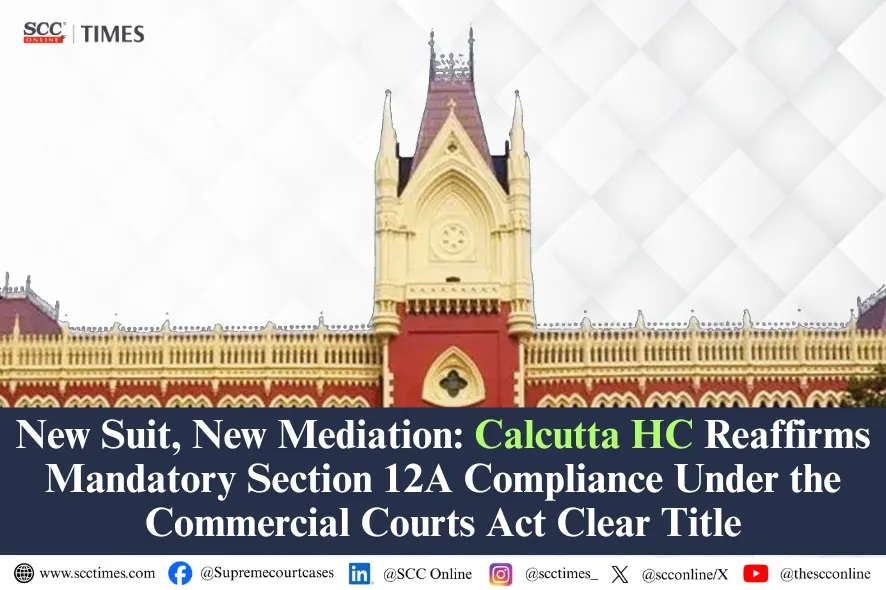
Calcutta High Court: The Single Judge Bench of Aniruddha Roy, J. rejected a commercial suit seeking enforcement of a negative covenant in a family agreement as the plaintiff failed to comply with the mandatory pre-institution mediation requirement under Section 12-A, Commercial Courts Act, 2015 (CC Act). The Court highlighted that the statutory pre-institution mediation is an indispensable condition precedent for instituting an independent commercial suit.
Background
The dispute originated from a family agreement dated 13 June 2017. The agreement contained a negative covenant which the defendant had allegedly violated. Although the family agreement had been executed by several parties, the plaintiff chose to proceed only against the defendant without impleading the remaining parties to the agreement. The plaintiff had earlier filed civil suit before the Regular Division. The suit involved substantially the same parties and arose out of the same cause of action. However, a coordinate Bench dismissed the earlier suit without trial, holding that it was not maintainable before the Regular Division as the dispute was commercial in nature and ought to have been instituted before the Commercial Division.
During the pendency of the appeals, the Division Bench referred the parties to mediation by an order dated 19 June 2025. The mediation failed to produce any settlement. The Division Bench dismissed the appeals and affirmed the finding that the original suit had not been maintainable before the Regular Division. The plaintiff carried the matter further before the Supreme Court by filing a special leave petition, but it also got dismissed.
Following the dismissal of the previous proceedings, the plaintiff instituted the present suit before the Commercial Division, seeking enforcement of this negative covenant and also filed an interlocutory application seeking an injunction against the defendant. The plaintiff argued that there had been substantial compliance with the statutory requirement. It was submitted that the parties had already participated in mediation during the earlier litigation pursuant to the directions of the Division Bench. Since the mediation had failed and the present suit involved the same parties and the same cause of action, requiring another round of mediation would serve no practical purpose. According to the plaintiff, the objective of Section 12-A is to facilitate settlement before litigation, and that purpose had already been fulfilled through the earlier mediation process.
The plaintiff relied upon the decision of the Delhi High Court in Aaone Developers (P) Ltd. v. Sabita Jha, (2025) 1 HCC (Del) 28 : 2025 SCC OnLine Del 42 where mediation conducted in an earlier stage of the proceedings had been treated as sufficient compliance after a suit was converted into a commercial suit. It was further pointed out that the Supreme Court had declined to interfere with that judgment by dismissing the special leave petition filed against it. Therefore, the plaintiff contended that the present suit should also be treated as maintainable despite the absence of a fresh pre-institution mediation.
Decision and Analysis
The Court observed that the earlier suit and the present commercial suit were independent proceedings. The earlier suit had been finally dismissed after being held not maintainable before the Regular Division. Once that suit came to an end, the present commercial suit acquired an independent legal identity and was required to satisfy every mandatory condition prescribed under the CC Act, 2015. The Court held that Section 12-A is a mandatory statutory provision. Once the instant suit has been registered as a commercial suit all the rigors including the mandate provided under Section 12-A, CC Act are attracted and would apply. The Court noted that at the time of institution of this suit, no leave had been prayed for dispensation of the pre-litigation mediation as provided under Section 12-A. The mere existence of an averment in the plaint seeking dispensation was insufficient as no formal order granting exemption had ever been passed.
The Court further held that the earlier mediation could not substitute statutory compliance because it had been conducted under Section 89, Civil Procedure Code, 1908 during appellate proceedings in the earlier suit. Such mediation was different from the pre-institution mediation envisaged under Section 12-A and the 2018 Rules. The Court emphasised that the statutory procedure must be followed exactly as enacted. While distinguishing the Delhi High Court decision, the Court explained that the principle laid down therein was confined to a situation where a single suit continued after conversion into a commercial suit. The present case involved a fresh commercial suit instituted after dismissal of an earlier suit. Consequently, the ratio of Aaone Developers was held inapplicable.
The Court reiterated the golden rule of law that when a specific statutory provision to do certain act is codified under the statute, such an act must be and should be done in the same manner as codified under the statute or not at all. Any other mode is expressly forbidden in law. Therefore, when the instant suit has been instituted as a commercial suit, the same has to be maintained in strict compliance of the provisions laid down under the CC Act and non-compliance of any mandatory provision of the CC Act would render the suit bad and not tenable in law. Thus, non-compliance of the provision under Section 12-A, CC Act would render the suit bad being barred by law.
Accordingly, the Court dismissed the commercial suit. However, the Court directed the parties to undergo mediation before the competent jurisdictional mediation centre in accordance with the CC Act and ordered that the mediation process should be concluded within 1 month from the date of the first sitting. Recognising that the rejection of the plaint was based solely on procedural non-compliance, the Court directed the return of the Court fees paid by the plaintiff. Finally, the Court expressly clarified that it had not examined the remaining objections regarding maintainability or the substantive merits of the dispute. The decision was confined exclusively to the mandatory requirement of compliance with Section 12-A, CC Act.
[Ramji Lal Agarwal v. Sourav Agarwal, 2026 SCC OnLine Cal 10218, decided on 24-6-2026]
*Judgment authored by: Justice Aniruddha Roy
Advocates who appeared in this case:
For the Plaintiff: Rajarshi Dutta, V.V.V. Sastry, Rahul Poddar, Advocates
For the Defendant: Anuj Singh, Sourojit Dasgupta, Niharika Singh, Trinisha De, Rupal Singh, Anukriti Poddar, Ashok Kumar Singh, Advocates