Delhi High Court: In a petition under Section 34, Arbitration and Conciliation Act, 1996 challenging an arbitral award, a Single Judge Bench of Harish Vaidyanathan Shankar, J., held that documents forming part of confidential arbitral proceedings cannot be relied upon in separate arbitral proceedings merely because they are relevant to a party’s case. Emphasising that Section 42-A of the Act embodies the legislative intent to preserve arbitral confidentiality, the Court observed that permitting reliance on such material would substantially undermine the statutory confidentiality regime and render the protection envisaged by Parliament illusory. Holding that the Arbitral Tribunal had rightly declined to rely upon a letter exchanged between the respondent and the Dedicated Freight Corridor Corporation of India Ltd. (DFCCIL) in separate arbitral proceedings, the Court found no patent illegality or conflict with the public policy of India warranting interference under Section 34 and dismissed the petition.
Background
The dispute arose out of a back-to-back subcontract executed between the petitioner and the respondent in connection with the Eastern Dedicated Freight Corridor Project undertaken by the DFCCIL. Under the subcontract dated 15 December 2015, the petitioner was engaged to execute civil, electrical and allied works for 55 structures forming part of Slice-103 of the principal contract awarded by DFCCIL to the respondent. While the petitioner alleged that the respondent failed to provide encumbrance-free access to project sites, finalised project particulars and other prerequisites necessary for carrying out geotechnical investigations, topographical surveys and design activities, the respondent maintained that all requisite access and information had been provided and that the delays were solely attributable to the petitioner. The parties subsequently fell into dispute over delays, execution of works, payments and responsibility for non-performance, culminating in the descoping of portions of the work and eventual termination of the subcontract by the respondent.
Pursuant to the arbitration clause contained in the subcontract, the disputes were referred to a three-member Arbitral Tribunal under the ICC Rules of Arbitration, 2021. During the proceedings, the petitioner sought to rely upon a letter dated 7 June 2017 addressed by the respondent to DFCCIL, contending that it constituted an admission that geotechnical investigations and surveys could not commence without encumbrance-free access and necessary project particulars. The respondent objected to its reliance on the ground that the communication formed part of confidential proceedings arising out of the principal contract with DFCCIL. Accepting the objection, the Tribunal excluded the document from consideration and, by its award dated 15 November 2023, partly allowed certain claims of the petitioner, rejected all counterclaims of the respondent, but disallowed, inter alia, the petitioner’s claims relating to geotechnical investigations, topographical surveys, overhead costs and loss of profit.
Aggrieved, the petitioner invoked Section 34, Arbitration and Conciliation Act, 1996, confining its challenge to the rejection of these claims and, in particular, to the Tribunal’,s refusal to admit and rely upon the said letter.
Analysis
The Court reiterated the limited scope of interference under Section 34, Arbitration and Conciliation Act, 1996, and observed that the petitioner’s challenge was confined to the rejection of Claims 2, 3, 13 and 16, all of which rested on a single grievance, that the Arbitral Tribunal had erred in declining to rely upon the letter dated 7 June 2017 addressed by the respondent to DFCCIL.
The Court noted that this was not a case where the Tribunal had overlooked the document; rather, it had undertaken a detailed examination of its provenance, admissibility and the implications of Section 42-A of the Act before concluding that the communication formed part of confidential arbitral proceedings between the respondent and DFCCIL. Upholding this approach, the Court held that Section 42-A embodies the legislative intent to preserve arbitral confidentiality and cannot be interpreted in a manner that renders such protection illusory. Even assuming that the provision does not create a rigid rule of inadmissibility, the Tribunal was well within its authority to regulate the evidentiary record and decline reliance upon a document procured from separate confidential arbitral proceedings. The Court further held that relevance of a document is distinct from its permissible use, and rejected the petitioner’s reliance on precedents concerning Section 34(5), the effect of non obstante clauses, and the ICC Rules, observing that institutional rules cannot dilute the mandatory provisions of the Act where the seat of arbitration is in India.
The Court also rejected the petitioner’s contention that the document had entered the public domain merely because it formed part of judicial proceedings, holding that the Tribunal’s findings regarding the document’s provenance were findings of fact that disclosed no perversity. It further observed that a Section 34 proceeding cannot be converted into a forum for raising factual contentions not urged before the Tribunal. Since the petitioner had not independently challenged the merits of the Tribunal’s findings on the rejected claims and had founded its case entirely on exclusion of the letter dated 7 June 2017, the very foundation of the challenge necessarily failed once the Tribunal’s evidentiary approach was upheld.
Decision
The Court concluded that the impugned award neither conflicted with the public policy of India nor suffered from any patent illegality, and that the petitioner had failed to establish any ground warranting interference under Section 34 of the Act. Accordingly, the petition was dismissed, the arbitral award was left undisturbed, and no order as to costs was passed.
Also Read: Confidentiality in Arbitration: Legal and Practical Challenges in India | SCC Times
[JPC Infrastructure and Constructions (P) Ltd. v. Alstom Transport India Ltd., 2026 SCC OnLine Del 5091, decided on 6-7-2026]
Advocates who appeared in this case:
For the Petitioners: Manini Brar and Muskaan Chawla, Advocates
For the Respondent: Dinesh Pardasani, Aishwary Kumar Tiwari, Siddharth Chechani and Amrit Singh, Advocates.
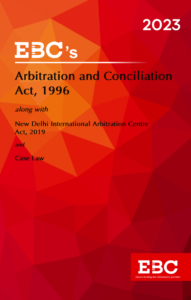
Buy Arbitration and Conciliation Act, 1996 HERE