Disclaimer: This has been reported after the availability of the order of the Court and not on media reports so as to give an accurate report to our readers.
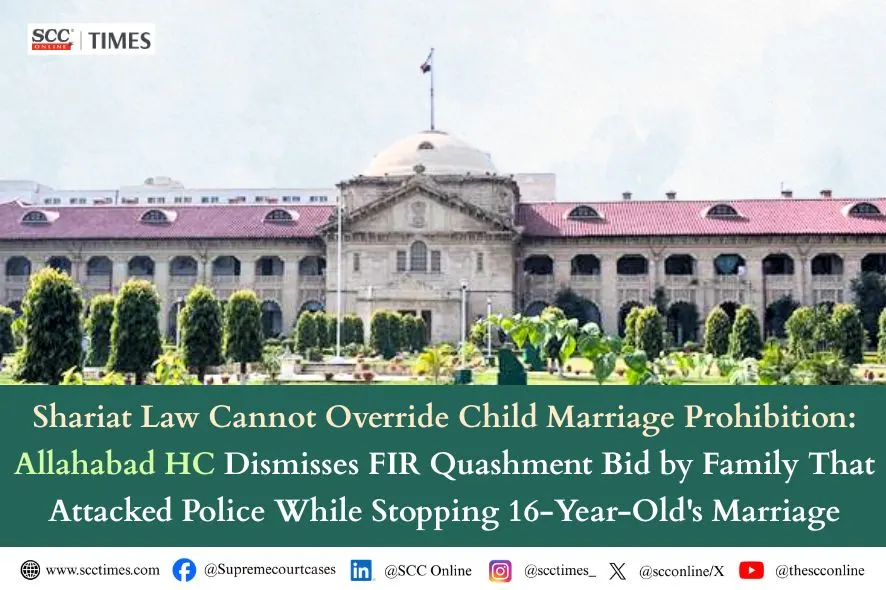
Allahabad High Court: In a petition filed seeking quashing of an FIR filed against the accused persons for stopping Police and Child Line Team from rescuing a minor girl from child marriage, the Division Bench of J.J. Munir* and Achal Sachdev, JJ., dismissed the petition, holding that the nature of the allegations and the corpus delicti were such that it was not a fit case to injunct he investigation at an initial stage by quashing the FIR and disregarding the process of investigation. The Court also held that the Muslim Personal Law (Shariat) Application Act, 1937 (Shariat Law) providing for puberty as the competent age under the law, permissible for a girl to marry or be married, violates the Prohibition of Child Marriage Act, 2006 (PCMA) and the Protection of Children from Sexual Offences Act, 2012 (POCSO), i.e., child marriage could not be permitted under Shariat Law.
The Court said,
“If, therefore, in a position as the present one, the Police and the Child Line Team swung into action and rescued the victim, they were indeed acting within the four corners of law and most certainly in the bona fide discharge of their duties under the law.”
Background
The police had received information about an impending child marriage of a 16-year-old girl. To prevent the same, the police, in charge of the Child Line Team, 2 case workers, and the informant reached the victim’s house and spoke to her and her parents. After inquiries into the matter, the Child Line Team disclosed their intention of producing the victim before the Child Welfare Committee, Bulandshahr, and asked the victim and her parents to come along with them for the purpose of the aforesaid production. Thereupon, several people present there abused the Police and the Child Line Team personnel, threatened them, and forcibly took away the victim from the custody of the Child Line Team member.
The Police and members of the Child Line Team, facing aggression from the accused persons, had to escape to save their lives. Despite this, the Police and the Child Line Team managed to rescue the victim. Accordingly, an FIR was filed against the 19 accused persons under Sections 191(2), 132, 121(1), 352, and 351(2), Nyaya Sanhita, 2023 (BNS), besides the 50 other offenders, whose identity could not be ascertained.
Thus, the accused persons filed the present petition seeking the quashing of the FIR.
The accused persons contended that under the Shariat Law applicable to Muslims, a girl, after she attains the age of puberty (generally regarded as 15 years), is competent to marry, and the PCMA would not affect the personal law of the accused persons about marriage. Additionally, under Section 3, Majority Act, 1875, though the age of majority stipulated for a person is 18 years, Section 2 thereof carries a non-obstante clause, excluding laws relating to marriage, dower, divorce, and adoption from the purview of the said Act. Section 2, Shariat Law also had a non-obstante clause.
Also read: Child Marriages Rising in U.P.: Allahabad HC Flags Systemic Gap, Directs DGP to Issue Guidelines
Analysis
At the outset, the Court noted that there was a division of opinion among the High Courts on whether a minor who is married under the Muslim Law would be governed by the provisions of the personal law or the POCSO and the PCMA. The Court agreed with the reasoning in Moidutty Musliyar v. Sub Inspector, 2024 SCC OnLine Ker 4188, wherein it was held that no personal law can wipe out the prohibition of child marriage brought about by the PCMA, and the effect of the POCSO Act, which renders sexual intercourse with a child, that is a person below 18 years, a crime under that statute.
The age of marriage, the Court opined, for every citizen of the country, irrespective of religion, was the one spelt out by the PCMA. Also, it was equally true that if the marriage of a person below 18 years was permitted, carnal relations being inseparable from the institution of marriage, it would be an acknowledged violation of the POCSO Act. The Court stated that the PCMA and the POCSO Act are statutes based on public health and national interests. They have a scientific understanding of them, legislatively translated into prohibitory statutes, and there can be no escape from them for anyone.
Regarding the contention that the Majority Act under Section 2(a) makes the stipulated age inapplicable to the capacity of persons to act in the matter of marriage, amongst others, the Court stated that the same was irrelevant because the PCMA and the POCSO Act were enforced after the Majority Act. Section 1(2) PCMA provides that the Act extends to the whole of India and applies to all citizens of India, within and beyond India. A later statute, which is all-encompassing and applies to all citizens, would prevail over the exception made in the Majority Act. The Court also noted that the marriage performed in violation of the PCMA may be voidable, but the act of performing such a marriage by different parties is punishable by law. The offences under the PCMA are cognizable and non-bailable under Section 15.
Furthermore, the Court stated that despite the clear exposition of the law by the Supreme Court in Independent Thought v. Union of India, (2017) 10 SCC 800, the controversy had continued with some High Courts opining that the age of majority and the capacity to marry for Muslims would be governed by the Shariat Law. The Court noted that this question arose again in several cases, such as in Javed v. State of Haryana1, wherein the Punjab & Haryana High Court in held that a Muslim female aged 15 years could marry a person of her choice, on her own willingness and consent, and the marriage would not be affected by Section 12 of the PCMA. However, this decision was challenged before the Supreme Court.
The Court noted that neither did the parliament fill up the gaps in PCMA as suggested by the Supreme Court in Society For Enlightenment & Voluntary Action v. Union of India, 2024 SCC OnLine SC 2922, nor did the question seem to have been settled by an authoritative pronouncement of the Supreme Court so far. The Delhi High Court noted that it was a pending question before the Supreme Court in Mohd. Amaan Malik v. State (NCT of Delhi), 2023 SCC OnLine Del 3870, did not appear to have been decided finally. Several connected matters, including the challenge to Javed, were dismissed by the Supreme Court mostly on the question of locus standi.
Noting the aforesaid, the Court stated that there was no authoritative pronouncement by the Supreme Court on the point, but that did not preclude it from deciding on the question involved, the correct view of the law. Accordingly, the Court held that the Shariat Law providing for puberty as the competent age under the law, permissible for a girl to marry or be married, violates the PCMA and the POCSO Act.
Turning to the facts of the present case, the Court found that there was a determined attempt by her parents and the community to marry a girl when she was below 18 years of age. She was being married contrary to the mandate of the PCMA, and if married, in all likelihood and even logically, would have led to a transgression of the POCSO Act. Marriages solemnised are consummated as well, and once consummated, the POCSO Act comes into play. “If, therefore, in a position as the present one, the Police and the Child Line Team swung into action and rescued the victim, they were indeed acting within the four corners of law and most certainly in the bona fide discharge of their duties under the law.” The Court held that the Police and the Child Line Team were conscious of their duties under the PCMA and were acting to prevent a possible violation of the POCSO Act.
While their action is certainly commendable, the Court noted that what lay at the bottom of the FIR was an assault on the police party and the Child Line Team. While they were rescuing the victim, they were abused and threatened, and according to the allegations in the FIR, had to save their lives from the aggression of the accused persons and the other unnamed offenders. The victim was forcibly taken away from their care and custody till she was finally rescued. Thus, the Court held that a case where obstruction in the performance of duties of a government servant was prima facie made out, and the other offences disclosed also required thorough investigation.
The Court disagreed with the contentions that there was no medical report on record to justify the invocation of Sections 121(1) and 132 BNS, no overt acts were assigned, and ingredients of Section 351(2) BNS were not made out as no alarm was caused in the informant’s mind. The Court held that the offences were made out and ultimately, that would be the subject-matter of the charge-sheet submitted after investigation, or the charges framed by the trial court. It was also possible that some of the accused persons might not be found involved in the occurrence, but the Court held that the nature of the allegations and the corpus delicti was such that it was not a fit case to interdict investigation at an incipient stage by quashing the FIR and setting at naught the process of investigation.
Accordingly, the court dismissed the petition, holding that there was no good ground to interfere with the impugned FIR.
[Rubi v. State of U.P., 2026 SCC OnLine All 21146, decided on 1-7-2026]
*Judgment authored by: Justice J.J. Munir
Advocates who appeared in this case:
For the petitioner: Pooja
For the respondent: Additional Government Advocate-I Ghanshyam Kumar and Additional Government Advocate Shashi Shekhar Tiwari
1. CRWP No. 7426-2022 (O&M).