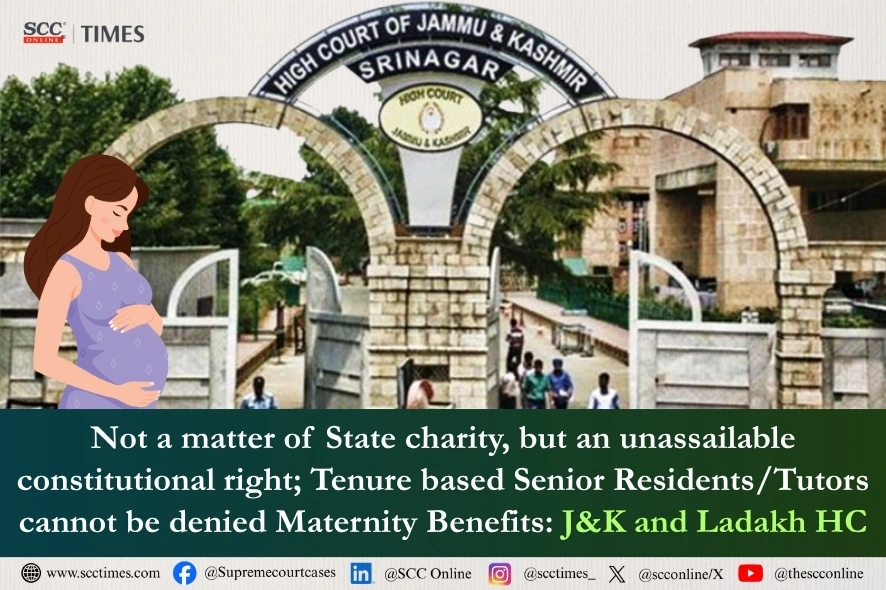
Jammu & Kashmir and Ladakh High Court: While considering a writ petition challenging the communication dated 14 October 2025 whereby pay and allowances were denied to Senior Residents/Tutors during maternity leave, a Single Judge Bench of Rajnesh Oswal, J., held that maternity benefits for Senior Residents/Tutors could not be denied merely because appointments were tenure-based. The Court quashed the impugned communication and directed payment of full pay and allowances during maternity leave as well as the corresponding extended period of residency.
Also Read: MP High Court: Maternity Benefit Act Applies to Guest Faculty
Background
The petitioners were engaged as Senior Residents/Tutors under the Jammu & Kashmir Medical and Dental Education (Appointment on Academic Arrangement Basis) Rules, 2020 (2020 Rules). They had availed maternity leave pursuant to a Government Order No. 451-JK(HME) of 2024 (G.O.) dated 8 July 2024, which extended maternity leave, MTP leave and abortion leave benefits to Postgraduate Students, Senior Residents/Tutors and DNB PGs in Government Medical Colleges across Jammu and Kashmir.
The petitioners contended that the G.O. expressly provided maternity leave in accordance with Government rules and regulations. They relied upon Rule 41(1), J&K Civil Services (Leave) Rules, 1979 (Service Rules) which grants maternity leave up to 180 days with entitlement to leave salary equal to the pay drawn immediately before proceeding on leave. According to them, the extension of residency contemplated under the G.O. was merely an administrative mechanism to facilitate completion of the mandatory 3-year residency and could not result in deprivation of salary. The salaries of the petitioners were withheld based on the communication dated 14 October 2025 issued pursuant to Finance Department advice dated 18 September 2025. The petitioners challenged the communication as illegal, arbitrary and violative of the
On the other hand, the respondents argued that the petitioners were not holders of civil posts but occupied fixed-tenure assignments. According to them, G.O. was promulgated to streamline leave entitlements and extension of tenure to complete training requirements. It was contended that the extension was an academic and administrative mechanism and not a source of additional fiscal benefits. The respondents further maintained that the impugned communication only clarified that no pay and allowances were admissible for periods during which no public service was rendered.
Also Watch: Supreme Court Strikes Down 3-Month Cap on Adoptive Maternity Leave
Analysis
The Court noted that while the G.O. provided for the extension of tenure by the number of leaves availed, it simultaneously guaranteed the core benefit of maternity leave under existing Government rules. The Court opined that this reference attracted Rule 41(1), Services Rules which grants maternity leave for 180 days and secures to a female employee leave salary equal to the pay drawn immediately before proceeding on leave. The Court observed that the respondents could not deny these protections under the pretext of the petitioners’ tenure status.
The Court observed that the communication dated 14 October 2025 could not be treated as a mere “clarification” but amounted to a “blatant administrative overreach”. The Court remarked that penalising a mother solely based on the technical nature of her employment contract, while her physical and biological realities remained identical to those of a regular employee, constituted an egregious infraction of equality incapable of surviving judicial scrutiny. The Court expressed concern that a welfare State could defend an ex facie discriminatory communication.
The Court relied on Jammu & Kashmir Bank Ltd. v. Tanu Gupta, 2026 SCC OnLine J&K 376, wherein a distinction drawn between contractual and regular female employees in relation to maternity benefits was disapproved. It was emphasised that maternity benefit provisions must receive beneficial construction and be interpreted in a manner that advances the cause of female employees rather than orchestrates their disentitlement.
The Court highlighted that maternity leave is not a matter of State charity, but an unassailable constitutional right anchored in the dignity of women. The Court observed that once the respondents had expressly incorporated existing Government rules while granting maternity leave through the G.O., they could not subsequently withhold salaries attached to such leave. The Court further observed that the right to full emoluments is an organic corollary of the right to maternity leave and cannot be defeated by arbitrary executive fiat.
Also Read: Kerala HC: Maternity leave cannot be clubbed with regular leaves
Decision
Accordingly, the Court quashed the communication dated 14 October 2025 insofar as it denied pay and allowances during maternity leave and paternity leave. The Court directed the respondents to grant full pay and allowances to the petitioners during the period of maternity leave and also during the extended period of residency corresponding to the number of days of maternity leave availed.
[Sonakshi Gupta v. State (UT of J&K), 2026 SCC OnLine J&K 548, decided on 10-7-2026]
Advocates who appeared in this case:
For the Petitioners: Abhinav Jamwal, Advocate.
For the Respondents: Raman Sharma, AAG with Saliqa Sheikh, Advocate.