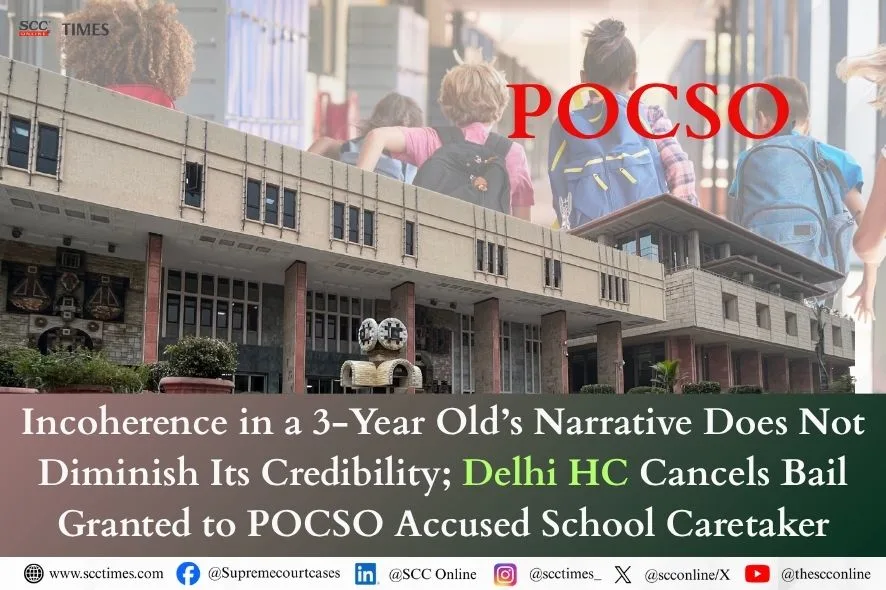
Delhi High Court: In the petitions filed by the State and the victim’s mother (complainant) respectively, seeking cancellation of bail granted to an accused charged with aggravated penetrative sexual assault on a 3-year-old child under the Protection of Children from Sexual Offences Act, 2012 (POCSO Act), the Single Judge Bench of Vinod Kumar, J., cancelled the bail holding that where the victim is a child of tender age and the investigation in a POCSO case is at a crucial stage, the Court must assign due weight to the child’s consistent disclosure, identification of the accused, surrounding circumstances, and the object of the POCSO Act.
“a child of such tender age may appear to be incoherent and sometimes even illogical but that does not mean that what a child is saying is incorrect”.
Factual Matrix
In the instant matter, the victim was a 3-year-old nursery student who had attended school only for the second time on 30 April 2026. After returning home, she complained of severe pain in her private part and disclosed to her mother that a “bada sa ladka” at school had taken her downstairs and inserted his finger into her private part, causing pain and bleeding. The FIR was registered on the following day.
During investigation, the child identified the respondent at the police station as the person who had assaulted her. She later identified her class teacher as the teacher who had taken her to the basement and cleaned the bloodstains. The investigating agency inspected the place of occurrence, collected forensic exhibits including bloodstained tissue paper and a cut piece of bedsheet, and seized the DVR for forensic examination because nearly 64 CCTV cameras were found non-functional. The only working portable camera showed the respondent moving towards the Junior Wing between approximately 8.13 a.m. and 8.37 a.m. on the day of the incident.
Despite the ongoing investigation and the pendency of forensic reports, the trial court granted regular bail primarily on the basis of CCTV footage, the absence of injuries in the medical report, and the fact that custodial interrogation was no longer required. The State and the complainant challenged the order before the High Court.
Issues for Determination
-
Whether the trial court correctly exercised its discretion in granting regular bail to the respondent during the pendency of investigation.
-
Whether the impugned bail order ignored material facts and the settled principles governing grant of bail in serious offences under the POCSO Act.
Also Read: “Evidence Act does not prescribe any minimum age for a witness”; SC elucidates principles on appreciation of testimony of a child witness
Analysis and Reasoning
The Court observed that the trail court had granted bail at a stage when the investigation was “in full swing and at a crucial stage”. It also noted that the trial court had attached insufficient importance to the victim’s immediate disclosure of pain on the very day of the occurrence and her subsequent identification of the respondent. There was nothing on record to suggest any motive for false implication by either the child or her parents.
The Court emphasised that the CCTV footage itself confirmed the respondent’s presence in the Junior Wing during the relevant period. It further noted that the Junior School had only 2 male staff members, the respondent and a security guard. Consequently, the Court found it difficult to accept that a 3-years-old child could have mistakenly identified the wrong person.
The Court asserted that the trial court missed a very important fact that the victim is barely 3-years-old and such a small child cannot be equated with an adult victim, who can narrate the facts in proper sequence with accuracy of time. It held that “a child of such tender age may appear to be incoherent and sometimes even illogical but that does not mean that what a child is saying is incorrect”. It further held that the child’s identification of both the respondent and the place of occurrence constituted significant material which could not be discarded merely because the respondent was seen leaving the premises at about 8.37 a.m.
Rejecting respondent’s interpretation of the medical report, the Court observing that the reference to 3.00 p.m. appeared to denote the time when the child informed her mother rather than the time of occurrence. Likewise, the absence of injuries or forensic confirmation at that stage did not justify doubting the prosecution’s case, particularly when investigation remained incomplete.
The Court reiterated that although superior courts ordinarily do not interfere with orders granting bail, interference becomes necessary where the trial court has overlooked “some extremely important factors in an offence of grave nature”. Relying upon X v. State of U.P., 2026 SCC OnLine SC 43, the Court observed that while considering bail in POCSO cases, due regard must be had to the gravity of the offence, the vulnerability of the child victim, and the statutory rigour of the POCSO Act.
Decision
The Court allowed both petitions, set aside the order granting bail, and directed the respondent to surrender before the jurisdictional Additional Sessions Judge (POCSO Court) on 1 July 2026 at 2.00 p.m.
[State v. Lalit Kumar, 2026 SCC OnLine Del 4827, decided on 29-6-2026]
*Judgment authored by Justice Vinod Kumar
Advocates who appeared in this case:
For the Petitioner: Mr. S.V. Raju, Additional Solicitor General and Mr. Aman Usman, APP.
For the Respondent: Mr. Sanjeev Sagar, Sr. Adv. with Mr. Sanjeet Kumar, Adv.